






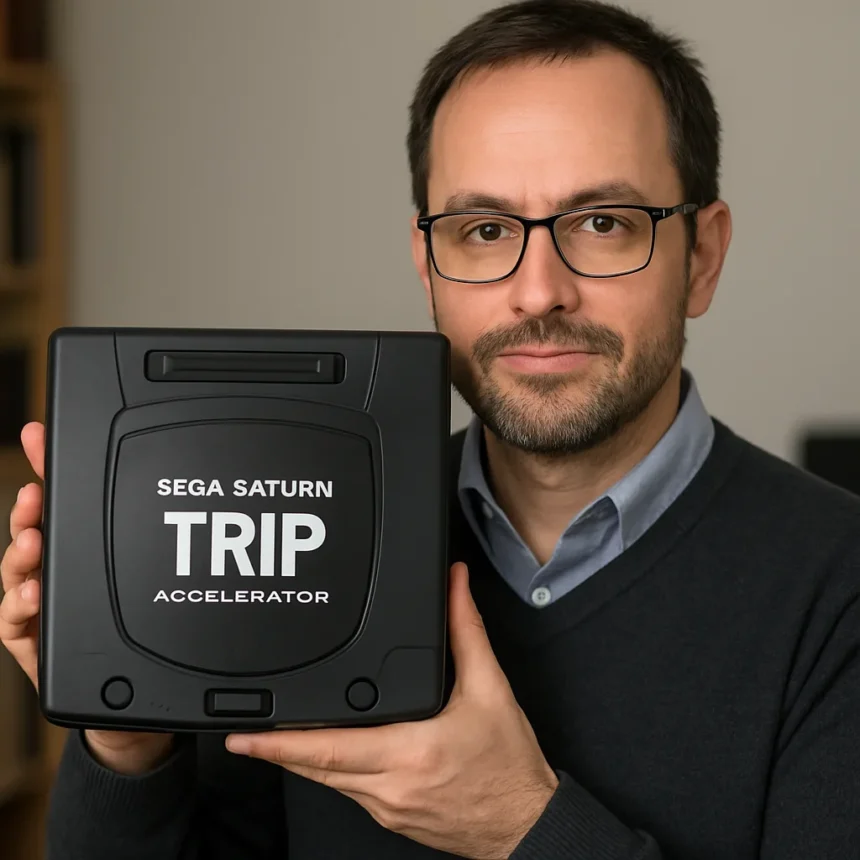
The Sega Saturn TRIP accelerator, a graphics upgrade project that spent decades as little more than a whisper in gaming magazines, has now been confirmed as a genuine piece of hardware history. Junichi Naoi, a former Sega developer, has gone on record for the first time to confirm that the project was real — ending nearly thirty years of speculation about one of the most tantalising what-ifs in console gaming.
What Was the Sega Saturn TRIP Accelerator?
The Sega Saturn TRIP accelerator was a planned graphics enhancement add-on for Sega’s fifth-generation console, which launched in 1994 and became notorious for its unconventional dual-CPU architecture. The Saturn was a capable machine, but its design — built around two Hitachi SH-2 processors working in parallel — made it notoriously difficult to program and left it struggling against Sony’s PlayStation when it came to rendering 3D polygons smoothly.
The TRIP project represented Sega’s internal answer to that problem. According to Naoi, the accelerator concept was based on Hitachi’s SH-3 processor. The idea was to give the Saturn a meaningful hardware upgrade that could close the gap with its competition, rather than waiting for a full next-generation successor. For context, this was the era when Sega was also pursuing the 32X add-on for the Mega Drive — a period when the company was willing to explore unconventional hardware strategies to stay competitive.
How Far Did the Sega Saturn TRIP Accelerator Actually Get?
This is where Naoi’s testimony becomes genuinely significant for gaming historians. The project was not merely a concept sketch or a boardroom proposal — Naoi’s team completed simulation work on the accelerator in January 1997. That level of development suggests the TRIP accelerator had moved well beyond the idea stage and into serious engineering territory before it was ultimately abandoned.

The fact that simulation work was completed in early 1997 is telling. By that point, the Saturn was already losing ground to the PlayStation in key markets, and Sega’s attention was beginning to shift toward what would eventually become the Dreamcast. Whether the TRIP accelerator was cancelled because of those shifting priorities, technical obstacles, or cost concerns is not something Naoi’s confirmation fully resolves — but the confirmation itself rewrites the historical record in a meaningful way.
Why the Sega Saturn TRIP Accelerator Matters Now
Gaming hardware rumours from the 1990s rarely get confirmed with this level of specificity. The TRIP accelerator had circulated in gaming magazines during the mid-1990s, but without an engineer willing to speak on the record, it remained in the same category as dozens of other apocryphal console stories — plausible but unverified. Naoi’s decision to go public changes that entirely.


It also reframes how we think about the Saturn’s commercial decline. The console’s reputation as a 3D underdog compared to the PlayStation has always been somewhat unfair — the Saturn was genuinely capable hardware, and developers who understood its architecture produced impressive results. But the existence of the TRIP accelerator project suggests that even Sega’s own engineers recognised the gap and were actively working to address it. The Saturn’s architecture, built around its dual SH-2 setup, was always a compromise born from a rushed response to Sony’s announcement. The TRIP project, had it shipped, might have given developers a more straightforward path to the kind of 3D performance the market was demanding.
Is this the last secret the Saturn is hiding?
Almost certainly not. The Saturn’s development history is unusually rich with documented pivots, last-minute architectural changes, and projects that never shipped. Naoi’s confirmation of the Sega Saturn TRIP accelerator is a reminder that the full story of 1990s console hardware is still being written, three decades on. For retro gaming enthusiasts and hardware historians, that is genuinely exciting — primary sources from that era are still willing to talk, and each new confirmation adds texture to a period that shaped the entire modern games industry.
What processor was the Sega Saturn TRIP accelerator based on?
The Sega Saturn TRIP accelerator was based on Hitachi’s SH-3 processor, according to former Sega developer Junichi Naoi. This would have represented an upgrade from the Saturn’s existing pair of Hitachi SH-2 processors.
How far along was the TRIP accelerator before it was cancelled?
Naoi’s team completed simulation work on the project in January 1997. That places the accelerator well into active development before it was ultimately shelved, though the specific reasons for its cancellation have not been fully detailed.


Why did the Sega Saturn struggle with 3D graphics?
The Saturn was designed around two Hitachi SH-2 processors working in parallel, an architecture that proved difficult for developers to optimise for 3D polygon rendering. Sony’s PlayStation used a more straightforward single-processor design that made 3D development considerably easier, giving it a significant advantage in the mid-1990s console market.
Naoi’s confirmation of the Sega Saturn TRIP accelerator is more than a footnote in retro gaming history — it is evidence that Sega’s engineers were fighting hard to keep the Saturn competitive, even as the commercial tide was turning against it. The project never shipped, and the Saturn’s story ended as most people remember it. But knowing the TRIP accelerator was real, and that serious simulation work was completed on it, makes the console’s legacy feel even more complicated and compelling than it already was.
This article was written with AI assistance and editorially reviewed.
Source: Tom's Hardware