





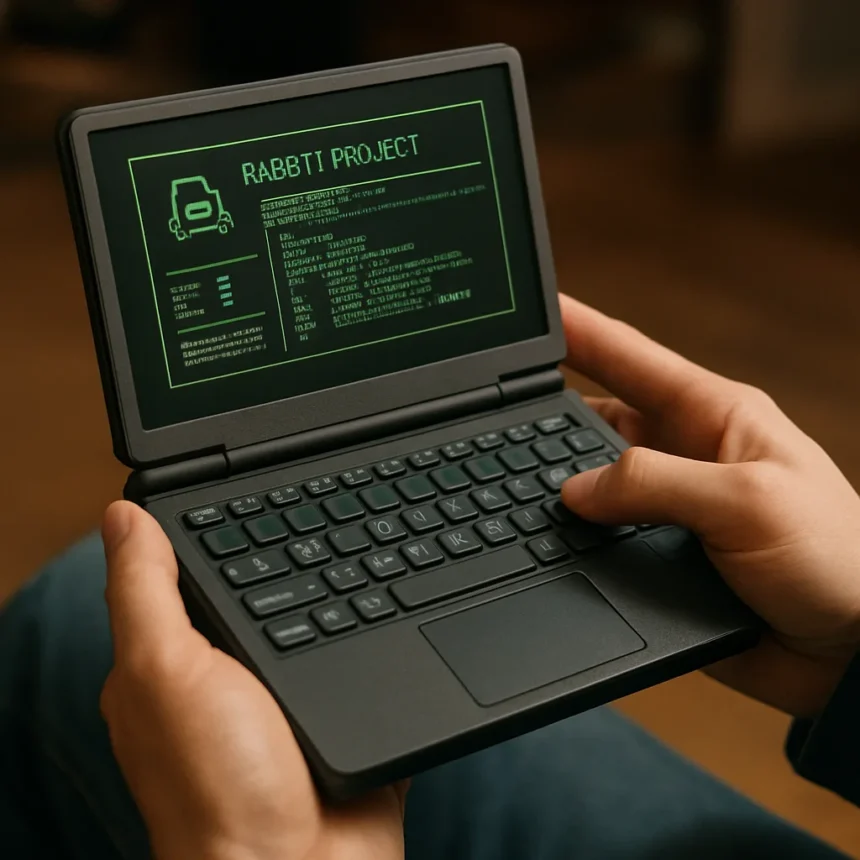
Rabbit Project Cyberdeck is a compact mini laptop announced by Rabbit, the startup behind the controversial r1 AI handheld, targeting developers and enthusiasts who want a dedicated machine for vibe coding and CLI-based AI workflows. The announcement signals a notable pivot for Rabbit: away from the pocket-sized AI companion that divided opinion, and toward something that looks more like a real productivity tool. Whether it delivers is another question entirely — because right now, almost nothing concrete has been confirmed.
What Is Rabbit Project Cyberdeck and Who Is It For?
Vibe coding refers to writing software through natural language queries and AI instructions rather than manually typing code line by line. It is a workflow that has gained serious traction among developers who want to move fast and iterate quickly, and the Rabbit Project Cyberdeck is designed specifically around that use case. Rabbit describes it as a device built for command-line interface and native agent use, running the Claude Code CLI tool and an upcoming Rabbit CLI natively.
The design draws inspiration from the DIY cyberdeck community — a subculture of enthusiasts who build rugged, retro-futuristic portable computers from scratch. Rabbit’s version promises a 40% mechanical keyboard layout favored by keyboard enthusiasts, a hot-swappable keyboard mechanism, a high-quality screen, and open hardware that lets users choose their own AI models and agents. The aesthetic carries what Rabbit calls its signature CMF (color, materials, finish) touch, the same design DNA it developed with Teenage Engineering for the r1.
The r1 Shadow Looms Large Over This Announcement
It is impossible to evaluate the Rabbit Project Cyberdeck without acknowledging what came before it. The r1 launched at $199 and arrived to deeply mixed reviews. The device ran on a MediaTek Helio P35 chipset with 4 GB of RAM and a 2.88-inch touchscreen — hardware that critics argued was underpowered for the AI ambitions Rabbit attached to it. The gap between the r1’s marketing promise and its real-world performance was wide enough to damage Rabbit’s credibility significantly.


That context matters here. Rabbit is now positioning the Cyberdeck as a more practical, developer-focused device — a pivot that implicitly acknowledges the r1’s shortcomings without directly addressing them. Moving from a $199 AI novelty gadget to a Chromebook-priced mini laptop is a meaningful shift in ambition. But Rabbit has not yet provided processor specs, battery capacity, screen resolution, or any other hardware detail that would let anyone judge whether this device is genuinely capable or another concept dressed up in compelling aesthetics.
Rabbit Project Cyberdeck vs the Broader AI Hardware Landscape
The Rabbit Project Cyberdeck is entering a market that has grown skeptical of AI-first hardware. Devices that promise AI-native experiences but ship with underwhelming internals have repeatedly disappointed — the r1 itself being one example. The Cyberdeck’s closest natural comparison is not a traditional laptop but the broader category of compact developer machines and specialized coding devices, where build quality, keyboard feel, and battery life matter enormously.



Rabbit’s emphasis on a hot-swappable mechanical keyboard and open hardware is genuinely differentiated. Most Chromebooks and budget laptops make no such concession to enthusiast preferences. If the Cyberdeck ships with keyboard quality that matches its promises, that alone would make it stand out. But without confirmed specs, it is impossible to know whether the screen, processor, and battery will hold up to serious daily use — the fundamentals that ultimately determine whether a developer device earns a place in a bag.
Is Rabbit Project Cyberdeck actually coming to the UK and Europe?
Based on the current announcement, there are no confirmed regional availability details for the Rabbit Project Cyberdeck — no launch markets, no shipping dates, and no pricing beyond a vague reference to Chromebook-level costs. Rabbit has opened a Discord community for feedback and transparency during development, which suggests the device is still in an early phase rather than approaching a firm release window. International buyers who were frustrated by the r1’s limited distribution outside the US should temper expectations until Rabbit confirms specifics.
What does vibe coding actually mean for everyday developers?
Vibe coding is the practice of directing AI to write, edit, and debug code through natural language rather than writing every line manually. For developers, it can dramatically accelerate prototyping and repetitive tasks. The Rabbit Project Cyberdeck is designed to make that workflow hardware-native, with CLI tools like Claude Code running directly on the device rather than through a browser or cloud interface.
The Rabbit Project Cyberdeck is an intriguing idea wrapped in a genuine credibility problem. Rabbit has the aesthetic sensibility to build something people want to carry, but the r1 proved that design alone cannot compensate for hardware that does not deliver. Until specs are confirmed, pricing is locked in, and a real release date is announced, the Cyberdeck remains a compelling concept rather than a compelling product — and the AI hardware market has already seen enough of those.


Where to Buy
This article was written with AI assistance and editorially reviewed.
Source: T3