


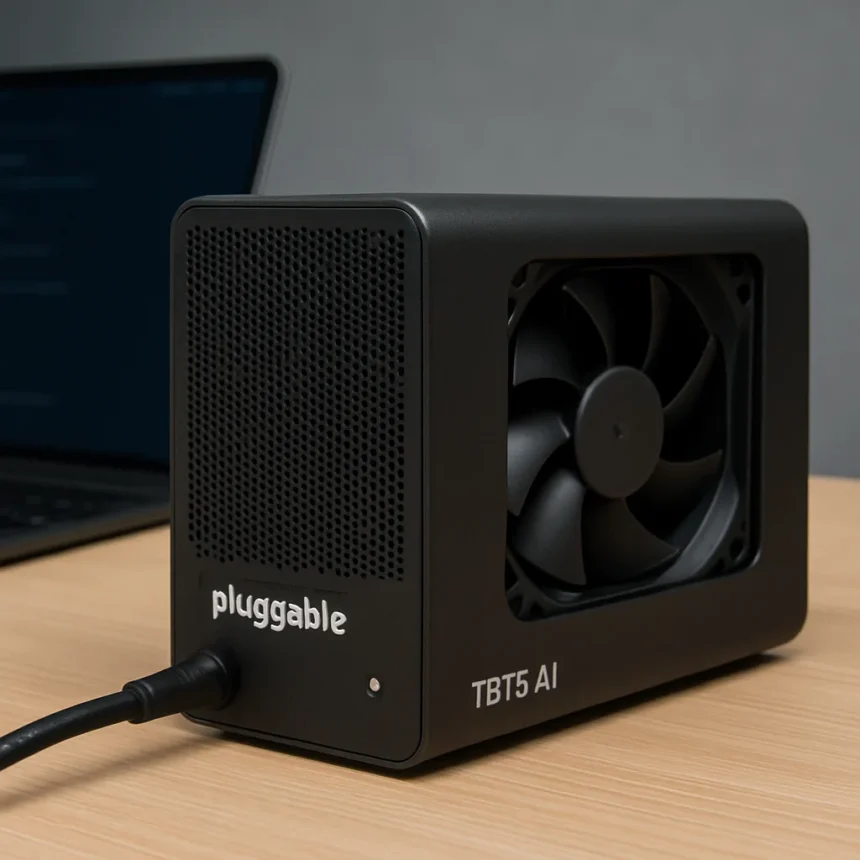
The Pluggable TBT5-AI is an eGPU enclosure made by Pluggable, priced at $599.95, currently available for preorder with no specific launch date confirmed. It uses Intel’s Barlow Ridge Thunderbolt 5 chipset to deliver up to 80Gbps bidirectional bandwidth — and it’s the first enclosure of its kind to explicitly position itself around local LLM inference and workstation GPU workloads.
TL;DR: The Pluggable TBT5-AI eGPU enclosure pairs Thunderbolt 5’s 80Gbps bandwidth with an 850W ATX 3.1 power supply capable of delivering 600W to a user-supplied GPU. At $599.95, it targets developers and small teams who want desktop-grade AI performance from a laptop without cloud dependency.
What makes the Pluggable TBT5-AI eGPU enclosure different?
The TBT5-AI is the first eGPU enclosure built explicitly for local AI inference, not just gaming or general workstation use. It supports Thunderbolt 5’s 120Gbps boost mode for data-intensive tasks, a meaningful step up from previous Thunderbolt generations that regularly bottlenecked GPU throughput.
Previous Thunderbolt 4 and USB4 enclosures were constrained by bandwidth ceilings that made running large AI models from an external GPU genuinely painful. Thunderbolt 5 removes that ceiling — at least partially. The PCIe x16 slot still delivers only four lanes of PCIe 4.0 bandwidth, which caps real-world throughput at around 64Gbps PCIe. That’s not the same as a direct desktop slot, and anyone expecting identical performance to a native PCIe connection should temper expectations.



The 850W internal ATX 3.1 power supply, built with 100% Japanese capacitors, can deliver up to 600W directly to the GPU. That’s enough headroom for power-hungry cards like the RTX 4090 or RTX 5090 series, which is exactly the audience Pluggable is targeting. The enclosure accepts GPUs up to 346mm x 170mm x 77mm — up to 3.5 slots wide — covering the vast majority of current high-end cards.
Does the TBT5-AI work for local LLM inference?
For local LLM inference, the TBT5-AI’s real advantage is software integration alongside raw hardware capability. Pluggable bundles a Unified Model Catalog that allows one-click deployment of models including Phi, OpenAI GPT open-source variants, and Mistral. The enclosure supports ONNX Runtime GenAI, NVIDIA NIM, CUDA, Llama.cpp, Hugging Face, and Microsoft Foundry — a broad stack that covers most serious AI development workflows.



The privacy angle matters here. Running inference locally means data never leaves your machine, which is a genuine concern for developers working with sensitive datasets or enterprise clients who can’t route queries through third-party cloud APIs. Cloud AI services carry recurring costs, latency overhead, and data exposure risks. A one-time hardware purchase like the TBT5-AI sidesteps all three — assuming the performance is there.
That’s the caveat worth holding onto. Pluggable’s own performance claims around token latency haven’t been independently verified, and real-world results will vary depending on model size, the specific GPU installed, cable length, and firmware state. The PCIe Gen4 x4 bandwidth constraint is a real ceiling for the most demanding models. It’s not a dealbreaker, but it’s not invisible either.
Ports, connectivity, and what the TBT5-AI actually plugs into
The connectivity layout is practical without being excessive. One upstream Thunderbolt 5 port connects to the host laptop and delivers 96W USB Power Delivery back to it — enough to charge most thin-and-light workstations while the GPU runs. A downstream Thunderbolt 5 port adds 15W PD for a second device, alongside a 10Gbps USB-C port, three 10Gbps USB-A ports at 7.5W each, and a 2.5Gbps Ethernet port. An 80cm Thunderbolt 5 cable is included in the box.
Compatibility is Windows 11 only for now, requiring a system with Thunderbolt 5, Thunderbolt 4, or USB4 with eGPU support. TB4 and USB4 connections will work but deliver reduced performance — the full bandwidth advantage only materialises with a native Thunderbolt 5 host port. That limits the addressable market today, though Thunderbolt 5 laptops are becoming more common.



TBT5-AI vs cloud AI: is local inference actually worth it?
The eGPU enclosure market has existed for years, but it’s always been a niche for gamers who wanted desktop GPU performance on a laptop. The TBT5-AI is the first serious attempt to redirect that niche toward AI developers and small teams who are watching cloud inference costs compound month after month.
Cloud AI inference means recurring fees, round-trip latency on every query, and handing your data to a third-party infrastructure. A local setup like the TBT5-AI is a one-time cost that keeps data isolated and response times tied to local hardware rather than network conditions. For a small development team running models continuously, the economics can shift in favour of local hardware surprisingly quickly.
The honest comparison, though, is that cloud providers offer on-demand access to far more powerful GPU clusters than any single desktop card. For inference at scale, cloud wins. For privacy-sensitive, latency-sensitive, or cost-constrained single-team workloads, local infrastructure like the TBT5-AI makes a credible case.
Is the Pluggable TBT5-AI worth buying for AI development?
At $599.95, the TBT5-AI enclosure itself is reasonably priced — the GPU you put inside it is where the real cost lands. If you already own a high-end Nvidia or AMD card, this is a compelling way to bring desktop-grade AI inference to a Thunderbolt 5 laptop without building a separate workstation.
What GPUs are compatible with the Pluggable TBT5-AI?
The TBT5-AI supports Nvidia, AMD, and Intel GPUs, including cards in the RTX 4090 and RTX 5090 series. The maximum GPU dimensions are 346mm x 170mm x 77mm, accommodating cards up to 3.5 slots wide. Users supply their own GPU — the enclosure ships without one.
Does the TBT5-AI work with Thunderbolt 4 laptops?
Yes, but with reduced performance. The TBT5-AI is compatible with Thunderbolt 4 and USB4 systems that support eGPUs, though the full bandwidth advantage — up to 80Gbps bidirectional, or 120Gbps in boost mode — only activates with a Thunderbolt 5 host port. TB4 users will see a meaningful throughput drop compared to a native TB5 connection.
The Pluggable TBT5-AI is a genuinely interesting product arriving at the right moment, as edge AI demand pushes developers to find alternatives to cloud dependency. Its Thunderbolt 5 bandwidth, 600W GPU headroom, and integrated AI software stack set it apart from any eGPU enclosure that came before it. The PCIe x4 ceiling and unverified performance claims deserve scrutiny — but if you’re a developer with a Thunderbolt 5 laptop and a powerful GPU sitting idle, this is the most purpose-built enclosure available for local LLM work right now.
Edited by the All Things Geek team.
Source: TechRadar