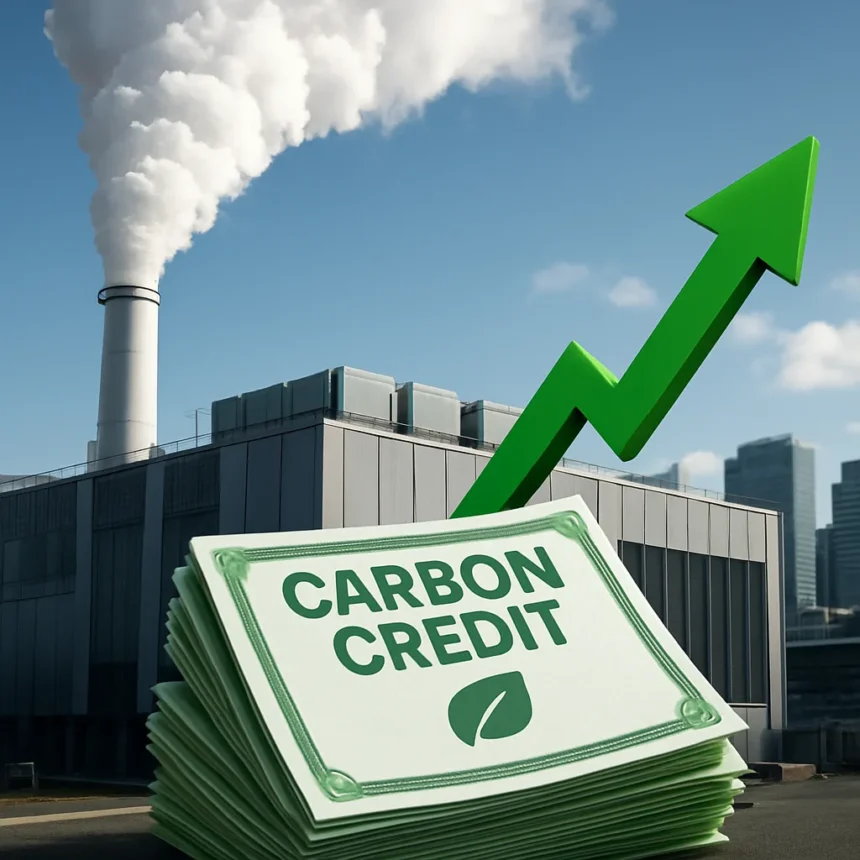
Big Tech carbon credits have become the industry’s most revealing accounting trick, and the numbers from 2025 make it impossible to ignore. Carbon credit purchases across Amazon, Google, Meta, and Microsoft surged to 68.4 million in 2025, a 181% increase from 24.4 million in 2024, according to data from carbon credit management platform Ceezer cited by CNBC. That is not a rounding error. That is a structural shift in how the world’s most powerful technology companies are managing the gap between their climate promises and the reality of powering an AI arms race.
TL;DR: Big Tech carbon credit purchases hit 68.4 million in 2025, up 181% year-on-year, driven by AI data center expansion that is outpacing clean energy development. Microsoft leads the surge with a 337% rise in purchases between fiscal 2023 and fiscal 2024 alone. Net-zero targets set before the AI boom are now looking increasingly difficult to meet without offsets.
What the Big Tech carbon credits surge actually means
Carbon credit purchases by Big Tech tripled in two years, rising from 11.9 million in 2023 to 24.4 million in 2024 — a 104% increase — before more than doubling again to 68.4 million in 2025. One carbon credit equals one metric tonne of CO2, so the scale of what these companies are offsetting is enormous. The trajectory is not a blip; it is a pattern accelerating faster each year.
The driver is straightforward. AI models require data centers of unprecedented scale, and those data centers consume vast amounts of electricity. Clean energy development, despite significant investment, has not kept pace with the speed at which these companies are building infrastructure. The result is a growing emissions gap that carbon credits are being used to paper over rather than close.



It is worth being direct about what a carbon credit actually does. It does not reduce the emissions from a specific data center. It funds an activity elsewhere — typically forestry, renewable energy, or methane capture — that theoretically removes or avoids an equivalent tonne of CO2. Whether purchased credits result in genuine real-world emissions reductions is a contested question that the industry has not resolved, and the research brief for this article does not provide verified data on that point.
Microsoft leads the Big Tech carbon credits race — and not in a good way
Microsoft has seen the most dramatic increase in carbon credit purchases among its Big Tech peers. The company reported a 247% rise in credit purchases between fiscal 2022 and fiscal 2023, then followed that with a 337% rise from fiscal 2023 to fiscal 2024. Those are not the numbers of a company steadily managing its carbon footprint — they are the numbers of a company in emissions catch-up mode.



Amazon, Google, and Meta have also increased purchases in recent years, though the research brief does not provide the same granular year-on-year figures for those companies that it does for Microsoft. What the data does confirm is that the trend is industry-wide, not a Microsoft-specific anomaly. Every major cloud and AI provider is navigating the same tension between infrastructure ambitions and sustainability commitments.
The comparison matters because Microsoft, Google, and Amazon all made net-zero pledges that predate the current AI expansion. Those targets were set in a different era of data center demand. The question now is whether those commitments will be revised, extended, or quietly retired as the emissions math becomes harder to reconcile.
Is the net-zero goal still achievable for AI-era Big Tech?
The honest answer, based on current trajectories, is that net-zero targets look increasingly implausible without significant reliance on carbon offsets. Current technology makes it unlikely that companies could meet their stated targets given the scale of data center expansion and the slower pace of clean energy development. That is not a fringe critique — it is the implicit conclusion of the credit purchase data itself.
There is a meaningful difference between a company that is net-zero because it has eliminated emissions and a company that is net-zero because it has purchased enough credits to balance its ledger. The first represents genuine decarbonisation. The second is an accounting outcome. Big Tech is currently on a path toward the latter, and the 181% surge in 2025 purchases suggests the gap is widening, not closing.


Clean energy investment is not absent from the picture. But building new renewable capacity, securing long-term power purchase agreements, and actually connecting that capacity to the grid takes years. AI investment cycles move in months. The mismatch is structural, and carbon credits are filling the gap in the interim.
Is buying carbon credits the same as being carbon neutral?
No. Purchasing carbon credits allows a company to claim net-zero status on paper by funding emissions reductions elsewhere, but it does not reduce the actual emissions produced by that company’s operations. The quality and legitimacy of individual credits vary significantly, and whether any given credit represents a genuine tonne of CO2 removed or avoided remains a debated issue in climate science and policy.
Why are Big Tech data centers emitting so much more carbon now?
The AI boom is the primary driver. Training and running large AI models requires enormous computing power, which in turn requires large-scale data centers drawing significant electricity. That electricity still comes partly from fossil fuel sources in many grid regions, generating emissions that companies are struggling to offset through clean energy procurement alone.
The surge in Big Tech carbon credits is a story about what happens when the pace of technological ambition outruns the pace of energy transition. The 181% jump in 2025 is not evidence that these companies have abandoned their climate commitments — but it is strong evidence that those commitments are under more strain than their public sustainability reports tend to acknowledge. If the trajectory continues, the industry will need to either slow its AI infrastructure build-out, accelerate clean energy deployment at an unprecedented rate, or accept that net-zero pledges have become aspirational targets rather than binding commitments. None of those options is comfortable, and the carbon credit market is currently absorbing the cost of avoiding that conversation.
Edited by the All Things Geek team.
Source: TechRadar