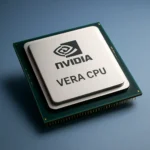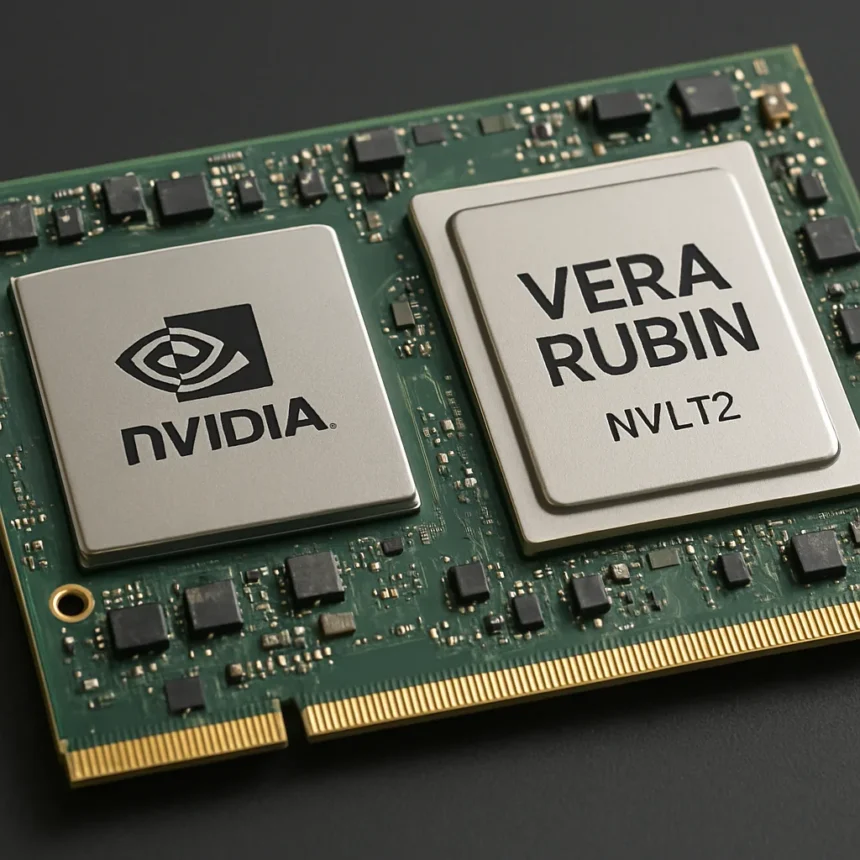
The Nvidia Vera Rubin NVL72 is Nvidia’s rack-scale AI supercomputer platform, combining 72 Rubin GPUs and 36 Vera CPUs into a single integrated system designed for large-scale AI workloads. It represents Nvidia’s most direct move yet into CPU territory — and it puts every major processor maker on notice. The question isn’t whether this platform is powerful. It’s what it means for the broader AI infrastructure market when Nvidia starts competing with its own partners.
TL;DR: The Nvidia Vera Rubin NVL72 pairs 36 of Nvidia’s own 88-core Arm-based Vera CPUs with 72 Rubin GPUs. Nvidia is also making the Vera CPU available as a standalone product, with CoreWeave as the first customer — a move that puts it in direct competition with Intel and AMD in the data center CPU market.
What is the Nvidia Vera Rubin NVL72 and how does it work?
The Nvidia Vera Rubin NVL72 is a rack-scale AI supercomputer that integrates 72 Rubin GPUs alongside 36 Vera CPUs, built to handle the most demanding AI training and inference tasks at scale. Each Rubin GPU comes equipped with 288 GB of HBM4 memory, making the memory bandwidth on this platform extraordinary by any current standard. The system is designed as a tightly coupled unit — not a loose collection of components, but an engineered whole.
The Vera CPU at the heart of this system is Nvidia’s own custom 88-core Arm-based processor. Nvidia designed it specifically for this platform, optimizing it for the communication patterns and memory access demands that AI workloads create. That’s a fundamentally different design philosophy from general-purpose server CPUs, which are built to handle a wide range of workloads rather than one category of tasks done at extreme scale.


Why Nvidia building its own CPU changes the AI data center market
Nvidia entering the CPU market with the Vera processor is the most significant structural shift in data center hardware in years. Traditionally, Nvidia supplied the GPUs and relied on Intel or AMD to supply the host CPUs. The Vera Rubin NVL72 collapses that boundary — Nvidia now controls the full compute stack. That’s not just a product decision; it’s a statement about where Nvidia sees the industry heading.
The standalone availability of the Vera CPU makes this even more pointed. Nvidia has confirmed the Vera CPU will be available as a separate product, with CoreWeave named as the first customer to gain access. CoreWeave is one of the largest GPU cloud providers in the world, and its adoption of the Vera CPU as a standalone component signals that the market sees genuine value in Nvidia’s processor independent of the full NVL72 system. That’s a direct challenge to Intel’s Xeon and AMD’s EPYC lines in the AI infrastructure segment.



Compare this to Intel’s position: Xeon processors have long served as the standard host CPU in GPU-accelerated servers, handling the orchestration work while Nvidia GPUs handled the heavy compute. The Vera Rubin NVL72 platform, by integrating Nvidia’s own CPUs, reduces the role that third-party processors play in Nvidia’s flagship systems. Whether Intel retains a role in certain NVL configurations — as the Tom’s Hardware headline suggests — the direction of travel is clear.
Does the Nvidia Vera Rubin NVL72 signal the end of CPU-GPU partnerships?
Not immediately — but the trajectory is uncomfortable for traditional CPU vendors. The Vera Rubin NVL72 demonstrates that Nvidia has the engineering capability and the market leverage to build its own CPUs at a competitive level. The 88-core Arm architecture is not a prototype or a side project; it’s a production processor shipping to major cloud customers. That changes the negotiating dynamic between Nvidia and every CPU vendor it has historically partnered with.
There’s also a broader industry context here. Arm-based server CPUs have been gaining ground for years, with AWS Graviton and Ampere Altra already proving that x86 doesn’t have a monopoly on data center workloads. Nvidia‘s Vera CPU joins that wave, but with a crucial advantage: it ships pre-integrated into the world’s most in-demand AI platform. Adoption doesn’t require a leap of faith — it comes bundled with the hardware customers already want.
Is the Vera CPU available separately from the full NVL72 system?
Yes. Nvidia has confirmed that the Vera CPU will be offered as a standalone product, separate from the full Vera Rubin NVL72 rack system. CoreWeave is the first named customer to receive access to the standalone Vera CPU, which suggests Nvidia is actively building an ecosystem around the processor rather than restricting it to its own integrated platforms. This mirrors the strategy that made Nvidia’s GPUs ubiquitous — make the hardware available broadly, then capture value through software and platform lock-in.



When will the Nvidia Vera Rubin platform be widely available?
Nvidia has delivered first samples of the Vera Rubin AI GPU to customers, with the 88-core Vera CPU paired with Rubin GPUs in those early units. Wide commercial availability timelines have not been confirmed in the available sources, and specific pricing for either the NVL72 system or the standalone Vera CPU has not been publicly disclosed. Given Nvidia’s current production ramp patterns, enterprise customers should expect availability details to emerge through official Nvidia channels and partner announcements.
The Nvidia Vera Rubin NVL72 is more than a new server platform — it’s a declaration that Nvidia intends to own the full AI compute stack, from the CPU to the GPU to the interconnect. Intel’s potential role as a host CPU supplier in some configurations doesn’t change the strategic picture: Nvidia is now a CPU company, CoreWeave is already buying the chips standalone, and the data center market will not look the same in three years. The companies that adapt fastest to a world where Nvidia competes at every layer will be the ones that survive it.
Edited by the All Things Geek team.
Source: Tom's Hardware