






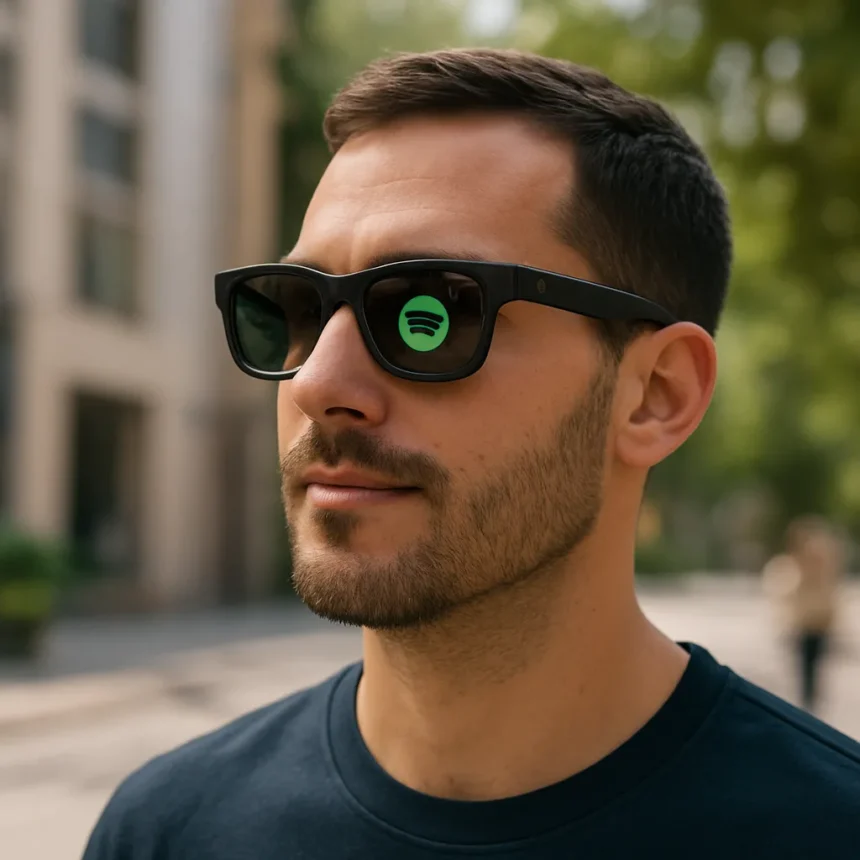
Spotify smart glasses integration is now rolling out to Ray-Ban Meta and Oakley Meta HSTN users, bringing the first multimodal AI music experience directly to your face. Meta announced the v21 software update on December 16, 2025, combining visual recognition with Spotify’s personalization algorithms to let you play songs that match whatever you’re looking at.
Key Takeaways
- Spotify integration uses computer vision to generate context-aware playlists based on visual scenes
- Available now via Early Access Program in US and Canada, expanding globally in 2026
- Say “Hey Meta, play a song to match this view” while looking at album covers, murals, or holiday scenes
- Update is free for existing Ray-Ban Meta Gen 2 and Oakley Meta HSTN owners
- Conversation Focus feature also debuts, amplifying voices in noisy environments
How Spotify Smart Glasses Integration Actually Works
The feature is straightforward in concept but technically ambitious in execution. Point your glasses at any visual scene—an album cover, a festive holiday display, a street mural, a Christmas tree—and say “Hey Meta, play a song to match this view.” The glasses analyze what you’re seeing through their built-in camera and send that visual data to Meta’s AI, which bridges computer vision recognition with Spotify’s recommendation engine. Within seconds, the glasses begin playing or curating a playlist that matches the mood, aesthetic, or context of what you’re looking at.
This bridges two previously separate technologies: smart glasses as a visual interface and Spotify as a personalization platform. Rather than scrolling through playlists on your phone, you’re using your environment as the search query. It’s particularly suited to niche moments—solo karaoke sessions where you want songs inspired by album artwork, or holiday gatherings where the visual atmosphere should dictate the soundtrack.
The multimodal AI component is what makes this different from simple voice-to-music commands. Traditional voice assistants require you to describe what you want. Here, the glasses do the describing for you, turning visual input into musical context.


When You Can Access Spotify Smart Glasses Features
The v21 update is rolling out gradually, starting with Meta’s Early Access Program. To join, you need to sign up via the Meta AI app waitlist in your device settings. Initial availability is limited to the United States and Canada, with broader global rollout planned for 2026. If you own a Ray-Ban Meta Gen 2 or Oakley Meta HSTN, you’re eligible—no new hardware purchase required.
The free software update also includes Conversation Focus, a separate but complementary feature that amplifies voices in noisy environments like restaurants, trains, and concerts. This uses the glasses’ open-ear speakers and smart microphone focusing to isolate and boost targeted voices, with adjustable amplification levels accessible via swipe or settings.



Spotify Smart Glasses Integration vs. Competitor Approaches
Google has demonstrated similar music features for its Project Aura and Android XR prototype glasses, but Meta is shipping first with a consumer-ready integration. Apple is rumored to be developing smart glasses, though observers expect those devices remain years away from launch. Meta’s advantage here is existing hardware in users’ hands—Ray-Ban Meta and Oakley Meta HSTN already have the camera, speakers, and processing power needed. Google and Apple must still build and distribute their hardware before feature parity is possible.
The partnership also highlights Spotify’s willingness to integrate deeply with wearable ecosystems. Rather than treating smart glasses as a secondary platform, Spotify is positioning itself as a core experience layer. This matters because the smart glasses market is projected to grow significantly—Meta’s AI glasses segment alone was valued at $6.3 billion in 2024.
What Else Changed in the v21 Update
Beyond Spotify integration and Conversation Focus, the update includes multilingual expansion in Spotify-supporting countries, with additional languages rolling out in 2026. Fitness features are also being added, though specific details remain limited. Meta updated its official blog on January 8, 2026, to reflect the new Early Access sign-up process, signaling that the company is actively managing the rollout.
Is Spotify smart glasses integration actually useful?
For casual moments—solo karaoke, ambient music selection, or mood-based playlists—yes. The feature eliminates friction between seeing something visually appealing and wanting music to match that vibe. For everyday music listening, it’s a novelty that won’t replace traditional search or voice commands. The real value emerges in social and creative contexts where visual inspiration should drive audio choices.



How do I join the Early Access Program for Spotify smart glasses?
Open the Meta AI app on your Ray-Ban Meta or Oakley Meta HSTN glasses, navigate to settings, and find the Early Access Program waitlist. Sign up there. You’ll receive notification when your device is eligible for the v21 update. Currently, access is limited to US and Canada, with global expansion expected in 2026.
Does Conversation Focus work like a hearing aid?
No. Conversation Focus is a consumer audio enhancement tool using open-ear speakers and microphone focusing, not a regulated medical device. It amplifies targeted voices in noisy environments, but clinicians note it differs fundamentally from clinical hearing aids, which require independent testing and regulatory approval.
Spotify smart glasses integration represents a meaningful shift in how wearables approach personalization. Rather than treating smart glasses as tiny phones strapped to your face, Meta is exploring them as context-aware devices that understand their environment and respond accordingly. Whether this becomes a killer feature or a clever gimmick depends on adoption—but for now, it’s the most ambitious consumer implementation of visual-to-music AI on the market.
Edited by the All Things Geek team.
Source: TechRadar




