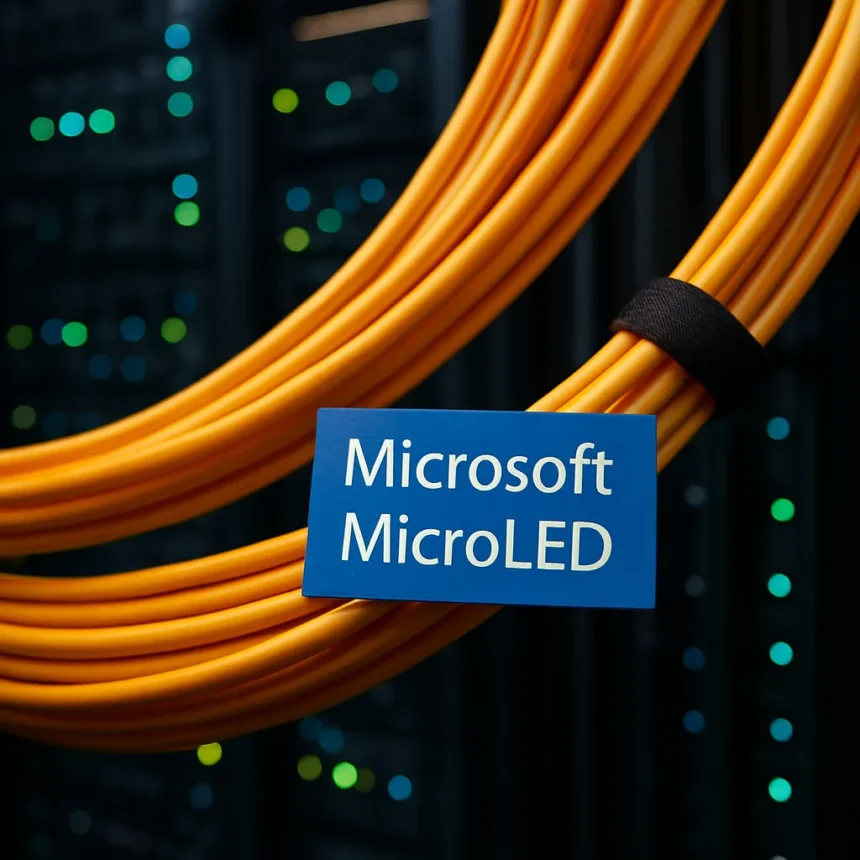
Microsoft’s MicroLED datacenter cables represent a fundamental rethinking of how data moves through AI infrastructure. The company expects to commercialize these cables by late 2027, using a technology called MOSAIC (MicroLED Optical interconnectS for AI Clusters) that promises 47% faster data transmission and approximately 33% lower latency compared to existing solutions. This shift matters because AI datacenters face a power wall—scaling GPU clusters demands faster interconnects, but traditional options force a painful trade-off between reach, power consumption, and reliability.
Key Takeaways
- Microsoft’s MOSAIC uses hundreds of parallel low-speed microLED channels instead of traditional high-speed laser links.
- MicroLED datacenter cables achieve 50-meter reach, 10 times longer than copper, with 68% lower power than optical alternatives.
- Reliability improves 100-fold over laser-based optical links, which fail far more frequently.
- MOSAIC is fully compatible with existing infrastructure—no server, switch, or NIC changes required.
- Commercial deployment expected late 2027; prototypes already demonstrated 800 Gbps across 100 channels at 50 meters.
The Architecture Behind MicroLED Datacenter Cables
MOSAIC abandons the conventional approach of pushing data through a single ultra-fast channel. Instead, it uses a Wide-and-Slow (WaS) architecture with hundreds of parallel low-speed channels—each running at just 2 Gbps through a microLED array smaller than 1 square millimeter—rather than the traditional Narrow-and-Fast (NaF) design that concentrates all bandwidth into one or two high-speed serial paths. This shift is counterintuitive but elegant. Directly modulated microLEDs consume only hundreds of microwatts each, orders of magnitude less power than lasers, while multicore imaging fibers handle the parallel transmission.
The practical result: copper’s weakness is reach (typically under 5 meters for GPU-to-GPU, mere millimeters for GPU-to-memory), while laser-based optical links are expensive, power-hungry, and unreliable. Copper cables fail rarely, but optical links fail up to 100 times more often. MicroLED datacenter cables split the difference. They achieve up to 50 meters of reach—10 times further than copper—while consuming up to 68% less power than traditional optical interconnects. Reliability jumps 100-fold over current optical solutions.
The architecture also eliminates electromagnetic interference, a growing problem in densely packed GPU clusters where copper cables radiate noise across adjacent connections. This enables non-blocking network topologies—multi-dimensional torus, dragonfly, hypercube configurations—that current infrastructure cannot support.



Why Compatibility Matters for Datacenter Rollout
Microsoft engineered MOSAIC to work with existing QSFP and OSFP pluggable form factors, meaning the cables fit into today’s switches and NICs without modification. The technology operates at the physical layer, making it completely protocol-agnostic—it works with PCIe, Ethernet, CXL, or any electrical interface without firmware changes. This is not theoretical compatibility. It is a deliberate design choice that eliminates the infrastructure overhaul that would otherwise delay adoption by years.
Datacenters cannot afford to rip out and replace every switch, NIC, and server to adopt new interconnect technology. MOSAIC avoids that trap. A datacenter operator can swap copper cables for MicroLED cables in GPU clusters, immediately gaining longer reach and lower latency, without touching anything else. This compatibility advantage cannot be overstated—it is the difference between a lab prototype and a product that actually gets deployed at scale.



Performance and Scalability of MicroLED Datacenter Cables
Current MOSAIC prototypes demonstrate 800 Gbps throughput using 100 optical channels at 2 Gbps each across a 50-meter link. That is a meaningful starting point, but the architecture scales. Increasing per-channel rates to 4 or 8 Gbps would push aggregate throughput to 1.6 Tbps or 3.2 Tbps without fundamentally redesigning the system. This scalability matters because AI workloads are not static. A datacenter built in 2027 will need to handle 2028 and 2029 traffic without wholesale replacement.
The power advantage compounds at scale. A datacenter with thousands of GPU-to-GPU links running MicroLED cables instead of optical interconnects saves enormous amounts of energy—energy that translates directly to cooling, real estate, and operational cost. For AI infrastructure providers already struggling with power supply constraints, this efficiency gain is not a luxury feature, it is a necessity.
When Will MicroLED Datacenter Cables Actually Ship?
Microsoft expects commercial datacenter cables by late 2027 [original title]. That timeline is specific enough to plan around but far enough away that skepticism is warranted. Semiconductor manufacturing timelines slip. Yield challenges emerge. But Microsoft has already demonstrated working prototypes at 800 Gbps, suggesting the core technology is not vaporware. The question is not whether MOSAIC works, but whether it will be manufactured at the scale and cost required for datacenter deployment.
TSMC and other microLED manufacturers are positioning themselves for this market, leveraging their expertise in semiconductor mass transfer and wafer-level packaging. If the supply chain executes, MicroLED datacenter cables could begin appearing in hyperscaler networks in 2027 and become standard by 2029. If manufacturing hits snags, the timeline stretches to 2028 or 2029.


How MicroLED Datacenter Cables Compare to Current Solutions
Copper dominates short-reach datacenter links because it is cheap, low-power, and reliable—but it cannot span more than a few meters without signal degradation, and dense copper bundles create electromagnetic noise that disrupts adjacent cables. Laser-based optical interconnects solve the reach problem but introduce new ones: they consume far more power, fail frequently, and require complex driver electronics. They are also expensive to manufacture and integrate.
MicroLED datacenter cables occupy a third position. They match copper’s low power and reliability while matching optical’s reach. They are not a niche solution for one type of link—they address the entire spectrum from GPU-to-GPU (where they beat copper on reach) to GPU-to-memory (where they beat optical on power and reliability). This versatility is why the technology matters.
What This Means for AI Infrastructure in 2027 and Beyond
AI datacenters are hitting a power wall. Training large language models and running inference at scale requires enormous GPU clusters, and the bottleneck is no longer compute—it is interconnect bandwidth and the power required to deliver it. MicroLED datacenter cables do not solve the power problem entirely, but they reduce the interconnect penalty significantly. A datacenter built around MicroLED cables instead of copper or optical links will be materially more efficient, more reliable, and capable of higher aggregate throughput without proportional power increases.
For hyperscalers like Microsoft, OpenAI, and Google, this efficiency translates to competitive advantage. For smaller AI companies and enterprises building private datacenters, it makes scaling economically feasible. The technology is not revolutionary—it is engineering, not magic—but engineering that removes a real constraint.
Is MicroLED datacenter cable technology ready for production?
Prototypes are working and Microsoft has demonstrated 800 Gbps at 50 meters with 100 channels. The core technology is proven. Manufacturing at scale and cost-competitive pricing remain open questions, but TSMC’s involvement suggests the supply chain is taking the challenge seriously. Late 2027 is a reasonable target if yield and cost targets are met.
How much power do MicroLED datacenter cables save compared to optical?
MOSAIC achieves up to 68% lower power consumption than traditional laser-based optical interconnects. This savings comes from using directly modulated microLEDs (hundreds of microwatts) instead of lasers (milliwatts) and simplifying the analog backend electronics. At datacenter scale, this compounds into megawatts of savings.
Will MicroLED datacenter cables require infrastructure changes?
No. MOSAIC is fully compatible with existing QSFP/OSFP form factors and operates at the physical layer, making it protocol-agnostic. Datacenters can deploy MicroLED cables as a direct replacement for copper or optical without modifying servers, switches, or NICs. This compatibility is intentional and critical to adoption.
Microsoft’s MicroLED datacenter cables represent the kind of incremental-but-meaningful engineering that shapes infrastructure for the next decade. They do not solve AI’s power problem, but they remove one significant constraint. Late 2027 is still two years away, but the groundwork is laid. When these cables ship, they will begin appearing in the most demanding datacenters first—and by 2029, they may become the default for high-performance GPU clusters worldwide.
Edited by the All Things Geek team.
Source: Tom's Hardware