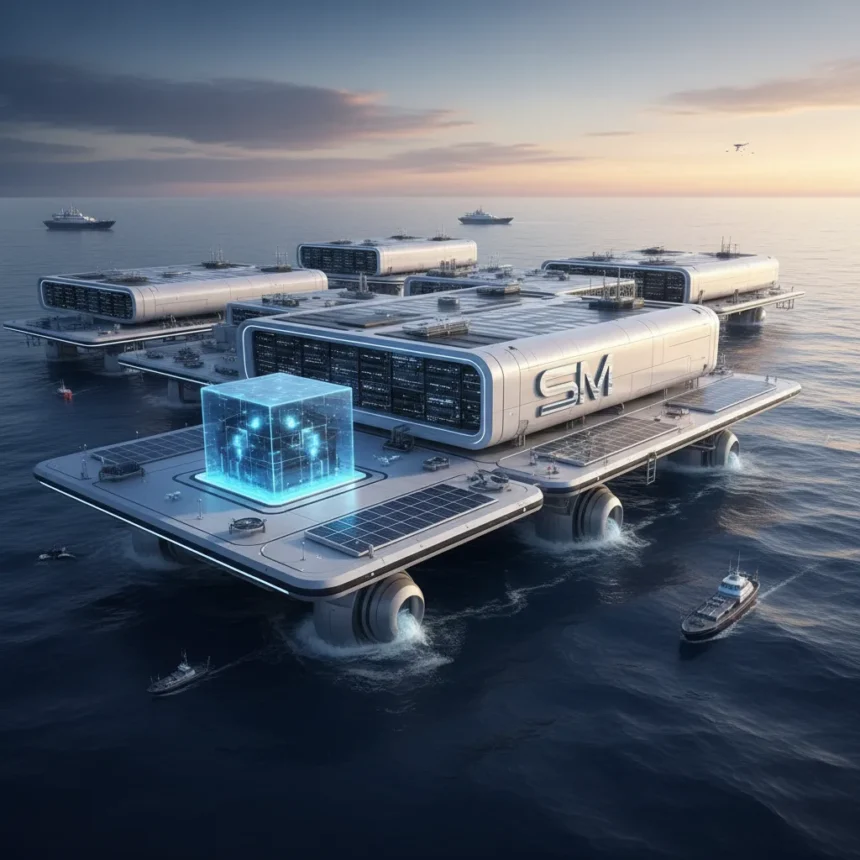
Floating data centers represent a fundamental shift in how hyperscalers can deploy AI infrastructure. Samsung Heavy Industries (SHI) and Dallas-based Mousterian Corporation are betting that offshore facilities can solve the single biggest constraint choking AI expansion: the 5+ year U.S. power interconnection queue.
Key Takeaways
- Samsung Heavy Industries received regulatory approval for its 50MW floating data center design in April 2026.
- Mousterian and SHI partnered to deliver 1.5 GW of floating data center capacity within 36 months.
- Floating data centers skip traditional interconnection delays by siting directly next to existing power generation.
- The global floating data center market is projected to grow from USD 224.2 million in 2023 to USD 732.6 million by 2033.
- SHI’s shipyard construction model cuts typical data center build timelines from 4+ years to 1-2 years.
Why Floating Data Centers Matter Now
The AI infrastructure crisis is real. Hyperscalers like OpenAI need gigawatts of power immediately, but U.S. electrical grids cannot deliver. Traditional land-based data centers require years of environmental reviews, grid upgrades, and interconnection approval. Floating data centers sidestep this entirely by deploying on water adjacent to existing power plants, rivers, or coastal infrastructure. No land acquisition battles. No grid bottlenecks. No five-year waits.
Mousterian CEO Min Suh crystallized the competitive advantage in a single phrase: speed to power is the new moat. His company emerged from stealth in April 2026 with a singular mission—deliver gigawatt-scale AI infrastructure on timelines that land-based competitors simply cannot match. SHI brings the manufacturing muscle. Mousterian brings the site origination, customer relationships, and capital markets expertise. Together, they are positioning floating data centers as the only viable path for hyperscalers drowning in interconnection queue delays.
Samsung’s Floating Data Center Design and Regulatory Approval
SHI showcased its 50MW Floating Data Center (FDC) model at Data Center World 2026 in Washington, D.C., April 20-23, 2026. More importantly, the design received Approval in Principle (AiP) from both the American Bureau of Shipping (ABS) and Lloyd’s Register (LR)—the two most stringent maritime classification societies in the world. This is not a concept. This is a certified, buildable design ready for commercial deployment.


The engineering elegance matters. SHI’s FDC uses standardized shipyard construction processes that integrate design, manufacturing, and equipment simultaneously. This parallel approach compresses timelines dramatically compared to traditional data center construction, which sequences design, then land acquisition, then permitting, then build. Self-power generation reduces dependence on land-based electrical infrastructure. Liquid cooling systems exploit seawater or river water for efficiency gains impossible on land. The vessel can be installed on rivers or at sea, making site selection far more flexible than terrestrial facilities.
The 1.5 GW Deployment Timeline and Market Implications
Mousterian’s 36-month promise to deliver 1.5 GW of capacity is audacious, but it reflects genuine architectural advantages. Floating data centers can be fabricated in shipyards in parallel, then towed to pre-selected sites with power already secured. No waiting for grid upgrades. No interconnection queues. The economics are compelling: the global floating data center market reached USD 224.2 million in 2023 and is projected to grow to USD 732.6 million by 2033, more than tripling in a decade.



SHI signed Memoranda of Understanding with ABB (a Swiss technology firm) and Mousterian for FDC development. SHI provides engineering, fabrication, and delivery for the floating assets themselves. Mousterian leads site origination, tenant sourcing, and project delivery, with headquarters in Dallas and a joint engineering office in Seongnam, South Korea. SHI plans U.S. commercialization through local partnerships for electricity systems, regulatory approvals, and ongoing operations.
Competitive Landscape and Alternatives
SHI and Mousterian are not alone in this space. Mitsui O.S.K. Lines (Japan) and Karpowership (Turkey) are developing a 73MW floating data center from modified used ships, targeting one-year construction and trial operations by 2027. However, their approach relies on repurposing existing vessels rather than designing purpose-built infrastructure from scratch. SHI’s regulatory approval and integrated shipyard model represent a more robust, scalable path than retrofitting used ships.
Land-based data center developers face structural headwinds that offshore competitors simply do not. Site acquisition, environmental review, grid interconnection, and cooling water sourcing each add 12-24 months to project timelines. Floating data centers eliminate or dramatically compress these constraints. For hyperscalers racing to deploy AI infrastructure, the speed advantage is existential.
The OpenAI Connection and Speculation
Articles have speculated that Samsung’s floating data center technology could house OpenAI’s future infrastructure, tied to a rumored Stargate AI data center project involving Samsung C&T, Samsung Heavy Industries, SK Hynix, and OpenAI. None of these details have been confirmed by primary sources, and the Stargate project specifics remain unverified. What is confirmed is that Samsung entities and OpenAI have discussed collaboration, and the timing of SHI’s FDC regulatory approval alongside these rumors is suggestive—but not conclusive.



What This Means for AI Infrastructure Expansion
Floating data centers will not replace all land-based facilities. But they will unlock stranded power capacity that hyperscalers currently cannot access. A coal plant retiring in Kentucky. A hydroelectric dam in the Pacific Northwest. A natural gas facility in Texas. All of these have excess generation capacity sitting idle because grid interconnection queues prevent new data center connections. Floating facilities sited directly adjacent to these plants can capture that power immediately, bypassing the queue entirely.
SHI’s Ahn Young-kyu, CTO and EVP of Technology Development, framed the strategic importance clearly: FDC is a new business model that expands shipbuilding technology into the digital infrastructure industry. Combined with eco-friendly energy, it will present a new standard for the global data market and secure growth momentum. This is not hyperbole. This is a legacy shipbuilder pivoting into AI infrastructure because the market demand is that urgent.
Will Floating Data Centers Actually Work at Scale?
Regulatory approval from ABS and Lloyd’s Register validates the design, but execution risk remains. Mousterian’s 1.5 GW in 36 months is a promotional target lacking independent verification. Environmental permitting for offshore or river-sited facilities may introduce delays not present in the current timeline. Cooling water sourcing, especially in freshwater rivers, could face restrictions in drought-prone regions. Cybersecurity and physical security of offshore infrastructure present novel challenges.
That said, the fundamental problem they solve is real. U.S. power interconnection queues are not a rumor—they are documented bottlenecks cited by every major hyperscaler. If floating data centers can even deliver 50% of their promised timeline compression, they become strategically essential for AI infrastructure expansion.
FAQ
What is a floating data center?
A floating data center is a purpose-built or repurposed vessel equipped with servers, cooling systems, and power generation, deployed on water adjacent to power sources. Samsung’s 50MW design uses standardized shipyard construction to compress build timelines and integrates self-power generation with seawater or river cooling for efficiency gains unavailable on land.
How do floating data centers bypass power interconnection delays?
By siting directly next to existing power generation assets (power plants, dams, renewable facilities), floating data centers avoid the 5+ year U.S. grid interconnection queue entirely. They capture stranded power capacity already available but inaccessible to traditional land-based data centers.
When will Mousterian and Samsung’s floating data centers launch?
Mousterian promises 1.5 GW of capacity within 36 months (by approximately May 2029), but no specific project launch dates have been confirmed. SHI received regulatory approval for its 50MW design in April 2026, clearing the technical pathway for commercial deployment via local U.S. partnerships.
Floating data centers represent a genuine inflection point in AI infrastructure strategy. The regulatory approval is real. The timeline compression is mathematically sound. The power bottleneck is undeniable. Whether Mousterian and SHI execute at scale remains to be seen, but the market conditions are aligned for floating facilities to absorb a meaningful share of AI infrastructure deployment over the next decade. For hyperscalers suffocating under interconnection queue delays, offshore is no longer speculative—it is becoming necessary.
Edited by the All Things Geek team.
Source: TechRadar