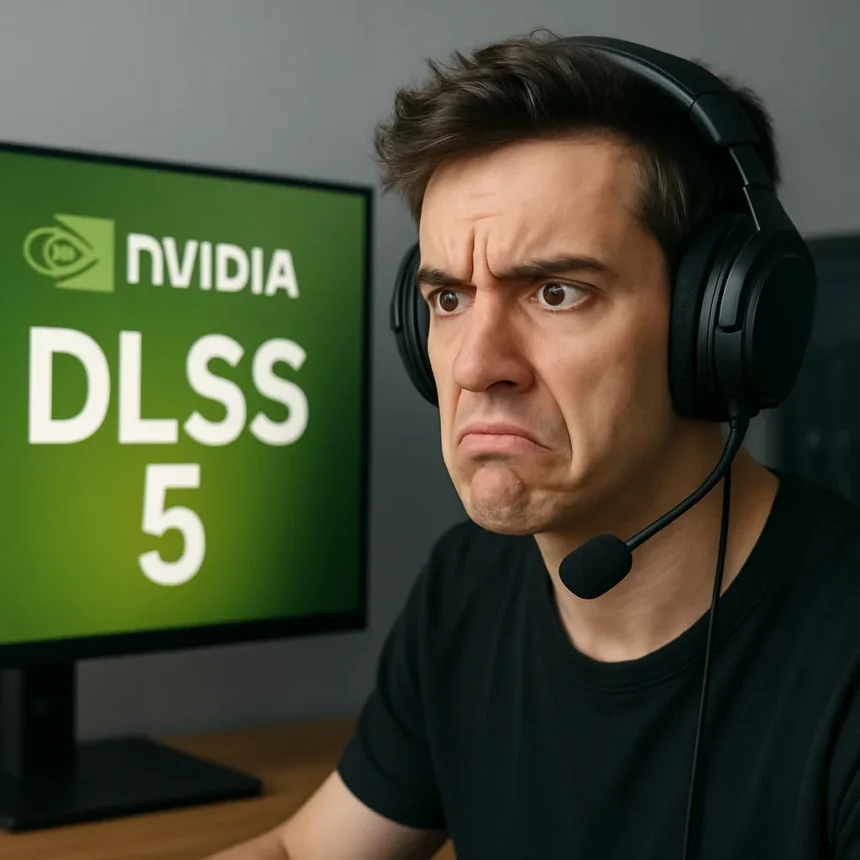
Nvidia DLSS 5 backlash has become the latest flashpoint in gaming’s ongoing debate over AI and artistic control. Announced on March 16, 2026, the AI-powered real-time neural rendering model promised to bridge rendering and reality, infusing pixels with photoreal lighting and materials at up to 4K resolution. Instead, Nvidia’s reveal video sparked immediate outrage from gamers and artists who saw not a breakthrough but an algorithm erasing creative intent.
Key Takeaways
- Nvidia DLSS 5 backlash erupted after the March 2026 announcement, with gamers calling the technology “AI slop” and “soulless.”
- The reveal video showed altered character faces in Resident Evil Requiem, Starfield, and Hogwarts Legacy, triggering uncanny valley reactions.
- Nvidia’s YouTube announcement received roughly 2,000 dislikes versus 1,400 likes, reflecting deep community division.
- Bethesda confirmed DLSS 5 will be optional and under artist control, but skepticism remains about real-world implementation.
- Digital Foundry praised it as a “massive technological leap,” showing the tech community remains split on the innovation.
What Nvidia DLSS 5 Actually Does (And Why That Terrifies Artists)
Nvidia DLSS 5 backlash stems from a fundamental misunderstanding of what the technology is supposed to accomplish. The system uses game engine motion vectors and source color as inputs to generate consistent frame-to-frame performance, trained on hair, skin, and fabric. In theory, it delivers photorealistic lighting and materials previously only achievable in offline Hollywood VFX, now running in real time. In practice, the announcement video revealed something far more unsettling: faces that looked algorithmically smoothed, lighting that felt artificial, and an overall aesthetic that struck viewers as creepy rather than impressive.
The demo footage featured Resident Evil Requiem with character faces—Grace Ashcroft and Leon Kennedy—that appeared subtly wrong, as if an invisible hand had softened every edge and flattened every imperfection into an uncanny valley. YouTubers and forum users flooded social media with comparisons to AI-generated imagery, calling the effect “an AI filter” overlaid on actual game art. The backlash was swift and brutal. One prominent YouTube comment captured the consensus: “This looks extremely uncanny”. Another creator stated bluntly: “Nvidia decided to cook… they burn down the whole video game industry with some very questionable technology that just looks downright horrible… creatively bankrupt”.
The YouTube Numbers Don’t Lie: Community Rejection
Nvidia DLSS 5 backlash is quantifiable in the engagement metrics. The official announcement video accumulated approximately 2,000 dislikes against 1,400 likes, a rare inversion for a major tech reveal from a market leader. This is not a vocal minority—it reflects genuine mainstream skepticism about whether photorealism should override artistic vision. Gamers questioned whether smoother skin and brighter lighting actually improve games or simply homogenize them into a single algorithmic aesthetic.



The division runs deeper than surface-level graphics preferences. Artists worry that DLSS 5 represents a broader shift toward AI-driven “correction” of creative choices. If an algorithm can override a character artist’s intentional stylization in real time, what stops it from doing the same to environments, lighting rigs, or color grading? Digital Foundry’s hands-on experience with four games praised the technology as a “massive technological leap for graphics,” but even that endorsement acknowledged no pushback from the creators involved. The silence from developers was deafening compared to the roar from players.
Bethesda’s Damage Control: “It’s Optional”
Bethesda stepped in to manage fallout after Todd Howard’s initial hype. Howard had called DLSS 5 remarkable: “When NVIDIA showed us DLSS 5 and we got it running in Starfield, it was amazing how it brought it to life”. That enthusiasm collided hard with public rejection. Bethesda quickly clarified that DLSS 5 implementation “will all be under our artists’ control, and totally optional for players”. Translation: we heard you, and no, we’re not forcing this on anyone.



That statement matters because it reveals the real tension behind Nvidia DLSS 5 backlash. The technology itself is not inherently bad—it is genuinely novel, applying neural rendering in real time rather than offline. The problem is perception. When Nvidia marketed it as a universal upgrade to realism, gamers heard: “We’re replacing your game’s artistic style with our AI interpretation of photorealism.” By making it optional, Bethesda defused the immediate crisis but left the underlying question unanswered: will artists actually choose to use it, or will player preference—and player backlash—keep it disabled by default?
Why This Matters Beyond Graphics: The AI Authenticity Problem
Nvidia DLSS 5 backlash is not really about pixels or lighting algorithms. It is about trust. The gaming community has grown skeptical of AI-driven “improvements” that claim to enhance creativity but often homogenize it instead. Offline video AI models are unpredictable and non-real-time; DLSS 5 is real-time and consistent, which should theoretically make it safer. Yet the uncanny valley effect suggests consistency without authenticity is its own kind of failure.
The comparison to AMD FSR and native rendering matters here. Community testing shows that nearly half of PC gamers prefer DLSS 4.5 over AMD’s alternative or native rendering, indicating that upscaling technology itself is not the villain. What failed with DLSS 5 was the marketing: positioning it as an artistic upgrade when it was actually a stylistic override. Gamers accept performance gains and visual trade-offs. They reject the suggestion that an algorithm understands their game’s intended aesthetic better than its creators do.
When Does This Launch? And What Happens Next?
Nvidia DLSS 5 backlash will likely persist through the fall 2026 launch window, when the technology becomes available on RTX GPUs. The question is not whether it will ship—it will. The question is adoption. Will studios embrace it as a tool for optional visual enhancement, or will it become a footnote in gaming history, a technological marvel that nobody actually wanted? Bethesda’s artist-control pledge suggests caution, but skepticism runs deep. Gamers have learned to distrust “AI-powered” features that arrive with corporate enthusiasm and vague promises of optionality.


The real test comes when players encounter DLSS 5 in the wild. If it feels like a tool—something that enhances without erasing—it survives. If it feels like a filter, a homogenizing layer between player and creator, it becomes a cautionary tale about the gap between technical capability and artistic judgment. Nvidia built something remarkable. It just built it without asking whether gaming needed it in the first place.
Is Nvidia DLSS 5 mandatory in games that support it?
No. Bethesda confirmed that DLSS 5 will be optional and under artist control in their games. Players will be able to disable it and use traditional rendering instead.
How does DLSS 5 differ from DLSS 4.5?
DLSS 5 uses neural rendering to add photorealistic lighting and materials in real time, while DLSS 4.5 focuses on upscaling and frame generation for performance gains. DLSS 5 is a fundamentally different technology targeting visual fidelity rather than frame rates.
Will DLSS 5 work on older RTX GPUs?
DLSS 5 is designed for RTX GPUs, including older models like the RTX 3070 laptop, though performance may vary depending on hardware.
Nvidia DLSS 5 backlash reveals an uncomfortable truth: not every technological leap is a creative improvement. The company delivered a genuine breakthrough in real-time neural rendering, but it arrived wearing the wrong face—an algorithmic smoothing that made gamers recoil. Whether DLSS 5 survives depends less on technical merit than on whether developers treat it as a tool rather than a mandate, and whether players ever feel comfortable letting an AI algorithm make creative decisions on their behalf.
Where to Buy
Edited by the All Things Geek team.
Source: TechRadar