



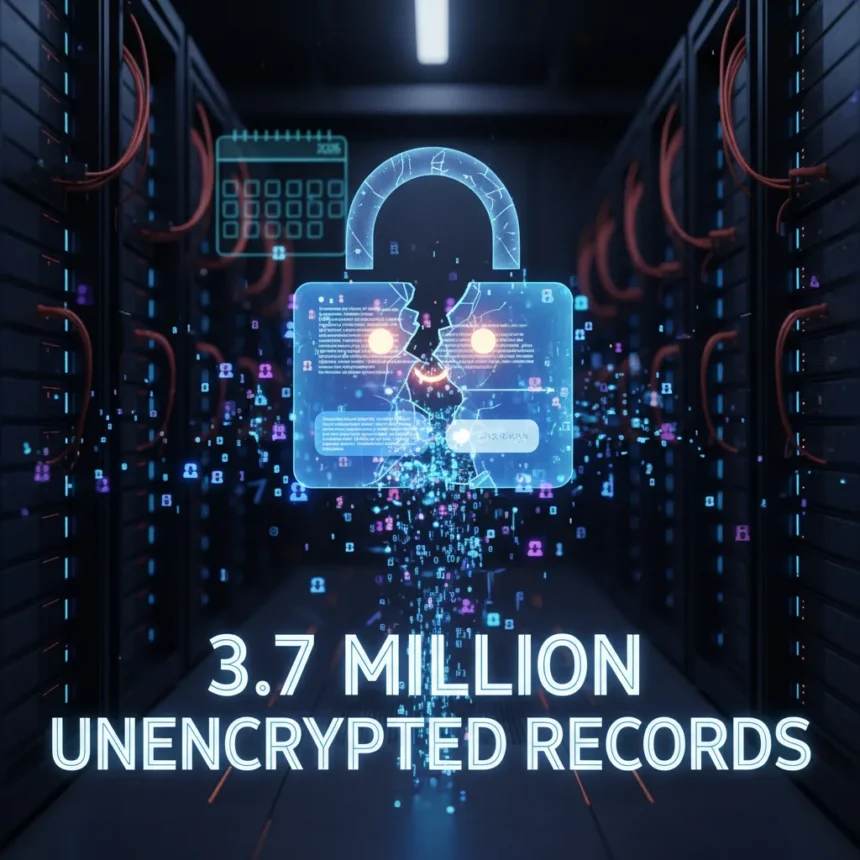
An AI chatbot data leak affecting millions of customer interactions has exposed a fundamental weakness in how companies handle sensitive conversational data. Cybersecurity researcher Jeremiah Fowler discovered three separate publicly exposed databases containing 3.7 million items of unencrypted chat logs, audio recordings, and phone call transcripts linked to a Sears Home Services virtual assistant. The databases were not password-protected, meaning anyone with basic internet reconnaissance skills could access them.
Key Takeaways
- 3.7 million unencrypted records from an AI chatbot virtual assistant were publicly exposed without password protection
- Data included chat transcripts, audio recordings, and phone call text conversions spanning 2024-2026
- Exposed records contained email addresses, timestamps, unique IDs, and internal system metadata
- Attackers could reverse-engineer system prompts, guardrails, and tuning decisions to replicate or weaponize the AI
- The discovery underscores encryption’s role in preventing widespread AI security failures
What the AI chatbot data leak revealed
The exposed databases contained far more than anonymized chat snippets. Records included full email addresses embedded in chat transcripts, unique user identifiers, hashcodes, and internal system events. Some transcripts showed audio recordings continuing for up to four hours, capturing extended customer service calls with full text-to-speech conversion. Links in the transcripts connected directly to audio recording databases, allowing anyone to reconstruct entire customer interactions from start to finish.
This is not a minor privacy slip. The Sears Home Services AI assistant handled scheduling, customer support, phone calls, and online chats—the kinds of interactions where users discuss home addresses, payment information, and personal preferences. An attacker with access to these logs could map customer behavior patterns, identify repeat callers, or cross-reference sessions across multiple databases to build detailed customer profiles.
Why reverse-engineering poses a competitive and security threat
The most dangerous aspect of an AI chatbot data leak is what competitors and malicious actors can learn from the exposed system. Full access to chatbot logs reveals system prompts—the hidden instructions that guide how the AI responds—conversation flows, safety guardrails, and tuning decisions that took significant resources to develop. A competitor could use this information to replicate the assistant’s behavior at a fraction of the development cost. A malicious actor could identify weaknesses in those guardrails and exploit them to bypass safety measures, launch social engineering attacks, or weaponize the AI for fraud and misinformation.



This threat is not theoretical. The discovery of an AI chatbot data leak coincides with a broader pattern of AI system exposure. A separate incident exposed 300 million messages from Chat & Ask AI, a wrapper for OpenAI ChatGPT, Anthropic Claude, and Google Gemini, affecting 25 million users. These leaks suggest that encryption is not a standard practice across AI service providers, leaving systems vulnerable to the same basic attacks that exposed databases in the 1990s.
How encryption could have prevented the AI chatbot data leak
Encryption at rest would have rendered the 3.7 million records inaccessible to anyone without the decryption keys. Even if an attacker discovered the databases, they would have found only encrypted gibberish instead of readable chat logs, audio files, and user identifiers. Encryption in transit would have protected data as it moved between the AI assistant, customer devices, and storage systems. Neither protection is exotic or expensive—both are standard security practice for financial institutions and healthcare providers.



The fact that a Sears Home Services database lacked both password protection and encryption in 2024-2026 suggests a fundamental gap between what companies claim to do and what they actually implement. Jeremiah Fowler’s advice to affected users is direct: be aware of common phishing tactics, identity fraud patterns, and account takeover methods, because once your email address and conversation history are in the wild, criminals have multiple entry points.
Is this an isolated incident or a pattern?
The AI chatbot data leak is part of a larger trend. In the same reporting period, Fowler uncovered a separate leak of 149 million infostealer credentials, including compromised Facebook, Instagram, and Netflix accounts. These discoveries suggest that companies treating encryption as optional are not rare exceptions—they are the norm. The AI industry, which moves faster than traditional software but slower than security practices, has inherited the worst habits of both worlds.
What happens next for users affected by the AI chatbot data leak?
If your email address appeared in chat transcripts from Sears Home Services between 2024 and 2026, assume it is now in criminal databases. Change passwords on accounts associated with that email, enable two-factor authentication, and monitor credit reports for signs of identity theft. Sears Home Services has not announced a formal breach notification or victim compensation program based on available information, though the company should be notified immediately if it has not already discovered the exposure.
The real lesson is that encryption is not a premium feature—it is a baseline requirement. Companies handling conversational AI data, audio recordings, and customer contact information must treat encryption as non-negotiable. An AI chatbot data leak this large exposes not just customer privacy but the fragility of systems we increasingly rely on for everyday service interactions.


Edited by the All Things Geek team.
Source: TechRadar