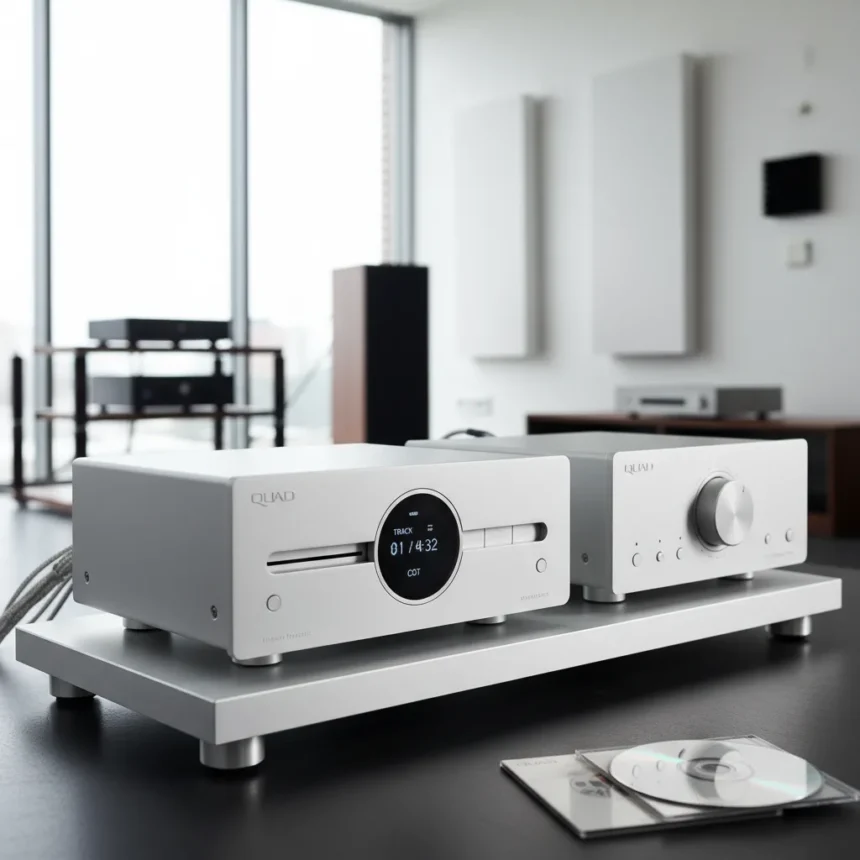
The Quad Platina CDT is a premium CD transport designed as the flagship component within Quad’s new Platina Series, alongside the Platina Integrated amplifier and Platina Stream network player. This isn’t a device chasing nostalgia—it’s a precision engineering statement for listeners who still value physical media and demand uncompromised audio quality.
Key Takeaways
- Quad Platina CDT features a custom-designed servo control system with 32-bit RISC CPU and dedicated MCU
- Ultra-low-noise toroidal transformer and temperature-controlled crystal oscillator ensure timing precision
- Can play damaged or dirty CDs rejected by standard transports
- Supports CD, CD-R, CD-RW, and data CDs with FLAC, WAV, WMA, MP3, and APE files
- Part of Quad’s commitment to maintaining high-fidelity disc playback in the streaming era
Architecture and Engineering of the Quad Platina CDT
The Quad Platina CDT separates its decoder stage from the motor and laser servo circuits, a design choice that reduces electrical noise and interference. This architectural approach prioritizes signal purity—the decoder operates in its own isolated domain, free from the electromagnetic chatter generated by the transport mechanism itself. The transport uses a high-precision CD mechanism with a custom-designed servo control system at its heart.
The processing power comes from a 32-bit Reduced Instruction Set Computer (RISC) CPU paired with a dedicated microcontroller unit (MCU), handling the complex timing and error-correction demands of disc playback. To maintain rock-solid timing, the transport includes a temperature-controlled ultra-precision crystal oscillator serving as the timing reference. An ultra-low-noise toroidal transformer powers the entire assembly, minimizing hum and interference that could color the audio output. These aren’t marketing flourishes—they’re the foundational engineering decisions that separate a serious transport from a convenience player.
What the Quad Platina CDT Actually Plays
The Quad Platina CDT handles the obvious: standard audio CDs, CD-R and CD-RW discs. But it also supports data CDs containing FLAC, WAV, WMA, MP3, and APE files, making it a bridge between physical media formats and high-resolution audio. This flexibility matters for listeners with mixed collections—a library that spans pressed discs, burned backups, and lossless rips.



One standout capability: the transport can play moderately damaged or dirty CDs that other transports reject outright. This resilience comes from the precision servo system and intelligent error handling, allowing it to read discs that would otherwise be unplayable. For collectors with older or well-loved CDs, that’s a genuine advantage—not every disc in your collection will be pristine.
Quad Platina CDT in the Broader Ecosystem
The Quad Platina CDT is part of a coordinated product family. Quad also offers the 3CDT, a standard-series transport priced at £599 / $1,099 / AU$1,399, which shares some core design philosophy but without the Platina Series refinements. The Platina CDT sits above it, paired with the Platina Integrated amplifier and Platina Stream network player to form a complete high-end system. This modular approach lets listeners invest in the Platina CDT as a dedicated transport feeding a quality DAC or integrated amplifier, rather than being locked into an all-in-one solution.



Why does this matter in 2025? Streaming dominates, yet physical media remains the reference standard for many audiophiles—CDs offer bit-perfect playback without compression or algorithmic processing. The Quad Platina CDT positions itself as the device for listeners unwilling to compromise on that principle, even as the industry shifts toward cloud-based music.
Connectivity and Output Options
The transport provides both optical and coaxial outputs, giving you flexibility in how you connect it to your DAC or integrated amplifier. Optical isolation can reduce jitter in some systems, while coaxial offers a direct digital connection—the choice depends on your downstream equipment and room setup.
Is the Quad Platina CDT worth the investment?
The Quad Platina CDT targets a specific listener: someone with a substantial CD collection, a commitment to high-fidelity playback, and the budget for premium components. It’s not a device for casual streaming listeners or those content with entry-level CD playback. If your music library is built on physical media and you’ve invested in quality amplification and speakers, the Platina CDT’s engineering pedigree and damage-tolerance make it a serious contender. The question isn’t whether CD transports are dead—it’s whether you value the sonic and tactile experience enough to keep spinning discs.
How does the Quad Platina CDT compare to the 3CDT?
The 3CDT is Quad’s entry into the CD transport market, priced at £599 / $1,099 / AU$1,399. The Platina CDT sits above it with enhanced engineering—the Platina Series benefits from additional refinement in power supply design, servo precision, and isolation. If you’re building a Platina-series system, the Platina CDT ensures component synergy. If budget is the primary concern, the 3CDT delivers Quad’s core transport philosophy at a lower price point.



What file formats does the Quad Platina CDT support on data CDs?
The transport plays FLAC, WAV, WMA, MP3, and APE files on data CDs. This means you can burn lossless or compressed audio files to disc and play them back through the same transport, blending physical media convenience with digital flexibility.
The Quad Platina CDT represents a deliberate choice: in an era of infinite streaming, some listeners still want the precision, ritual, and sonic purity of disc playback. Quad’s engineering—the isolated decoder, the precision servo system, the temperature-controlled oscillator—backs that choice with genuine technical depth. It’s not the last CD transport you’ll ever need because CD transports will eventually fade. It’s the last one you’ll want to own because it does the job with uncompromising fidelity.
Edited by the All Things Geek team.
Source: What Hi-Fi?