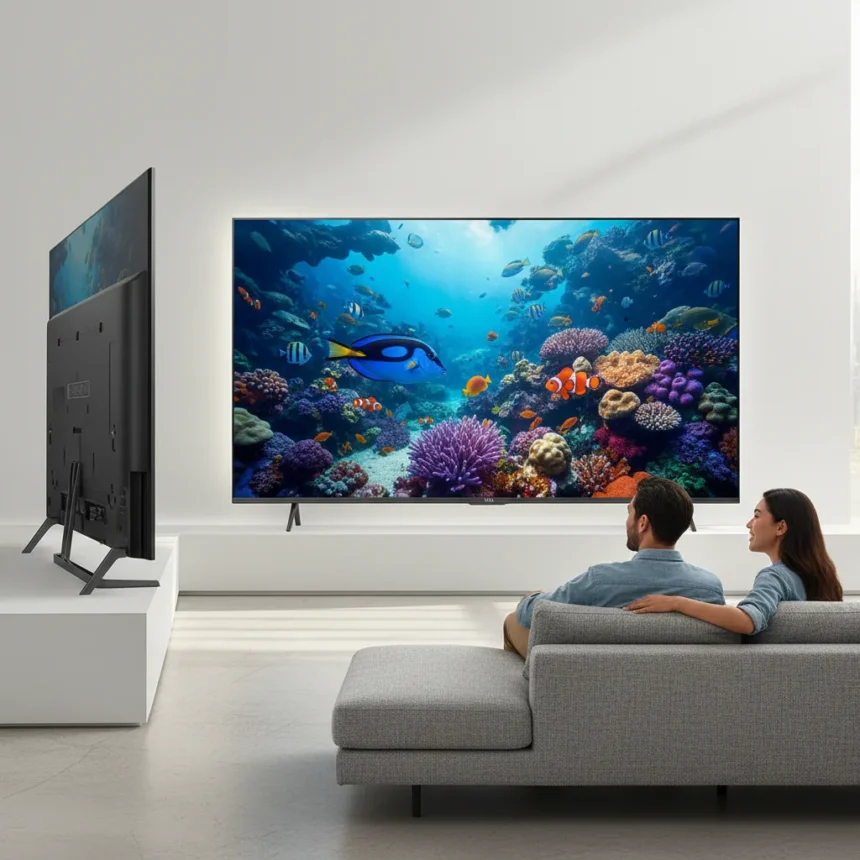
The TCL QM8L SQD mini-LED technology represents a meaningful leap in what midrange buyers can expect from a premium television. This 2026 successor to the QM8K swaps standard quantum dots for bigger, reformulated ones that cover the full BT.2020 color space, delivering brighter and purer colors than its predecessor. At 2,499 USD for the 65-inch model, it undercuts the competition while matching or exceeding the color volume performance of far more expensive rivals.
Key Takeaways
- TCL QM8L SQD mini-LED technology covers 100% BT.2020 color space with brighter, purer colors than the QM8K predecessor.
- 65-inch model starts at 2,499 USD, significantly cheaper than premium mini-LED alternatives like the X11L at 6,999 USD for 75 inches.
- Local dimming on High delivers near-infinite contrast with minimal blooming, though blacks fall short of true OLED depth.
- Off-axis viewing angles fade quickly—colors shift and contrast drops noticeably when watching from the side.
- Google TV platform includes Google Gemini hands-free control for voice commands and AI integration.
TCL QM8L SQD Mini-LED Technology: What Sets It Apart
The TCL QM8L SQD mini-LED technology edges out Samsung’s flagship S95F QD-OLED in color volume per direct testing, a significant achievement for a TV priced under 2,500 USD. The Super Quantum Dot formula is the core innovation—larger, reformulated dots deliver wider color gamut and superior brightness without sacrificing the contrast that mini-LED backlight arrays provide. Where traditional QLEDs struggle to maintain color saturation at peak brightness, the TCL QM8L SQD mini-LED technology maintains vibrant hues across the full range.
The panel itself is a QLED with mini-LED backlight, measuring roughly 2 inches at its thickest point with a ZeroBorder design accented by a silver frame. The TV supports 144Hz refresh rate (native 120Hz, upgradeable to 144Hz on HDMI 1), making it viable for gaming consoles and high-frame-rate content. Dolby Vision IQ, HDR10+, HDR10, and HLG round out the HDR toolbox. Audio includes Dolby Atmos and DTS Virtual:X, though the speakers themselves are modest for a TV of this caliber.
Contrast and Black Levels: Where Mini-LED Shines
Set the local dimming to High and the TCL QM8L delivers near-unmeasurable black levels with infinite contrast and good black uniformity. Blooming—that halo effect around bright objects on dark backgrounds—appears mainly on letterbox bars, a forgivable trade-off. During Spears & Munsil Ultra HD Benchmark HDR tests, the TV excels at rich colors and powerful contrast in sunsets and glass reflections, with no blooming in starfield sequences. This is where the TCL QM8L SQD mini-LED technology justifies its price: contrast performance rivals TVs costing three times as much.

The caveat is that blacks are not as deep as true OLED panels, which can turn pixels completely off. If you watch a lot of cinema in a dark room, you will notice the difference. For most content—sports, gaming, bright HDR scenes—the distinction fades into irrelevance. The TCL QM8L SQD mini-LED technology holds its own against the Sony Bravia 9, with the TCL line delivering brighter peak performance in direct comparisons.
Viewing Angles and the LCD Compromise
Here is where the TCL QM8L SQD mini-LED technology reveals its limitations. Viewing angles are narrower than OLED, with colors and contrast fading noticeably off-axis. In testing with the Ex Machina scene, red shifts toward orange when viewed from the side. The TV performs better than typical budget QLEDs but falls short of premium panel standards. If your seating is spread across a wide room or you watch from extreme angles, this is a real drawback worth considering.



This is not a flaw unique to TCL—all LCD and LED panels suffer from this weakness. The TCL QM8L SQD mini-LED technology does not solve physics, it just optimizes within LCD’s constraints. For a family room with centered seating or a bedroom setup, viewing angles are a non-issue.
Build, Size, and Ecosystem
The design is attractive and a step above cheaper TCL models, though it does not match the premium feel or ultra-thin profile (0.8 inches) of the pricier X11L sibling. The QM8L starts at 65 inches and scales up to larger sizes within the broader QM8 lineup. The X11L offers roughly double the brightness and over 20,000 dimming zones compared to the QM8L’s fewer zones, justifying its premium price for those who need maximum peak brightness or superior dimming precision.
Google TV powers the smart platform, now equipped with Google Gemini hands-free control for voice commands and AI-assisted content discovery. The port layout includes 4x HDMI (2x HDMI 2.1 with one eARC), which covers most gaming and home theater setups. An ATSC 1.0 tuner handles broadcast television for cord-cutters.
How Does the TCL QM8L Compare to Other 2026 Mini-LEDs?
The TCL QM8L SQD mini-LED technology sits in an interesting position. It outperforms the QM7L in color volume thanks to the same SQD formula, while the RM9L alternative uses RGB Mini-LED instead of quantum dots. The international C8L variant uses a WHVA 2.0 panel that improves contrast, brightness, and color over the older C8K. Against premium rivals, the TCL QM8L SQD mini-LED technology delivers exceptional value—it approaches the color performance of the far costlier X11L while undercutting Samsung and LG’s mini-LED flagships in price. The trade-off is fewer dimming zones and slightly narrower viewing angles, but for most buyers, the value proposition is unbeatable.


Should You Buy the TCL QM8L?
Yes, if you want the best color performance and contrast at a midrange price and can tolerate off-axis viewing angle limitations. The TCL QM8L SQD mini-LED technology delivers genuine picture quality improvements over standard QLEDs without the premium price tag of true flagship mini-LEDs or OLEDs. The Google TV ecosystem is snappy, and Gemini integration adds a layer of AI convenience. If you sit primarily in front of the TV, have a modest budget, and prioritize color and contrast over OLED’s absolute black depth, this is a compelling choice. If viewing angles matter or you demand the deepest blacks money can buy, consider stretching to an OLED or saving further for the X11L.
Does the TCL QM8L require color calibration out of the box?
The TCL QM8L SQD mini-LED technology delivers impressive color volume without calibration, but colors are not cinema-accurate out of the box. Cinephiles and color-critical users will benefit from tweaking the color temperature and gamma settings or running a professional calibration. For casual viewing, the default picture mode is vibrant and engaging.
How does the 144Hz refresh rate benefit gaming?
The 144Hz support (native 120Hz, upgradeable to 144Hz on HDMI 1) makes the TCL QM8L SQD mini-LED technology suitable for next-generation gaming consoles and high-frame-rate PC gaming. Most current games run at 60Hz or 120Hz, so the 144Hz ceiling future-proofs the TV for upcoming titles without introducing motion artifacts or input lag.
What sizes does the TCL QM8L come in?
The TCL QM8L starts at 65 inches and scales up to larger sizes. The broader QM8 lineup extends to 98 inches for those needing a truly massive display, though pricing and availability vary by region and retailer.
The TCL QM8L SQD mini-LED technology is a smart buy for anyone seeking flagship color performance without flagship pricing. It proves that midrange no longer means mediocre—with the right technology, you can own a TV that challenges premium rivals in the metrics that matter most.
Where to Buy
Edited by the All Things Geek team.
Source: TechRadar