





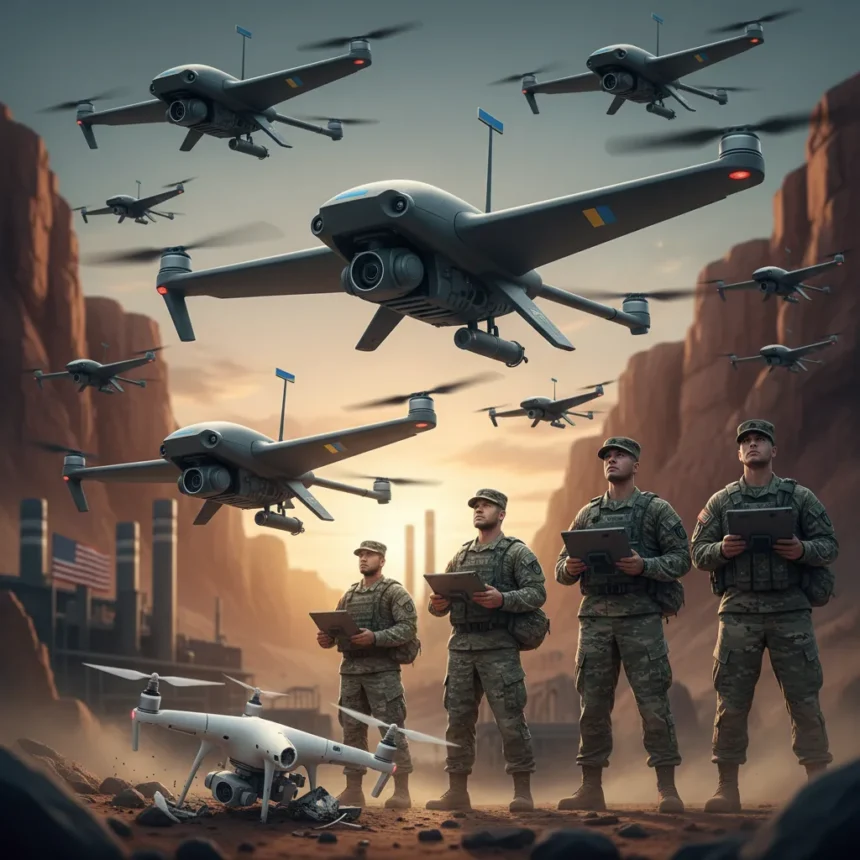
Ukrainian drones US Army selection represents a fundamental shift in Pentagon procurement strategy, moving away from Chinese-manufactured systems toward allied, battlefield-tested alternatives. The US Army’s Drone Dominance program, a $1.1 billion initiative spanning four rapid-cycle phases, has awarded prototype contracts to Ukrainian Defense Drones Tech Corporation (UDD Tech Corp), which manufactures the F10 quadcopter and Shrike models with zero Chinese component sourcing.
Key Takeaways
- F10 quadcopter from Ukrainian F-Drones scored 72.9/100 in Gauntlet phase, securing US Army procurement contract
- Drone Dominance program invites 25 companies; 11 advanced including two Ukrainian firms for $150 million in prototype contracts
- F-Drones manufactures components in-house or sources from European suppliers, eliminating Chinese supply chain risk
- Ukrainian FPV drones cost $1,360–$2,000 versus millions for conventional US strike systems
- Pentagon prioritizes non-Chinese supply chains; Ukraine leads in battlefield-tested production at scale
Why the Pentagon Is Betting on Ukrainian drones US Army Programs
The Pentagon’s turn toward Ukrainian drones US Army procurement reflects a strategic recognition that DJI and other Chinese manufacturers pose supply-chain and national-security risks. Rather than develop entirely new systems from scratch, the US military is leveraging Ukraine’s years of combat experience and proven manufacturing capability. Ukraine has produced millions of FPV (first-person-view) attack quadcopters in active warfare, creating a proven, scalable ecosystem that US manufacturers cannot match in speed or cost.
The Drone Dominance program itself is structured for rapid iteration. The Gauntlet phase at Fort Benning in February and early March 2026 allows military operators to fly and assess systems in real conditions, not laboratory settings. This hands-on evaluation cuts through marketing claims and reveals what actually works under stress. Post-Gauntlet, the Pentagon awards $150 million in prototype contracts, with deliveries beginning within five months. This compressed timeline—months instead of years—mirrors how Ukraine has accelerated drone development during active conflict.
According to reporting from United24media, the Pentagon’s emphasis on non-Chinese supply chains is explicit: Ukraine’s localized production and European component sourcing make it an ideal partner for a secure, allied supply chain. The F10’s 72.9/100 score in the Gauntlet evaluation placed it sixth overall, strong enough to advance to the next procurement phase.


Ukrainian drones US Army vs. DJI and Conventional Systems
DJI dominates the commercial and hobbyist drone market globally, but its reliance on Chinese manufacturing and components has made it a target for US national-security restrictions. The Drone Dominance program explicitly seeks alternatives, and Ukrainian manufacturers offer a direct replacement: purpose-built military quadcopters with no Chinese components. General Cherry (Heneral Chereshnya), another Ukrainian FPV maker, also advanced in the Gauntlet with fiber-optic and interceptor drone systems, demonstrating that Ukraine has multiple competitors in this space, not just one vendor.
The cost advantage is staggering. Ukrainian FPV drones retail for $1,360–$2,000 per unit, while conventional US strike systems cost millions—the Sidewinder missile system runs roughly $1 million, and Patriot systems exceed $4 million. A Pentagon that can procure thousands of low-cost, expendable drones for the price of a single conventional weapon fundamentally changes battlefield economics. This is not theoretical: Ukraine has already proven this model works at scale, producing millions of units during active warfare.



What Happens Next in the Drone Dominance Program
The program structure is clear: 25 initial companies compete; 11 advance after the Gauntlet phase. UDD Tech Corp and General Cherry are confirmed Ukrainian participants. The $150 million in prototype contracts awarded post-Gauntlet will fund deliveries over five months, allowing the Pentagon to field-test systems and gather data for the next phase. The full program spans four phases, with $1.1 billion allocated across the entire initiative.
This is not a one-off procurement. The Pentagon is building a pipeline. Each phase introduces new requirements and iterations, pushing manufacturers to innovate rapidly. Ukrainian firms have already demonstrated they can move at this pace—they have no choice in a shooting war. That operational urgency, combined with proven engineering and zero Chinese reliance, makes them credible long-term suppliers for US military drone programs.
Is Ukrainian drones US Army selection a permanent shift away from DJI?
Yes. The Pentagon’s emphasis on non-Chinese supply chains is policy-level, not a temporary preference. Ukrainian manufacturers have proven they can scale production, innovate under pressure, and deliver systems that perform in real combat. DJI will not regain Pentagon procurement contracts unless its supply chain fundamentally changes, which is unlikely given US-China tensions.
Could other countries compete in the Drone Dominance program?
The program invites companies globally, but Ukrainian and European manufacturers have immediate advantages: proven battlefield experience, non-Chinese component sourcing, and existing production capacity. Other NATO allies could compete, but none have Ukraine’s track record of rapid, large-scale FPV drone production.



What makes Ukrainian drones US Army-ready compared to commercial drones?
Military-grade drones must withstand interference, operate in contested electromagnetic environments, and tolerate loss without mission failure. Ukrainian FPV quadcopters are designed for exactly these conditions, having flown millions of sorties in active warfare against an adversary with advanced air defenses. Commercial drones like DJI systems prioritize consumer features—long flight times, camera quality, ease of use—not resilience in combat.
The Drone Dominance program signals a permanent realignment in US military procurement. Ukrainian drones are not a temporary substitute for DJI; they are the Pentagon’s chosen path forward for a new generation of low-cost, expendable strike systems. With $1.1 billion committed across four phases and proven manufacturers already advancing to prototype contracts, the question is no longer whether Ukrainian drones can replace DJI in US military use—it is how quickly the Pentagon can scale production and integrate them into operational doctrine.
Edited by the All Things Geek team.
Source: TechRadar




