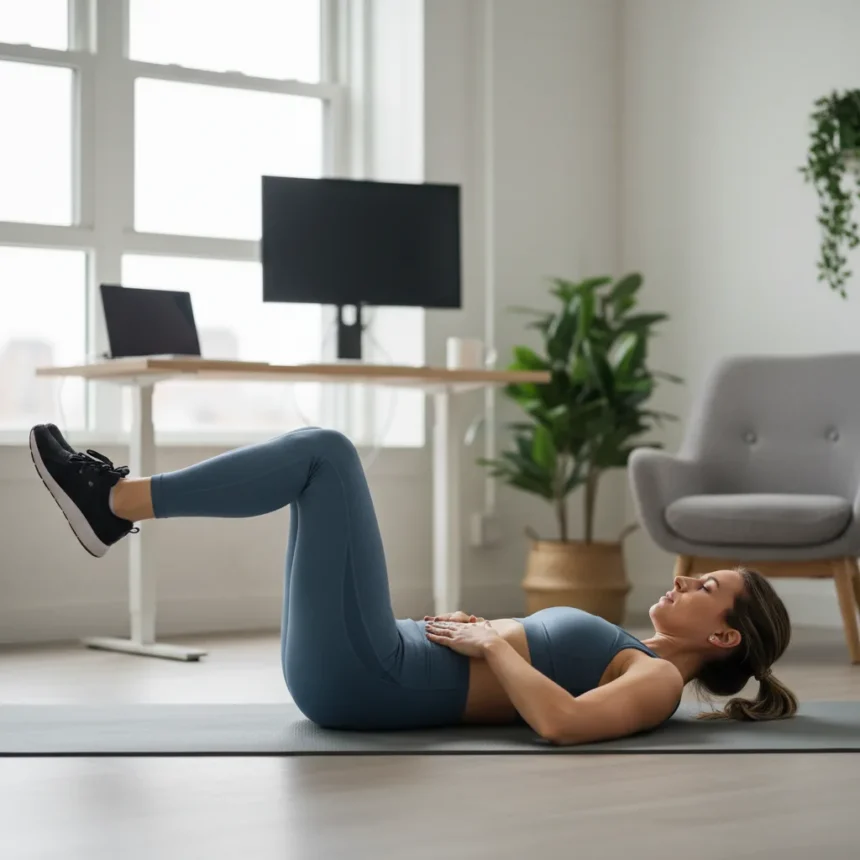
The psoas march exercise is a corrective movement that targets the psoas major and iliacus—your deepest hip flexors—alongside glute activation and core stability. A week of daily practice reveals why desk workers and athletes alike are turning to this simple bodyweight drill to counteract tight hips and improve functional movement.
Key Takeaways
- Psoas march targets deep hip flexors, glutes, and core stability in one movement
- Supine variation with heels on a box is the standard starting point for most people
- Resistance band options exist but bodyweight form should come first
- Benefits include improved posture, reduced lower back pain risk, and better hip stability
- A week of daily practice produces noticeable fatigue and activation in hip flexors and core
What the psoas march exercise actually does
The psoas march exercise isolates the deep hip flexors that tighten from prolonged sitting, a problem that affects millions of desk-bound workers worldwide. Unlike generic core exercises, the psoas march creates dynamic stability demands on your spine and pelvis while your legs move independently. This dual action—holding your pelvis steady while marching your knees—forces your core to work harder than static holds alone.
The movement addresses hip impingement, psoas strains, and low back issues by strengthening the muscles responsible for lumbopelvic control. When performed correctly, the psoas march produces a distinct burn in your legs, hips, and even the underside of your feet, signaling that deep hip flexor activation is occurring.
How to perform the psoas march exercise correctly
The standard supine variation requires minimal equipment: a box, chair, or sturdy bench. Lie on your back with your heels resting on the elevated surface, then lift your buttocks off the floor and squeeze your glutes hard. This creates the foundation—a stable, elevated pelvis. From here, lift one knee at a time in an alternating running motion while keeping your heels anchored to the box. Lower slowly and repeat for multiple sets until you feel fatigue in your hip flexors and core.

The critical cue is maintaining a neutral lower back throughout. Your lower back should stay pressed down or flat against the floor; any arching signals that your core is not engaged enough to stabilize your spine against the dynamic leg movement. Beginners should start with bodyweight only before adding resistance. A resistance band looped around your feet adds tension, but poor form with a band is worse than perfect bodyweight execution.
Variations and progressions for the psoas march exercise
Once bodyweight form is solid, the psoas march exercise can be modified for different goals and fitness levels. The banded lying variation removes the box entirely—you perform the march while lying flat, lifting your feet and legs off the ground with a band around them, creating an isometric hold in your stabilizing leg. This version demands more from your core and hip flexors because there is no external support.



The standing psoas march is the most functional variation, mimicking the hip flexor demands of walking and running. Stand upright, optionally against a wall for balance, and march your knees up alternately against band resistance. This progression increases demand on your standing leg’s glutes, core, and psoas, preventing unwanted hip rotation during the movement. Athletes and runners benefit most from this version because it trains the psoas march exercise in a position closer to actual running mechanics.
What a week of daily practice reveals
Testing the psoas march exercise daily for seven days demonstrates rapid adaptation and noticeable improvements in hip flexor activation and core endurance. By day three or four, practitioners typically report reduced tightness in their hip flexors—a meaningful change for people who spend eight or more hours sitting daily. The exercise also highlights stability weaknesses; many people discover they wobble or lose pelvic control when performing the movement, revealing areas where their core needs strengthening.
The cumulative effect of a week of practice is improved posture and reduced lower back tension. Desk workers often experience anterior pelvic tilt (excessive forward hip tilt) from tight hip flexors, which places extra stress on the lower back. The psoas march exercise counteracts this pattern by strengthening and activating the hip flexors in a way that restores proper pelvic alignment. After one week, many people notice they can sit longer without that familiar lower back ache.
Who should and should not do the psoas march exercise
The psoas march exercise is ideal for runners, athletes, people with chronic hip tightness, and anyone recovering from hip surgery or dealing with psoas strains. It is especially valuable for those experiencing hip impingement or persistent lower back pain linked to poor hip mobility. The movement restores function without requiring specialized equipment or gym access.



However, caution is warranted for people with existing low back issues. The dynamic nature of the psoas march exercise creates moving loads on your spine, so anyone with acute lower back pain should consult a therapist before attempting it. Additionally, if your hip flexors are extremely tight or dormant from prolonged sitting, massage or stretching before strengthening can prevent discomfort during the movement.
Is the psoas march exercise better than stretching alone?
Stretching addresses tightness but does not build the strength and stability your hip flexors need for functional movement. The psoas march exercise combines activation, strengthening, and stability work in one movement, making it more comprehensive than static stretching. For desk workers, strengthening is often the missing piece—your hip flexors are tight because they are weak and underused, not just because you sit too long.
How long does it take to see results from the psoas march exercise?
Most people notice reduced hip tightness and improved core engagement within three to four days of daily practice. Longer-term benefits—improved posture, reduced lower back pain, and better running mechanics—typically emerge after two to three weeks of consistent practice. Results depend on starting fitness level and how much time you spend sitting daily.
Can you do the psoas march exercise every day?
Yes, the psoas march exercise is safe for daily practice because it uses bodyweight resistance and targets muscles that are chronically underactive in most people. However, progression and recovery matter. Start with three sets of ten to fifteen repetitions daily, then increase volume or add resistance as your form improves and fatigue decreases. If you experience sharp pain rather than muscle fatigue, stop and consult a professional.
The psoas march exercise is a rare combination: simple enough for beginners, effective enough for athletes, and accessible enough to do at home without equipment. A week of daily practice proves that this corrective movement delivers real improvements in hip mobility, core stability, and lower back health—benefits that justify making it a permanent part of your routine.
Edited by the All Things Geek team.
Source: Tom's Guide