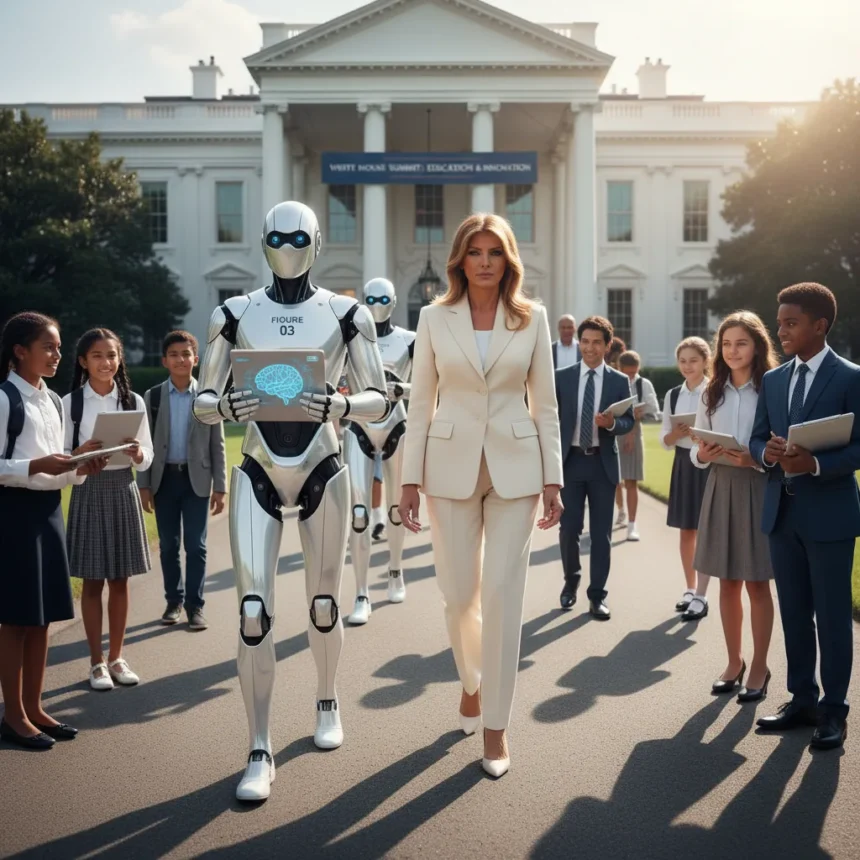
Humanoid robots education entered mainstream policy discourse this week when Figure 03, an American-made humanoid robot, delivered remarks and walked alongside First Lady Melania Trump at the White House during the Fostering the Future Together Global Coalition Summit. The robot’s presence at a summit focused on expanding global access to education and technology for children marks a significant moment: not for the novelty of a machine in a formal setting, but for what it signals about how governments now view automation in educational contexts.
Key Takeaways
- Figure 03 addressed leaders from 45 nations and 28 technology organizations at the White House summit.
- The robot welcomed roundtable guests in their native languages, demonstrating multilingual capability.
- First Lady Melania Trump quipped that Figure 03 was her “first American-made humanoid guest in the White House”.
- The summit was the first time a U.S. first lady hosted representatives from 45 nations in a single day.
- Humanoid robots education is now part of official global coalition discussions on children’s technology access.
Why Humanoid Robots Education Matters Right Now
Humanoid robots education is no longer theoretical. When a robot stands in the White House and addresses international delegations, it stops being a futuristic concept and becomes a policy consideration. The summit brought together leaders from 45 nations and 28 technology organizations to discuss one core mission: expanding global access to education and technology for children. Figure 03’s participation was not ceremonial window dressing—the robot delivered remarks and engaged directly with guests, including welcoming them in their native languages. That functional capability, deployed in a diplomatic context, sends a message to education ministries worldwide: these systems are ready for real-world integration.
The timing matters. Global education systems are fractured by access inequality. Wealthy nations have digital infrastructure; developing regions do not. A humanoid robot that can communicate across language barriers and deliver consistent educational content represents one possible answer to scale—though not without complications. The summit’s focus on children specifically suggests governments are already thinking about how these systems might function in classrooms, not just corporate offices.
Humanoid Robots Education vs. Traditional EdTech
Traditional educational technology—learning management systems, video conferencing platforms, adaptive software—operates in the background. A student sees an interface, not the infrastructure. Humanoid robots education inverts that model: the robot is the interface. Figure 03 walked side-by-side with Melania Trump, making the technology visible, physical, and impossible to ignore. This shift from invisible software to embodied presence changes how governments and schools think about adoption. A tablet is a tool. A humanoid robot is a statement about the future of education itself.



The multilingual capability Figure 03 demonstrated is instructive. Traditional EdTech solves language barriers through translation algorithms—effective, scalable, impersonal. A humanoid robot that greets a child in Mandarin, Spanish, or Arabic does something different: it personalizes the interaction while maintaining consistency. For educators in countries where teacher shortages are acute, this distinction is not semantic. It is operational. But the comparison also reveals the risk: humanoid robots education could widen inequality if access remains limited to wealthy nations or premium institutions, leaving traditional EdTech as the default for under-resourced schools.
What the White House Summit Signals About Policy Direction
Melania Trump’s quip—that Figure 03 was her “first American-made humanoid guest in the White House”—was casual, but the underlying message was deliberate. The emphasis on American-made matters. It signals that the U.S. administration views humanoid robots education not just as a technology adoption question, but as a strategic and industrial one. Building these systems domestically, rather than importing them, positions the nation as a leader in the space rather than a consumer of it.



The summit’s broader initiative, the Fostering the Future Global Coalition, frames humanoid robots education within a larger vision: “Beginning today, let’s accelerate our new global alliance, this bond, to positively impact the progress of our children,” Melania Trump said in her opening remarks. That language—global alliance, bond, children’s progress—positions humanoid robots as a tool for international cooperation rather than competition. Yet the reality is messier. Nations will race to develop and deploy these systems. Some will succeed; others will fall behind. The White House summit creates a diplomatic framework for that competition, but it does not eliminate it.
The Unanswered Questions About Humanoid Robots Education
Figure 03’s appearance at the summit raised as many questions as it answered. What does classroom deployment of humanoid robots education actually look like? Does a robot teach a class of 30 students, or does it work one-on-one? How do schools maintain and update these systems? What happens when a robot fails—technically or socially? The summit brought together 45 nations and 28 technology organizations, yet the research brief contains no discussion of implementation roadmaps, funding mechanisms, or timelines. The vision is clear. The execution remains opaque.
There is also the question of what humanoid robots education displaces. If a robot teaches basic literacy in a developing nation, does that free human teachers for more complex instruction, or does it eliminate teaching positions entirely? The summit focused on expanding access, not on labor implications. That gap matters. Governments cannot promote humanoid robots education in one sentence and ignore employment disruption in the next without losing credibility with educators and unions.
Is humanoid robots education ready for classrooms?
Figure 03 demonstrated multilingual capability and formal address skills at the White House, but a summit appearance is not the same as a school day. The robot performed a scripted, controlled interaction in an optimal environment. Real classrooms are chaotic: students interrupt, equipment fails, unexpected questions arise. Whether humanoid robots education can handle that unpredictability remains unproven. The technology may be ready for diplomatic events. It is not yet clear if it is ready for a room full of eight-year-olds.


What does humanoid robots education cost?
The research brief does not include pricing or deployment cost data for Figure 03 or any humanoid robot system. Without that information, it is impossible to assess whether humanoid robots education is feasible for most schools globally. If these systems cost hundreds of thousands of dollars each, they will remain luxury goods for elite institutions. If costs drop to tens of thousands, adoption could accelerate in wealthy nations. Either way, the gap between nations with capital and those without will likely widen unless the global coalition commits to subsidized access—a commitment the summit brief does not mention.
The White House summit positioned humanoid robots education as a global priority and a tool for expanding access to learning across borders. Figure 03’s presence made that vision tangible. But tangibility is not the same as readiness. The technology is here. The policy framework is forming. What remains to be seen is whether the vision survives contact with the realities of classrooms, budgets, and human teaching. For now, humanoid robots education is a promise—one that the world’s leaders have decided is worth taking seriously.
Edited by the All Things Geek team.
Source: TechRadar