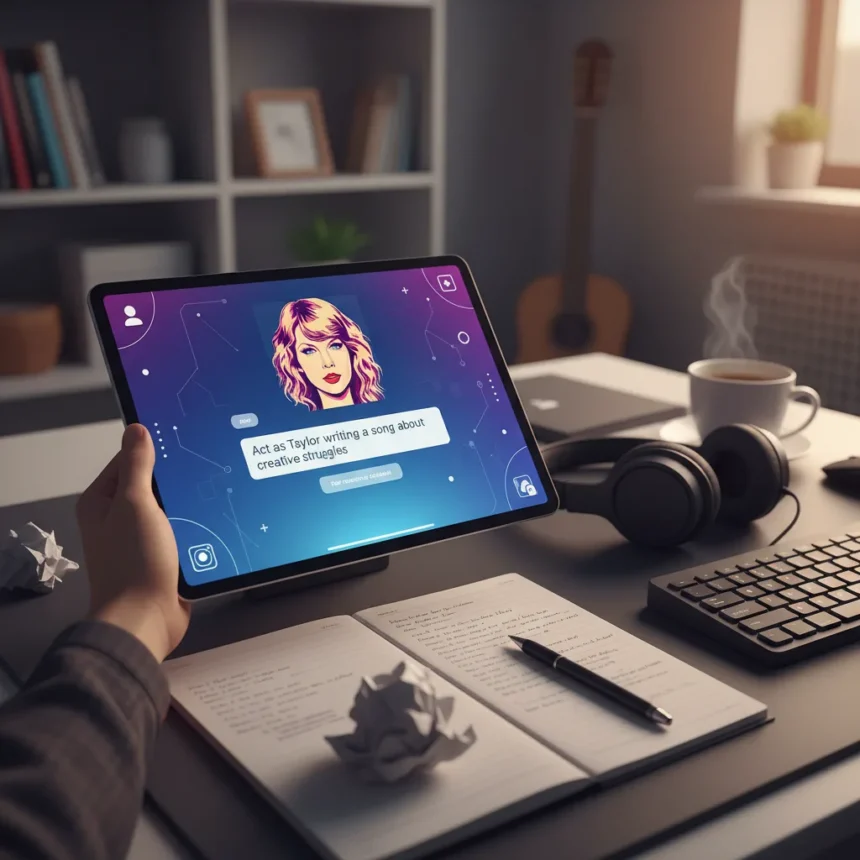
ChatGPT prompts for creative blocks don’t have to be generic. One Tom’s Guide AI writer discovered that borrowing Taylor Swift’s creative instincts as a prompt framework produced surprisingly effective results when he was stuck.
Key Takeaways
- A Taylor Swift-inspired ChatGPT prompt helped one writer escape a creative slump quickly.
- The technique involves asking ChatGPT to respond using Swift’s mindset and decision-making style.
- This method demonstrates how persona-based prompting can unlock new creative directions.
- ChatGPT prompts for creative blocks work best when they reference specific, recognizable frameworks or mindsets.
- The exercise was described as surprisingly simple yet effective for overcoming creative blockage.
Why ChatGPT Prompts for Creative Blocks Often Fail
Most writers and creators who use ChatGPT prompts for creative blocks rely on generic instructions like “help me brainstorm” or “give me five ideas.” These approaches treat the AI as a simple idea dispenser rather than a thinking partner. The results are predictable, safe, and forgettable. Generic prompts produce generic output. When you’re stuck in a creative slump, generic is the last thing you need.
The real problem is that standard ChatGPT prompts for creative blocks lack context. They don’t anchor the AI to any particular perspective, voice, or decision-making framework. Without that anchor, ChatGPT defaults to middle-of-the-road suggestions that sound like they came from a productivity blog, not from someone who understands your specific creative challenge.
The Taylor Swift Method: How One Writer Broke Through
Elton Jones, an AI writer at Tom’s Guide who tests ChatGPT, Gemini, and Claude, decided to experiment with a different approach. Instead of asking ChatGPT for generic creative help, he asked the AI to think and work like Taylor Swift. The premise was simple: use a recognizable creative figure as a mental model to reframe the problem.



This technique works because Taylor Swift is a documented case study in creative reinvention, strategic decision-making, and output consistency. By asking ChatGPT to adopt her mindset, Jones gave the AI a specific lens through which to generate ideas. The results were different enough to pull him out of his creative slump. The exercise was described as surprisingly simple, yet it produced outcomes that generic ChatGPT prompts for creative blocks had failed to deliver.
The underlying principle here is persona-based prompting. Instead of asking an AI for broad creative help, you anchor it to a specific person’s thinking style, values, or approach. This constraint actually makes the AI more useful, not less. A constrained prompt generates more coherent, directional output than an open-ended one.



How Persona-Based Prompting Compares to Standard Methods
Traditional ChatGPT prompts for creative blocks ask the AI to be helpful and creative in abstract terms. Persona-based prompting does the opposite: it narrows the scope by borrowing someone else’s specific approach. The difference is dramatic. Generic prompts treat creativity as a universal skill. Persona prompts treat it as a learnable style.
This is why the Taylor Swift experiment worked. Swift’s career is publicly documented. Her approach to songwriting, album strategy, and audience connection is visible. When you ask ChatGPT to think like her, you’re not asking it to invent a persona—you’re asking it to synthesize a known one. That’s a much more stable anchor for the AI to work from than “be creative.”
Other creators testing ChatGPT prompts for creative blocks might use different figures—directors, authors, musicians, entrepreneurs. The specific person matters less than the clarity of their documented approach. What matters is that the persona is specific, recognizable, and distinct from generic creativity advice.
Why This Works Better Than Brainstorming Alone
Creative slumps happen when your own thinking gets stuck in loops. You’ve exhausted your immediate ideas, and your brain keeps returning to the same dead ends. A brainstorming partner—human or AI—can break that loop by introducing new angles. But only if the partner has a distinct perspective to offer.


ChatGPT prompts for creative blocks fail when they ask the AI to think like you, just faster. They succeed when they ask it to think like someone else entirely. The Taylor Swift method works because it forces both you and the AI to operate outside your normal patterns. Swift’s business instincts, her songwriting approach, her understanding of her audience—these are different from how most creators think. That difference is the entire point.
When you’re stuck, you don’t need more of your own thinking. You need a different thinking style injected into the problem. Persona-based ChatGPT prompts for creative blocks deliver exactly that.
Can You Use This Method for Other Creative Goals?
The Taylor Swift experiment is just one application of persona-based prompting. The same principle works with any recognizable figure whose creative approach is well-documented. A filmmaker might ask ChatGPT to think like a specific director. A writer might borrow the mindset of an author known for a particular style. A marketer might adopt the strategy of a business leader known for unconventional thinking.
The key is choosing a persona whose approach is specific and distinct. Vague figures produce vague results. The more clearly you can describe—or the more clearly ChatGPT can infer—what the persona’s decision-making looks like, the more useful the prompt becomes.
How to Structure Your Own Persona-Based Prompt
If you want to try ChatGPT prompts for creative blocks using this method, the structure is straightforward. Tell ChatGPT who you want it to think like, describe the creative problem you’re facing, and ask for ideas or feedback from that persona’s perspective. The specificity matters. “Think like Taylor Swift” is better than “think creatively.” “Think like Taylor Swift when she’s planning a surprise album release” is even better.
The more context you give about the persona and the problem, the more targeted the AI’s response will be. Generic prompts produce generic answers. Specific prompts produce specific, usable output.
Can this method work with other AI models?
The Taylor Swift persona method is not exclusive to ChatGPT. Elton Jones tests multiple models including Gemini and Claude, and the underlying principle of persona-based prompting applies across all of them. Different models have different strengths—some handle longer contexts better, others produce more creative output—but all of them respond better to specific, anchored prompts than to generic ones.
What makes Taylor Swift a particularly good persona for creative prompting?
Taylor Swift’s career is exceptionally well-documented and publicly visible. Her songwriting process, her album strategy, her approach to audience engagement, and her business decisions are all part of the public record. This makes her an ideal persona for ChatGPT prompts because the AI has clear reference material to work from. A less-documented figure might produce vaguer results.
Is this just a gimmick, or does it actually improve creative output?
According to the Tom’s Guide experiment, it’s not a gimmick—it pulled one writer out of a brutal creative slump when other methods had failed. That said, the effectiveness depends on how well you construct the prompt and how clearly you understand the persona you’re borrowing. A thoughtfully constructed persona-based prompt produces better results than a generic one. A poorly constructed one might not help at all.
The real takeaway is this: ChatGPT prompts for creative blocks work best when they give the AI a specific lens to work through. Whether that lens is Taylor Swift or someone else is less important than the clarity of the framework itself. If you’re stuck creatively, try anchoring your next ChatGPT prompt to a specific person whose approach you admire. The constraint might be exactly what breaks you free.
Edited by the All Things Geek team.
Source: Tom's Guide