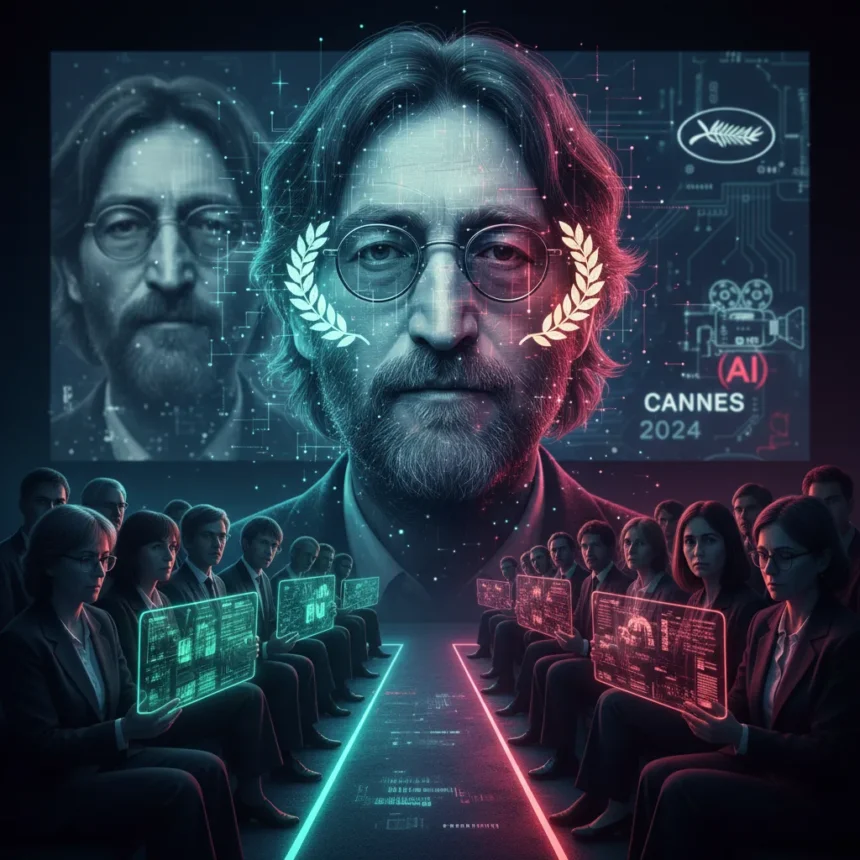
Steven Soderbergh’s AI-assisted documentary about John Lennon has become one of Cannes’ biggest controversies, splitting critics over whether the technology enhances or distracts from the film’s emotional core. The project represents a watershed moment for artificial intelligence in filmmaking — a high-profile director at cinema’s most prestigious festival betting on AI-generated visuals to tell the story of one of music’s most iconic figures.
Key Takeaways
- Soderbergh’s AI-assisted Lennon documentary sparked major debate at Cannes Film Festival
- Critics divided on whether AI visuals enhanced or overwhelmed the emotional narrative
- The film marks a significant moment for AI adoption in prestige documentary filmmaking
- Controversy centers on balancing technological innovation with storytelling authenticity
- The project raises broader questions about AI’s role in creative industries
The Cannes Controversy Around AI-assisted Documentary
The arrival of Soderbergh’s project at Cannes triggered immediate debate among festival attendees and critics. An AI-assisted documentary at cinema’s most respected venue signals that artificial intelligence has moved beyond experimental territory into mainstream filmmaking discourse. The controversy is not whether the technology works — it clearly does — but whether its presence serves or undermines the human story at the film’s center.
Some critics argue that the AI visuals overwhelmed the emotional dimension of the narrative. The concern reflects a deeper tension in contemporary cinema: as technology becomes more capable, does it risk overshadowing the intimate, human truths that documentaries are meant to explore? When audiences watch John Lennon’s story told through AI-generated imagery, are they connecting with the subject or distracted by the medium itself?
What the Critical Divide Reveals About AI in Filmmaking
The split reaction at Cannes exposes a fundamental disagreement about AI’s creative role. One camp sees the technology as a powerful storytelling tool — capable of visualizing concepts, archival material, or emotional states that traditional filmmaking cannot capture. The other views it as a distancing mechanism that interposes algorithmic mediation between audience and subject.



This debate extends beyond Soderbergh’s specific project. As more filmmakers experiment with AI-assisted production, the industry faces a reckoning about when technology serves narrative and when it becomes spectacle. Documentary filmmaking, traditionally rooted in authenticity and direct observation, presents particular challenges for AI integration. Audiences expect documentary to show them reality — or at least a credible interpretation of it. AI-generated visuals introduce an additional layer of mediation that some viewers find philosophically troubling, regardless of technical quality.
Why This Moment Matters for AI-assisted Documentary
Soderbergh’s decision to premiere an AI-assisted documentary at Cannes, rather than at a technology conference or streaming platform, signals confidence in the approach. It also forces the film industry’s gatekeepers — festival programmers, critics, and established directors — to engage with AI as a legitimate creative tool rather than a novelty. The controversy proves the point: people care enough to argue about it, which means the technology has crossed a threshold from experimental to culturally significant.



The John Lennon documentary will likely influence how other prestige filmmakers approach AI integration. If the project is remembered as a bold innovation, more directors may embrace AI-assisted production. If it becomes a cautionary tale about technology overwhelming substance, the industry may proceed more cautiously. Either way, Cannes has certified that AI-assisted documentary is no longer a hypothetical debate — it is a present reality demanding critical engagement.
Is the AI-assisted documentary approach right for all stories?
Not necessarily. AI-assisted visuals may enhance certain narratives — abstract concepts, historical reconstruction, or deeply personal emotional states — while feeling inappropriate for others. Documentaries rooted in direct testimony, archival footage, or observational cinema may resist AI integration more naturally. The question is not whether AI belongs in documentary, but which stories and which filmmakers can deploy it most effectively.
What makes the Cannes reaction significant for the film industry?
Cannes’ embrace of Soderbergh’s project — despite the controversy — signals that major festivals are willing to premiere AI-assisted work at the highest level. This legitimizes the technology within institutional filmmaking and opens doors for other directors to experiment. The critical debate, rather than dismissal, proves the industry is taking the work seriously.
Will AI-assisted documentaries become the industry standard?
Adoption will likely depend on how audiences and critics respond to specific projects. If AI-assisted work consistently serves storytelling and earns critical respect, adoption will accelerate. If projects prioritize visual spectacle over emotional truth, resistance will persist. Soderbergh’s film will become a reference point for this conversation — proof that AI can reach Cannes, but not yet proof that it should dominate documentary filmmaking.


The real takeaway from Cannes is not that AI has won a place in documentary filmmaking — it is that the conversation has matured. Critics are no longer asking whether AI-assisted work can exist; they are asking whether it should, and under what conditions. That shift from novelty to scrutiny suggests the technology will find its place in cinema, but not without ongoing debate about what gets lost when storytelling becomes algorithmic.
Edited by the All Things Geek team.
Source: TechRadar