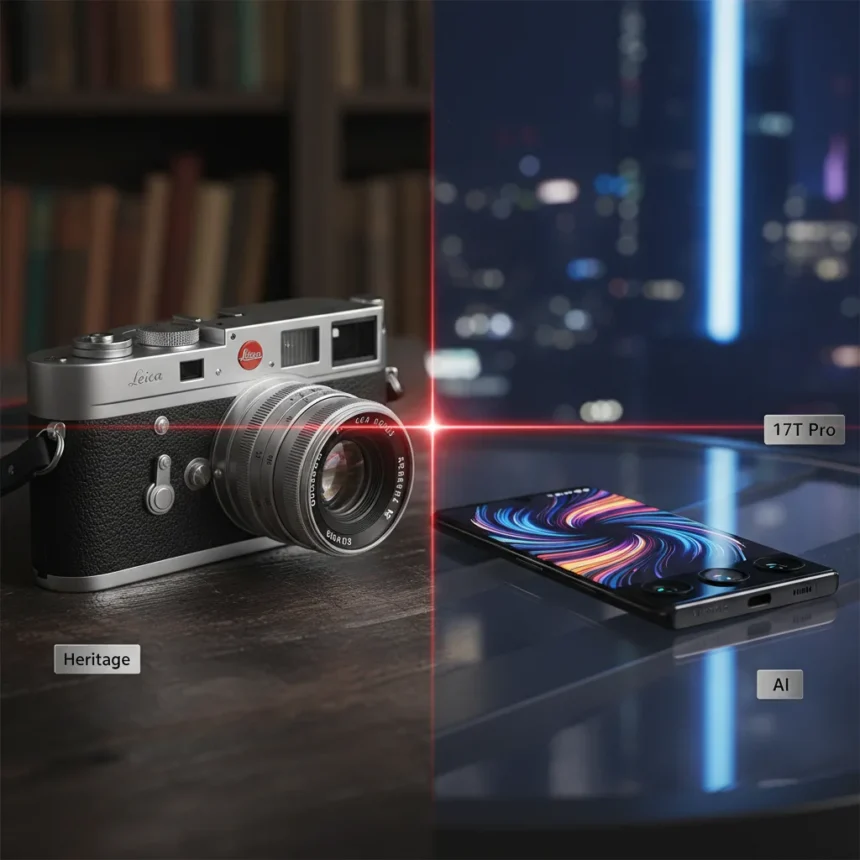
Leica has drawn a sharp distinction between generative AI photography heritage and its core mission as a camera manufacturer. In a recent roundtable discussion, the company made clear that tools like Gemini Omni sit uncomfortably with its decades-long commitment to authentic image capture, but acknowledged that generative AI photography heritage fits naturally into smartphone imaging partnerships such as the Xiaomi 17T Pro.
Key Takeaways
- Leica explicitly states generative AI tools are at odds with its photography heritage and won’t likely appear on Leica M cameras.
- The company distinguishes between its heritage camera line and smartphone imaging collaborations.
- Generative AI features make sense for mobile devices like the Xiaomi 17T Pro, according to Leica.
- This position reflects broader tension between AI-assisted imaging and traditional photographic principles.
- Leica’s stance reveals how luxury camera brands are navigating the AI revolution differently than smartphone makers.
Leica’s Philosophy: Authenticity Over Automation
Leica’s hesitation toward generative AI photography heritage stems from a fundamental principle: the camera should capture reality, not interpret it. The company’s M-series cameras have defined a genre of unfiltered, direct photography for over a century. Adding generative AI tools to these devices would undermine that core identity. As Leica indicated in the roundtable, such tools would be fundamentally misaligned with what the M camera represents to photographers worldwide.
This is not mere marketing posturing. Leica’s resistance to computational photography has been consistent even as competitors embraced it. The brand has resisted aggressive noise reduction, scene detection, and algorithmic enhancement that might compromise the raw photographic moment. Generative AI represents the logical extreme of this trend—not just processing what the sensor captures, but creating entirely new content. For Leica, that crosses a line.
Where AI Actually Fits: The Smartphone Compromise
Leica’s position becomes more nuanced when discussing smartphones. The company acknowledged that generative AI photography heritage aligns perfectly with mobile imaging, particularly in partnerships like its collaboration with Xiaomi on the 17T Pro. This apparent contradiction reveals how Leica thinks differently about different product categories.


Smartphones serve a different audience with different expectations. Users expect computational assistance, scene optimization, and yes, generative features. The smartphone camera is already a heavily processed experience—multiple exposures merged, colors graded by algorithms, details enhanced by machine learning. Adding generative AI tools to that ecosystem does not feel like a betrayal because smartphones have never claimed to be purely documentary devices. They are convenience cameras, and AI convenience features make logical sense in that context.
The Xiaomi partnership shows Leica is willing to participate in this AI-enabled smartphone future. But it does so on separate terms from its heritage camera business. The company is essentially saying: we can work with AI in phones, but not in our flagship cameras. That distinction matters.



The Broader Tension: AI Tools vs. Photographic Truth
Leica’s stance touches on a genuine philosophical debate in photography. Generative AI tools like Gemini Omni can remove unwanted objects, add missing elements, or completely reimagine a scene based on text prompts. At what point does an image stop being a photograph and become digital art? Leica is arguing that its M cameras should never cross that threshold.
This creates an interesting market segmentation. Photographers who value authenticity and craft will gravitate toward traditional Leica cameras precisely because they reject generative AI photography heritage. Meanwhile, smartphone users who want convenience and creative assistance will embrace the same features on devices like the Xiaomi 17T Pro. Leica is betting it can serve both markets by keeping them separate.
Other camera manufacturers will likely face similar pressures. As generative AI becomes standard in mobile imaging, premium camera brands must decide whether to resist or adapt. Leica’s answer is clear: resist in heritage cameras, adapt in partnerships with smartphone makers.
Does Leica’s Position Actually Hold Water?
There is a credibility question here. If Leica genuinely believes generative AI photography heritage is incompatible with authentic image-making, why is it comfortable with the technology appearing in Xiaomi phones? The answer reveals the pragmatism beneath the philosophy. Leica recognizes that smartphones are a different market with different rules. It is not hypocritical to say AI makes sense in one context and not another—it is just market reality.



Still, the line Leica is drawing may not hold indefinitely. As AI tools become more sophisticated and more users expect them, the pressure to add generative features to premium cameras will intensify. Leica’s position today might look quaint in five years. But for now, the company is making a clear choice: heritage cameras remain pure, smartphones get the AI treatment.
Will Leica Actually Stick to This?
Leica’s public stance against generative AI tools on its M cameras is strong, but camera manufacturers have been known to shift positions when market demand changes. The company’s willingness to embrace AI in smartphone partnerships suggests it is not ideologically opposed to the technology itself—just to its presence in certain product lines. As long as there is a market for non-AI cameras, Leica will likely maintain this distinction. The moment that market shrinks, the company may reconsider.
FAQ
What exactly did Leica say about generative AI?
Leica stated that generative AI tools like Gemini Omni are at odds with its photography heritage and will most likely not appear on Leica M cameras. However, the company acknowledged that such tools make perfect sense for smartphones, including its partnership with Xiaomi on the 17T Pro.
Does this mean Leica will never add AI features to its cameras?
Leica’s statement specifically addresses generative AI tools—features that create or substantially alter images based on prompts. The company may still adopt other AI technologies for processing or optimization without compromising its core philosophy. The distinction between generative AI and computational photography is important here.
Why is Leica comfortable with AI in smartphones but not in its cameras?
Leica views smartphones and heritage cameras as serving different purposes and audiences. Smartphones are already heavily processed devices where users expect convenience features. M cameras, by contrast, are positioned as tools for authentic image capture. Keeping generative AI out of M cameras preserves that positioning while allowing Leica to participate in the smartphone AI revolution through partnerships.
Leica’s stance represents a rare moment of clarity in the camera industry. While competitors chase computational photography and AI-assisted imaging, Leica is doubling down on the idea that some cameras should remain tools for capturing reality, not creating it. Whether that philosophy survives the next decade of AI advancement remains to be seen, but for now, Leica is betting that photographers still value authenticity over automation.
Where to Buy
Edited by the All Things Geek team.
Source: TechRadar