






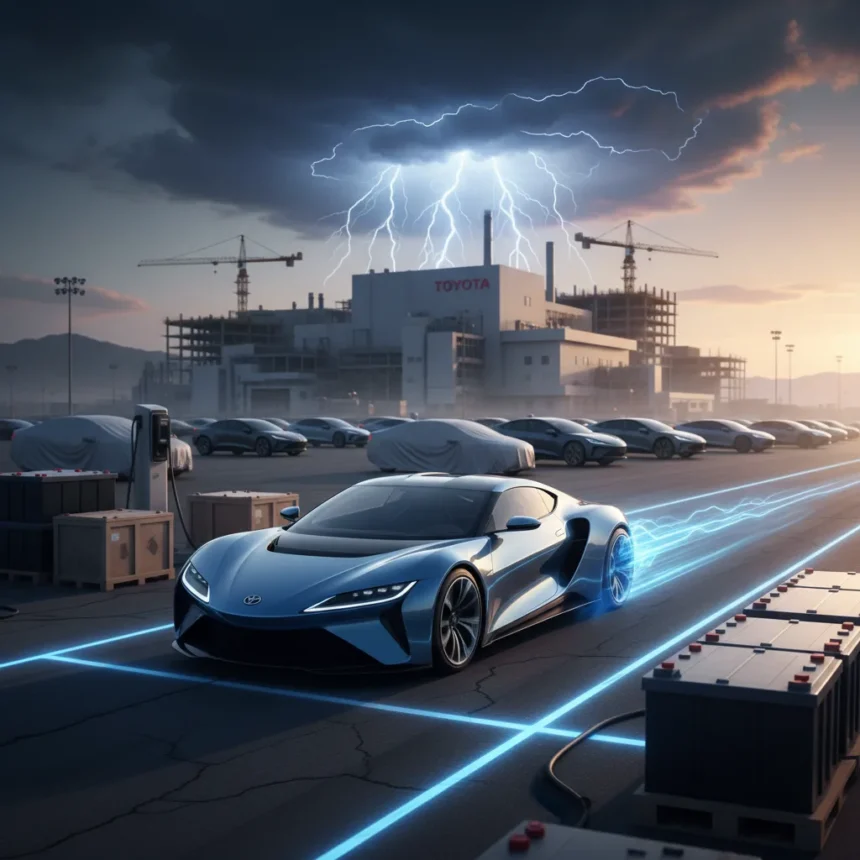
Toyota EV acceleration is reshaping American automotive manufacturing at precisely the moment when competitors are retreating. The company announced an $800 million investment in its Georgetown, Kentucky facility to prepare for a second battery electric vehicle, signaling a fundamentally different bet on electrification than rivals making headlines for EV slowdowns.
Key Takeaways
- Toyota investing $800 million at Georgetown plant for second BEV production, with $200 million additional for Indiana operations
- Georgetown is Toyota’s largest global manufacturing facility, employing nearly 10,000 workers and producing over 14 million vehicles since 1988
- Investment supports $10 billion five-year U.S. manufacturing commitment announced in November 2025
- Toyota donating $4.4 million to local education programs for STEM and manufacturing workforce development
- First North American BEV produced at Georgetown is the Highlander battery electric, with second model coming
Why Toyota EV Acceleration Matters Now
The timing is striking. While Ford, General Motors, and other legacy automakers are postponing or scaling back U.S. EV investments, Toyota EV acceleration represents a contrarian strategy rooted in a multi-pathway approach to electrification. Rather than betting exclusively on battery electric vehicles, Toyota continues investing in hybrids while simultaneously expanding BEV capacity. This flexibility allows the company to respond to shifting consumer demand without abandoning its electrification roadmap.
The Georgetown announcement came during the plant’s 40-year celebration, a milestone that underscores Toyota’s long-term commitment to U.S. manufacturing. Governor Andy Beshear remarked that the partnership has strengthened over four decades, with the new investment ensuring the facility remains competitive for generations. This is not a temporary commitment or a hedge—it is a fundamental statement about where Toyota sees the American market heading.
Georgetown Plant: The Epicenter of Toyota EV Acceleration
Georgetown, located in Kentucky, is Toyota’s largest vehicle manufacturing facility worldwide. Since opening in 1988, it has produced over 14 million vehicles and currently employs nearly 10,000 workers. The $800 million investment will prepare the facility for its second battery electric vehicle while also increasing production capacity for the Camry and RAV4. The first North American BEV assembled at Georgetown is the Highlander battery electric.


Battery cells arrive from Toyota’s new North Carolina plant, where they are assembled into battery packs at Georgetown before integration into vehicles. This vertical supply chain integration reduces dependency on external suppliers and positions the facility as a critical hub for Toyota EV acceleration across North America. The investment creates no job losses—a key distinction from many manufacturing pivots that require workforce reductions.
The Georgetown upgrade is part of a broader $1 billion investment split between Kentucky and Indiana operations. Toyota Indiana will receive $200 million to boost production of the Grand Highlander alongside the Sienna and Lexus TX. This dual-state strategy reflects Toyota’s commitment to distributed manufacturing capacity rather than consolidating all EV production in a single location.



The Education and Workforce Angle
Beyond the plant upgrade, Toyota EV acceleration includes a significant workforce development component. The company is donating $4.4 million to local education initiatives: $4 million to Fayette and Scott County Schools and $400,000 to Eastern Kentucky University for STEM, engineering, and manufacturing programs. Since 1988, Toyota has donated over $154 million locally, signaling deep community investment beyond factory operations.
This education push addresses a critical challenge in automotive manufacturing—pipeline development. As EV production requires different skill sets than traditional internal combustion engine assembly, investing in workforce preparation ensures Georgetown can sustain competitive advantage. Schools and universities in Kentucky will train students specifically for battery electric vehicle manufacturing roles, creating a talent supply aligned with Toyota EV acceleration timelines.
How Toyota EV Acceleration Compares to Rival Strategies
The contrast with competitors is stark. While several major automakers have announced EV production delays, plant closures, or reduced electrification targets in the U.S., Toyota EV acceleration reflects confidence in the market’s long-term direction. Toyota’s multi-pathway approach—maintaining hybrid production while expanding BEV capacity—provides flexibility that exclusive EV strategies lack. If consumer demand shifts toward hybrids, Toyota can adjust production ratios without idle capacity. If BEV adoption accelerates, the Georgetown and Indiana investments position the company to scale quickly.
This strategic positioning matters because it addresses a fundamental uncertainty in automotive electrification. Consumer adoption rates, charging infrastructure expansion, and regulatory timelines remain variables. Rivals betting heavily on rapid EV-only transitions face execution risk if market conditions shift. Toyota EV acceleration hedges that risk through diversification, a more conservative but potentially more resilient approach.



The Broader U.S. Manufacturing Context
The Georgetown investment is part of a larger November 2025 commitment to invest up to $10 billion in U.S. plants over the next five years. Toyota operates manufacturing facilities across Kentucky, Indiana, Missouri, West Virginia, and Alabama. This distributed footprint means Toyota EV acceleration is not concentrated in a single region but spread across multiple states, reducing supply chain vulnerability and maintaining political support across diverse markets.
The $10 billion pledge also signals confidence in U.S. manufacturing economics despite rising labor costs and competition from Mexican plants. Toyota is betting that proximity to North American consumers, supply chain resilience, and workforce stability justify domestic investment over offshore alternatives—a calculation that shapes not just Toyota’s future but the broader American automotive industry.
What the Second BEV Means for Toyota’s Lineup
The $800 million Georgetown investment explicitly prepares the facility for a second battery electric vehicle. The first is the Highlander battery electric, already in production. The second model remains unannounced, but the investment suggests Toyota is confident in BEV demand and committed to expanding its electric lineup beyond the Highlander. This Toyota EV acceleration in the SUV segment reflects market realities—consumers overwhelmingly prefer electric SUVs and crossovers over sedans.
The timing of this announcement, during the plant’s 40-year celebration, frames BEV production not as a departure from Toyota’s Kentucky legacy but as its logical evolution. Georgetown built the Camry, RAV4, and Highlander into global bestsellers. Now it will build the electric versions of those vehicles, maintaining the facility’s role as a cornerstone of Toyota’s North American strategy.
Is Toyota betting too much on EVs?
No. Toyota EV acceleration is balanced by continued hybrid investment, which remains profitable and popular in the U.S. market. The company is not abandoning hybrids or forcing consumers into BEVs before infrastructure and affordability align. Instead, Toyota is hedging across multiple electrification pathways, a strategy that reduces execution risk compared to competitors committed exclusively to rapid EV transitions.
When will the second Georgetown BEV launch?
The research brief does not specify a launch date for the second battery electric vehicle. The $800 million investment prepares Georgetown’s production capacity, but Toyota has not announced timing for the second model’s introduction. Expect an announcement within the next 12-18 months as the facility completes upgrades.
How does this compare to Ford or GM’s EV strategy?
Ford and General Motors have announced significant EV production delays and plant closures in the U.S., citing slower-than-expected consumer adoption and charging infrastructure gaps. Toyota EV acceleration, by contrast, is moving forward with major capital investment. The key difference: Toyota maintains hybrid production as a bridge technology, while competitors are committing more heavily to exclusive EV transitions. This makes Toyota’s strategy more flexible but potentially less aggressive in pushing electrification timelines.
Toyota EV acceleration represents a calculated bet that American consumers and markets will embrace electrification gradually, not overnight. By investing $800 million in Georgetown and committing $10 billion across U.S. plants over five years, Toyota is signaling that it believes in the long-term viability of domestic manufacturing and electric vehicles—even as rivals retreat. The strategy is not flashy, but it may prove far more durable than the all-or-nothing bets competitors are making.
This article was written with AI assistance and editorially reviewed.
Source: TechRadar