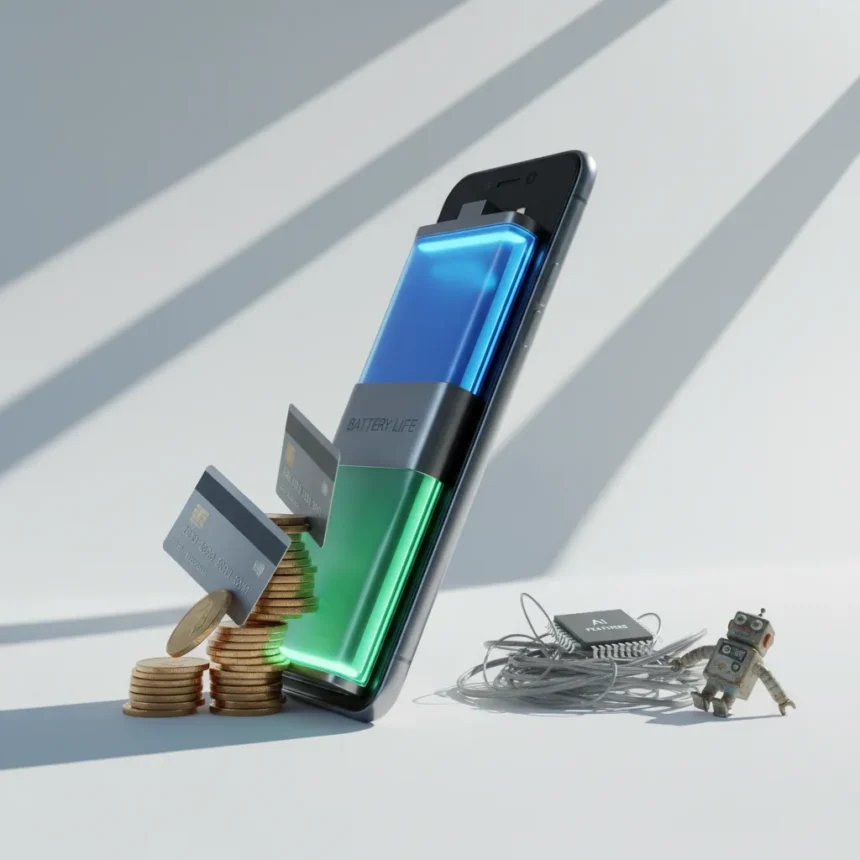
Battery life smartphone purchases have shifted dramatically in 2026, with endurance now outranking price as the single biggest factor driving consumer phone buying decisions. This represents a fundamental realignment in what smartphone buyers actually care about—and it exposes a critical gap between what manufacturers are marketing and what customers want to buy.
Key Takeaways
- Battery life has surpassed price as the top driver of smartphone purchases
- AI features rank far below battery life in influencing purchase decisions
- High-end flagships show similar battery performance with minimal differentiation
- MWC 2026 highlighted devices with larger batteries, including a 6,600mAh unit in a compact frame
- Tech experts are calling for even bigger batteries in 2026 smartphones
Why Battery Life Dethroned Price
The shift makes intuitive sense. Smartphone prices have plateaued at a level most buyers have accepted—flagships cost between $900 and $1,300, and consumers have largely made peace with that reality. What they have not accepted is the anxiety of running out of power mid-day. A phone that dies at 6 PM is objectively worse than one that lasts until bedtime, regardless of its processor speed or camera megapixels.
Price, once the dominant purchase lever, no longer differentiates in a market where every flagship costs roughly the same. But battery life still does. A device lasting two full days versus one day creates a tangible, lived experience that buyers feel every single time they use their phone. That experiential advantage has made battery life the new battleground for smartphone makers.
AI Features Are Losing the Narrative Battle
Perhaps the most striking finding is how little AI features influence actual purchase behavior. Despite years of marketing hype around on-device AI, generative features, and smart assistants, these capabilities rank far below battery life in what drives consumers to open their wallets. This gap between industry messaging and consumer priorities reveals a fundamental misalignment in the smartphone market.


Manufacturers have invested heavily in AI chips, neural processors, and exclusive AI features. Yet buyers are scrolling past these specs to ask a simpler question: How long does the battery last? The disconnect suggests that AI features, at least in their current form, solve problems consumers are not actively trying to solve, while battery anxiety remains a daily pain point.
The Battery Life Smartphone Purchases Reality: Flagships Are Converging
High-end flagships in 2026 demonstrate remarkably similar battery performance, which creates a new problem for manufacturers trying to differentiate on endurance. When Samsung, Xiaomi, and other makers all achieve roughly 1.5 to 2 days of typical use, battery life becomes a table-stakes feature rather than a competitive advantage. This convergence is why tech experts and industry observers are pushing for bigger batteries as the logical next step.



At MWC 2026, the industry began signaling a shift toward larger capacity cells. Manufacturers showcased devices with substantial battery upgrades, including flagship models featuring a 6,600mAh battery packed into a remarkably thin chassis. These announcements reflect an understanding that consumers want more endurance, and that bigger batteries are the path forward when AI features fail to move the needle.
What Consumers Actually Want from Phones in 2026
The data tells a clear story: consumers want phones that last longer, cost less, and do fewer things they do not need. They want to charge their device once and use it for a full day and night without anxiety. They want to watch video, browse, message, and take photos without rationing power. AI-powered photo enhancement sounds nice in a spec sheet, but a dead phone is useless regardless of its AI capabilities.
This reorientation of priorities has forced a reckoning. Smartphone makers spent the last two years racing to embed AI everywhere—in cameras, in keyboards, in messaging apps. But the market has spoken: consumers would rather have a phone that lasts 48 hours than one that can generate an image from a text prompt.
Why This Matters for Phone Makers
The battery life smartphone purchases trend exposes a strategic error in the industry’s recent direction. Manufacturers assumed that adding more AI would justify premium prices and drive upgrades. Instead, the market is telling them that battery life, reliability, and basic functionality matter more than latest features that feel bolted on rather than essential.



For makers like Samsung and Xiaomi, this means rethinking roadmaps. Rather than competing on AI capabilities, they need to compete on endurance. The TechRadar team has explicitly called for bigger batteries in 2026 smartphones, and consumer behavior is validating that demand. A phone that lasts three days instead of one is a genuine innovation. A phone that can generate an image from text is a feature.
What About Price?
Price has not disappeared from the equation—it has simply become less decisive. In a market where flagship phones cost roughly the same, price loses its power to influence choice. Buyers are no longer asking, “Is this phone expensive?” They are asking, “Will this phone get me through tomorrow?” The shift reflects maturity in the market and a clear-eyed assessment of value by consumers who have grown tired of paying premium prices for marginal improvements.
Can Manufacturers Deliver on Battery?
The challenge for phone makers is straightforward but not trivial: bigger batteries require different form factors, thermal management, and engineering. Yet MWC 2026 proved that larger capacity cells can fit into thin, desirable devices. The technology is not the barrier. The question is whether manufacturers will prioritize battery size over thinness, and whether they will market endurance as aggressively as they once marketed AI and camera megapixels.
Does battery life actually matter more than AI features to phone buyers?
Yes. Consumer surveys and purchase behavior clearly show that battery life is now the primary driver of smartphone purchases, while AI features rank far below. A phone that lasts two days is more valuable to daily users than a phone with advanced AI that requires constant charging.
Why did price stop being the top driver of smartphone purchases?
Flagship smartphone prices have converged around $900-$1,300, eliminating price as a meaningful differentiator. When all premium phones cost roughly the same, consumers base their choice on other factors—and battery endurance has become the most tangible.
What battery capacity should I expect in 2026 flagships?
Manufacturers are moving toward larger batteries, with some flagship models featuring 6,600mAh or higher capacity. The industry trend is toward prioritizing endurance over thinness, driven by consumer demand for all-day and multi-day battery life.
The smartphone market in 2026 is fundamentally different from the one that existed just three years ago. Consumers have stopped chasing the newest AI gimmick or the thinnest frame. They want phones that work reliably, last long, and do not require constant charging. Battery life smartphone purchases have become the metric that matters, and manufacturers who ignore this shift will find themselves competing in an increasingly irrelevant space. The age of feature-driven marketing is over. The age of endurance has begun.
Where to Buy
OnePlus 15 | Apple iPhone 17 Pro Max
Edited by the All Things Geek team.
Source: TechRadar