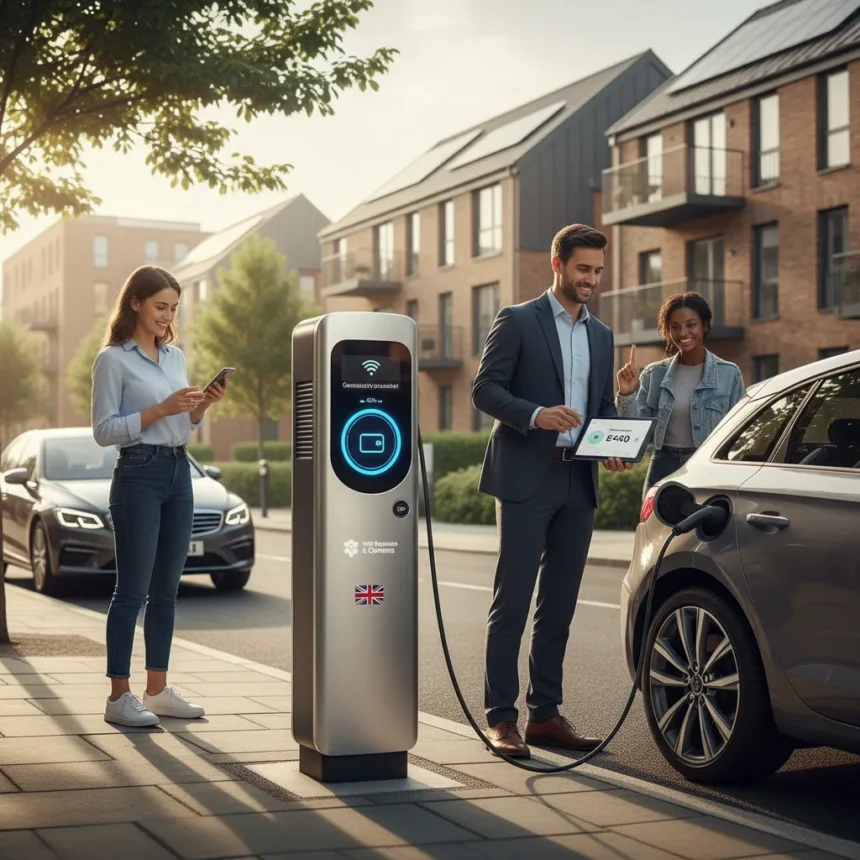
UK EV charging regulations have undergone a major overhaul designed to remove friction from the charging experience and tackle one of the biggest obstacles to EV adoption: the inability to charge at home. For millions without off-street parking, these changes could be transformative.
Key Takeaways
- Public chargers >8kW must accept contactless payments (debit, credit, Apple Pay, Google Pay) from November 2024
- Chargers >50kW must maintain 99% uptime; others 95%, with fines up to £10,000 for breaches
- EV owners earning £40,000–£50,000 save £440 annually on vehicle tax
- New homes with parking must include EV chargepoints or cable routes under Building Regulations Part S
- Smart chargers default to off-peak charging outside 8–11am and 4–10pm on weekdays
What changed in UK EV charging regulations
The UK government introduced sweeping changes to public EV charger standards effective 24 November 2024, targeting two critical pain points: accessibility and reliability. Any public charger with output above 8kW must now accept contactless payments—debit cards, credit cards, Apple Pay, and Google Pay. This single requirement eliminates a major frustration: arriving at a charger only to find it demands a specific app or payment method you don’t have.
The reliability mandate is equally significant. Chargers rated above 50kW must maintain 99% uptime; smaller chargers must hit 95%. Operators who fail face fines up to £10,000, giving the government real enforcement teeth. Real-time availability data is now mandatory, meaning drivers can trust that a charger showing as available is actually working. By June and December 2025, public chargers must standardize pricing by kilowatt-hour rather than by session or minute, and show estimated costs before charging begins.
How UK EV charging regulations address the driveway problem
One in three UK households lack off-street parking. For those living in flats, terraced houses, or on streets without driveways, home charging has been nearly impossible. Building Regulations Part S, introduced in June 2022, now requires new homes with parking spaces to include EV chargepoints or at minimum install cable routes ready for future installation. This applies to major renovations involving more than 10 parking spaces and non-residential buildings as well.

Smart charging regulations, active since 30 June 2022, mandate that new private chargepoints in homes and workplaces default to off-peak charging outside peak hours (8–11am and 4–10pm on weekdays), reducing grid strain while keeping costs down. Users can override this via app if needed, balancing convenience with grid stability. These rules apply across Great Britain and work alongside the public charger standards to create a more cohesive charging ecosystem.
Tax breaks reshape EV affordability
Beyond regulatory changes, the government raised the Vehicle Excise Duty (VED) Expensive Car Supplement threshold for new EVs from £40,000 to £50,000. This single change saves over one million EV drivers £440 per year. For a buyer choosing between an EV and a petrol car, that’s a meaningful annual incentive that compounds over the vehicle’s ownership period.



The government also committed an additional £100 million toward public chargepoints, building on £400 million in prior funding. This money targets home and workplace installations, plus £100 million for local authority training and infrastructure development. The cumulative effect—lower purchase taxes, easier home charging, and more reliable public infrastructure—removes multiple barriers to EV adoption simultaneously.
Why compliance matters for drivers
These regulations transform the charger experience from a lottery into a guaranteed standard. Before November 2024, a driver might arrive at a charger only to discover it was offline, accepted only one payment method, or displayed no pricing information. Now, operators face financial penalties for failures, shifting accountability away from drivers. The contactless payment requirement alone eliminates the app fatigue that has plagued EV ownership—no more juggling five different charger apps.
For renters and flat dwellers, the Building Regulations Part S requirement creates a pathway to home charging that didn’t exist before. While existing buildings are exempt, new construction and major renovations now must accommodate EV charging infrastructure. Over time, this regulatory shift will reshape the rental and flat-dwelling landscape, making EV ownership viable for demographics previously locked out of the market.
How does UK EV charging compare to other countries?
The UK’s focus on payment standardization and uptime guarantees mirrors approaches in other European markets, though the specific penalties and thresholds vary. By mandating contactless payments and real-time availability data, the UK is prioritizing user experience over proprietary networks—a lesson learned from years of fragmented charger ecosystems.



When do these UK EV charging regulations take effect?
The public charger payment and reliability rules came into force on 24 November 2024. Building Regulations Part S and smart charging defaults have been in effect since June 2022. The pricing standardization and cost-display requirements roll out by June and December 2025. The VED threshold change is already in effect, meaning eligible EV buyers can claim the £440 annual saving immediately.
Do I need to upgrade my home charger under these rules?
If you already own a home charger, these regulations do not require you to replace it. The smart charging defaults (off-peak charging outside 8–11am and 4–10pm weekdays) apply to new chargers installed from June 2022 onward, but existing chargers are grandfathered in. However, if you’re installing a new charger, it must comply with smart charging defaults unless you override via app.
Will these regulations reduce my EV charging costs?
Potentially. The off-peak charging defaults reduce electricity costs by shifting usage to cheaper hours. Standardized per-kWh pricing on public chargers eliminates surprise session or minute-based fees, making costs more predictable. Combined with the £440 annual VED saving for eligible vehicles, total ownership costs drop measurably. However, electricity rates themselves are set by suppliers, not regulators, so savings depend partly on your local grid’s pricing structure.
UK EV charging regulations mark a fundamental shift from fragmentation to standardization. By mandating payment flexibility, uptime guarantees, and transparent pricing, the government has removed friction that once made EV ownership feel risky. For the millions without driveways, Building Regulations now guarantee that new homes will have charging infrastructure ready. These changes won’t solve every barrier to EV adoption—grid capacity and upfront purchase costs remain challenges—but they eliminate the arbitrary obstacles that turned drivers away before. The real test comes next: whether operators comply consistently and whether the infrastructure keeps pace with demand.
Edited by the All Things Geek team.
Source: TechRadar