




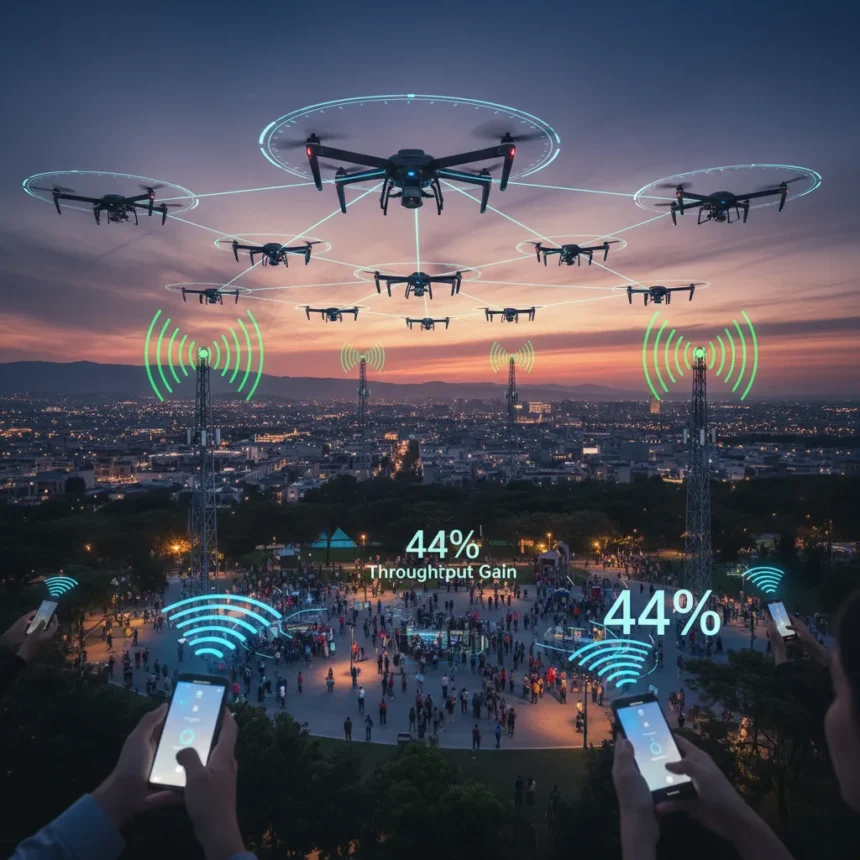
Drone networks for cell coverage represent a fundamental shift in how we might extend mobile signal to underserved areas, disaster zones, and congested urban hotspots. Researchers at the University of Illinois at Urbana-Champaign developed DroneNet, a system where drones equipped with WiFi interfaces and LTE/5G backhaul links fly to create on-demand networks in targeted regions, complementing traditional cell towers rather than replacing them.
Key Takeaways
- DroneNet prototype showed 44% throughput gain over static full-region scans using only 10% measurement overhead
- Drones at 30-60m heights achieved 16-18dB SNR gains, enabling dynamic network extension
- System targets unpredictable coverage gaps: traffic hotspots, poor signal zones, and natural disaster areas
- Early tests used 7 clients on a university campus; real-world scaling and deployment timelines remain unproven
- Ray-tracing simulations at 15m, 30m, and 45m altitudes guided drone positioning for optimal coverage
How Drone Networks for Cell Coverage Actually Work
The drone networks concept operates like a flying cellular relay. A drone hovers at a calculated position, establishes WiFi links to nearby clients, and maintains a backhaul connection to the cellular network via 4G or LTE. The system selects optimal hover positions by performing limited wireless scans—just 10% measurement overhead—then correlates those readings with ray-tracing models to predict signal strength at different altitudes. This efficiency matters because drones have finite battery life and cannot scan every possible location.
Early prototype tests on the UIUC campus demonstrated the concept’s potential. With seven scattered clients, the system achieved a 44% throughput improvement over full-region scans by intelligently positioning drones rather than blanket coverage. The SNR gains of 16-18dB at heights between 30m and 60m translated directly to usable bandwidth improvements. These numbers come from controlled ray-tracing simulations validated against real measurements, not field deployments at scale.
Why Drone Networks Matter for Cell Coverage Right Now
Traditional cell towers are static. They sit in one location, covering a fixed radius, unable to adapt when demand spikes or infrastructure fails. Drone networks for cell coverage solve this by introducing mobility and on-demand deployment. During a music festival, a natural disaster, or a sudden traffic jam, drones could launch within minutes to provide temporary network relief. The analogy used by researchers is apt: just as fire engines respond to emergencies, drones respond to network emergencies.


The broader context matters here. As smartphones become central to emergency response, logistics, and daily life, coverage gaps are no longer minor inconveniences—they are infrastructure failures. Drones offer a dynamic layer that traditional towers cannot provide, especially in rural areas where tower deployment is economically unfeasible or in disaster zones where existing infrastructure is damaged.
What Sets Drone Networks Apart From Traditional Cell Towers
Cell towers are optimized for permanent, wide-area coverage. Drone networks for cell coverage excel at temporary, targeted deployment. A tower serves hundreds of thousands of people continuously; a drone swarm serves dozens in a specific location for hours. This is not a replacement scenario—it is a complementary one. Towers provide the backbone; drones handle the exceptions.



The measurement efficiency is also distinct. Rather than requiring exhaustive site surveys before deployment, drones use ray-tracing correlation to predict optimal positions with minimal on-site scanning. This means a drone could theoretically be dispatched and positioned within a single battery cycle, whereas traditional tower placement requires months of planning and permitting.
The Real Limitations of Current Drone Network Research
The UIUC prototype tested seven clients on a university campus—a controlled environment far removed from real-world chaos. Urban canyons, interference from competing networks, moving targets, and battery constraints all remain unresolved challenges. The ray-tracing models assume correlations between simulations and real measurements that may not hold consistently across diverse environments, weather conditions, and building materials.
Commercial deployment timelines are also unclear. The research was presented at HotMobile 2017—over a decade ago—yet no commercial drone network systems exist today for emergency or temporary cellular coverage. Regulatory barriers, spectrum allocation, safety protocols, and economic viability remain largely unanswered. A drone swarm sounds impressive; actually coordinating dozens of autonomous aircraft while maintaining network links is an engineering problem of a different magnitude.
Could Drone Networks Replace Cell Towers Eventually?
No. Drones cannot provide the persistent, wide-area coverage that towers deliver. Battery life, weather constraints, and regulatory airspace limits make drones unsuitable for continuous service. What they can do is fill gaps—literally and temporally. A drone network system makes sense for disaster response, event coverage, or rural areas awaiting permanent infrastructure. It is a supplement, not a successor.



When might drone networks for cell coverage actually launch?
The UIUC research dates to 2017, and no commercial systems have emerged. Regulatory approval for autonomous drone operations, spectrum allocation for backhaul links, and cost-effectiveness analysis remain unresolved. If development accelerates, pilot programs might appear in the next 3-5 years, but widespread deployment is likely a decade away at minimum.
How do drone networks compare to satellite internet for coverage?
Satellite internet (like Starlink) provides global coverage with no infrastructure cost but suffers from latency and weather interference. Drone networks offer lower latency and higher capacity in targeted zones but require active deployment and coordination. They serve different use cases: satellites handle remote areas; drones handle temporary hotspots and disasters.
Drone networks for cell coverage represent a genuinely interesting idea that solves a real problem—dynamic network extension—but the path from prototype to deployment remains murky. Early results are promising, the engineering is sound, and the use cases are clear. What is missing is the will (and funding) to navigate regulatory approval, spectrum allocation, and economic viability. Until those barriers fall, expect drones to remain a research curiosity rather than a standard tool in the telecom toolkit.
This article was written with AI assistance and editorially reviewed.
Source: TechRadar