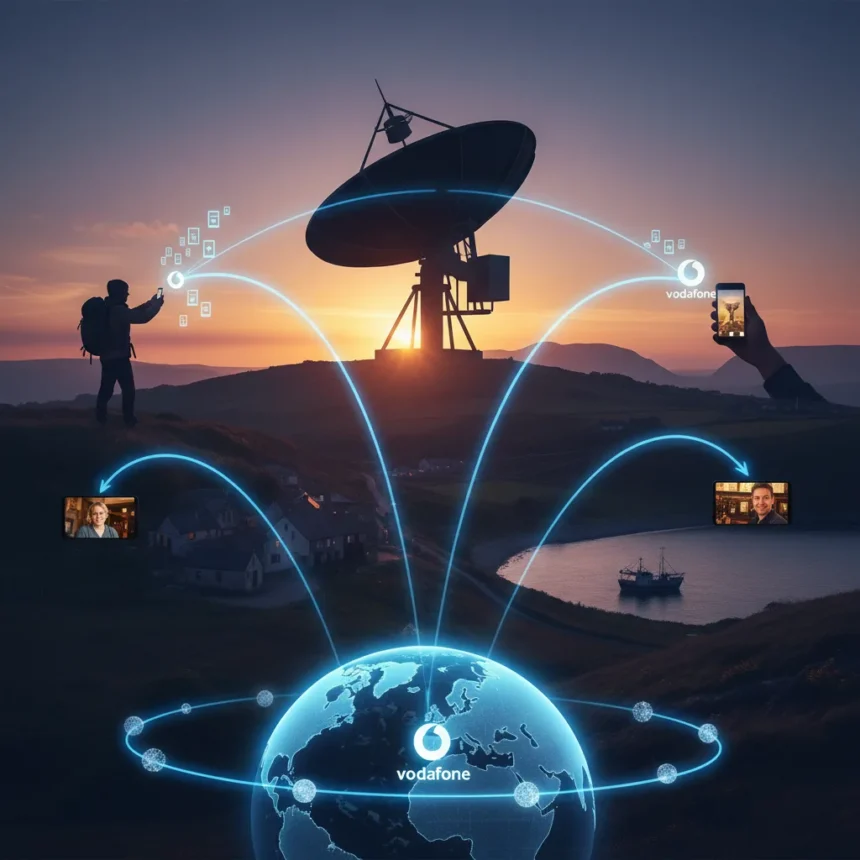
VodafoneThree satellite connectivity just became real. On April 15, 2026, Ofcom approved VodafoneThree’s request to amend its 900 MHz spectrum licence and offer direct-to-device (D2D) satellite services to standard 4G and 5G smartphones across the UK. This is not a distant possibility—it is regulatory approval, and trials start this summer.
Key Takeaways
- Ofcom approved VodafoneThree’s spectrum licence amendment on April 15, 2026, enabling satellite direct-to-device services.
- VodafoneThree is the second UK operator approved for D2D satellite; O2 launched its satellite service earlier in 2026.
- Satellites will beam calls, texts, data, and mobile broadband directly to phones in remote areas without ground mast coverage.
- Customer trials of VodafoneThree satellite connectivity begin summer 2026, building on a January 2025 video call milestone.
- Partner Satellite Connect Europe (Vodafone Group and AST SpaceMobile joint venture) will deploy five ground stations across Europe.
What VodafoneThree Satellite Connectivity Actually Changes
The approval removes a critical barrier. Until now, UK operators could not legally use satellites to send signals directly to consumer phones. Ofcom’s decision changes that. VodafoneThree can now use satellites to reach smartphones in dead zones—places where terrestrial mobile masts simply do not exist or are economically unfeasible to build. This is not about faster data in cities. This is about reaching hikers, farmers, and remote communities who currently have zero coverage.
The technology itself is straightforward: satellites in orbit beam signals directly to standard smartphones without requiring special hardware or modifications. Users make calls, send texts, and access mobile broadband as if they were on a normal cellular network. The difference is the signal comes from space, not from a ground mast. For VodafoneThree, this represents a genuine expansion of service territory.
How VodafoneThree Compares to O2’s Earlier Launch
VodafoneThree is not the first UK operator to win this approval. O2 (Virgin Media O2) got there first, receiving clearance to use the 1800 MHz band and launching its O2 Satellite service earlier in 2026 using SpaceX Starlink technology. That head start matters. O2 customers in remote areas can already access 4G data via satellite. VodafoneThree is playing catch-up, but with a different technical approach through its Satellite Connect Europe partnership.


According to Ofcom’s statement, VodafoneThree’s technology is positioned to offer direct-to-device satellite connectivity capable of data, voice, and SMS. The operator claims its approach delivers superior coverage compared to alternatives, though the practical differences between the two services remain to be tested in real-world deployments. Both operators are solving the same problem—coverage in no-signal zones—but using different satellite networks and frequency bands.
Timeline and What Comes Next
Regulatory approval is one thing. Actual service is another. VodafoneThree has announced customer trials beginning in summer 2026. These trials will test the technology in real UK conditions and measure reliability, call quality, and data speeds. The company is building on momentum from January 2025, when it achieved the first video call over satellite in a no-coverage area.



The infrastructure is being built now. Satellite Connect Europe, the joint venture between Vodafone Group and AST SpaceMobile, plans to deploy five ground stations across Europe. These ground stations are critical—they connect the satellite network to terrestrial infrastructure and route calls and data to their destinations. The UK is the first market for this partnership, but the European footprint suggests expansion plans beyond British borders.
The Regulatory Hurdle That Remains
Ofcom still has work to do. The approval of VodafoneThree’s spectrum licence is one piece. The regulator must also update its handset regulations through a public consultation process to formally accommodate direct-to-device satellite services. This is procedural but necessary—without updated regulations, manufacturers and operators cannot officially support D2D features in devices sold in the UK.
That consultation is coming, but no date has been announced. Once complete, it removes the final legal barrier to widespread deployment. Until then, the trials proceed under current approvals, testing the technology before full commercial launch.
Why This Matters Now
Rural connectivity is a persistent problem across the UK and Europe. Mobile operators have historically avoided remote areas because the cost of building ground infrastructure exceeds revenue from sparse populations. Satellite direct-to-device flips that economics. Instead of building masts, operators lease capacity from satellite networks and pass the signal directly to phones. For VodafoneThree, this is a way to offer service in places it could never profitably reach before.



The approval also signals a shift in how regulators think about spectrum and coverage. Ofcom is explicitly enabling satellite technology as a tool for closing coverage gaps. This is not a niche use case—it is policy. Both O2 and VodafoneThree moving forward suggests this is becoming standard practice in UK mobile infrastructure.
Will VodafoneThree satellite connectivity work in practice?
That is the summer 2026 trial question. Direct-to-device satellite technology works in lab conditions, but real-world performance depends on weather, terrain, and antenna design. VodafoneThree’s trials will measure call completion rates, data speeds, and user experience in actual remote UK locations. Early results from O2’s service will also inform expectations.
When will VodafoneThree satellite service launch commercially?
No commercial launch date has been announced. Customer trials begin summer 2026, which typically means June through August. A full rollout likely follows in late 2026 or 2027, pending successful trial results and completion of Ofcom’s handset regulation consultation.
Do I need a new phone for VodafoneThree satellite connectivity?
Standard 4G and 5G smartphones will support the service without modification, according to VodafoneThree’s specifications. However, device manufacturers may need to enable D2D features in software updates once Ofcom’s handset regulations are finalized. Existing phones may receive this capability through updates; newer devices will have it built in from the factory.
VodafoneThree satellite connectivity represents a genuine shift in how UK operators will serve remote areas. Regulatory approval is locked in, trials are imminent, and the infrastructure is being deployed. This is not speculative—it is happening this year. For anyone living or working in a coverage dead zone, summer 2026 trials will be worth watching.
Edited by the All Things Geek team.
Source: TechRadar