


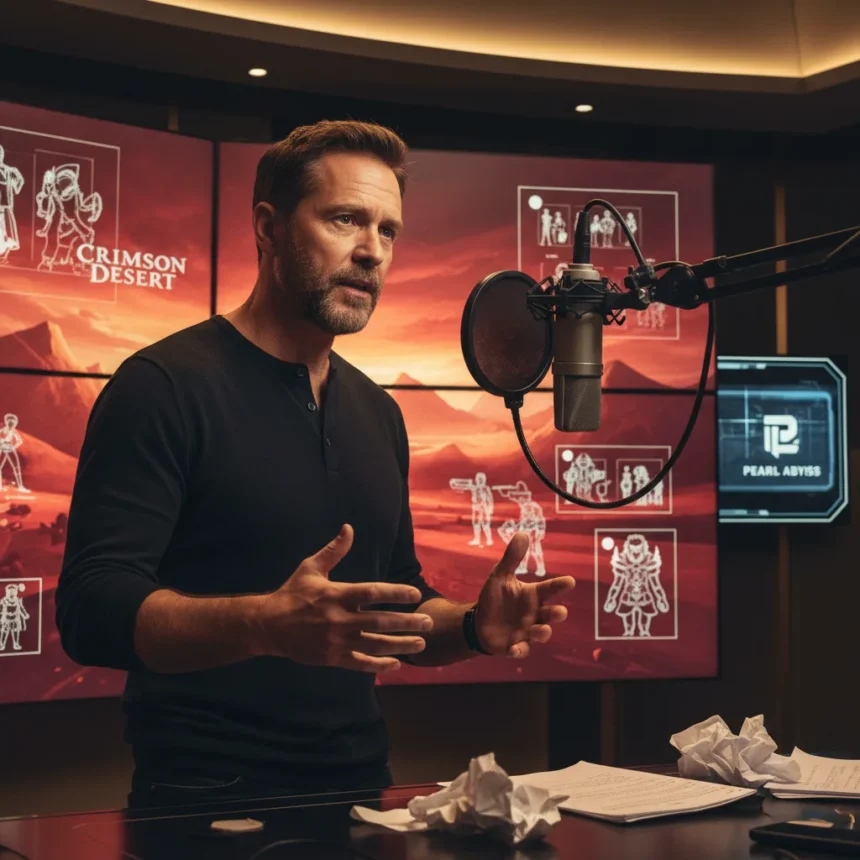
Alec Newman, voice actor for Crimson Desert’s protagonist Kliff, has exposed significant turbulence in the game’s Crimson Desert story development, describing years of script instability that forced him to repeatedly push developer Pearl Abyss for narrative coherence. Newman’s candid account, shared on the Friends Per Second podcast, reveals the kind of behind-the-scenes friction that rarely surfaces in official developer statements—and it raises real questions about what players should expect from a game that has spent so long in production limbo.
Key Takeaways
- Alec Newman voiced Crimson Desert protagonist Kliff through years of major character and story rewrites
- The game’s narrative focus kept shifting throughout development, creating script instability
- Newman repeatedly pressured Pearl Abyss for clarity on story direction and character motivation
- Development involved an “ever-changing script” that tested the actor’s commitment to the role
- Newman’s insider account signals potential challenges for the final game’s narrative cohesion
An Actor Fighting for Story Clarity in Crimson Desert Story Development
Newman didn’t mince words about the chaos. He described relentlessly pushing Pearl Abyss on narrative fundamentals, saying “I just kept pushing and pushing and pushing about story and character as much as I could”. For a voice actor, this is extraordinary—most actors record their lines and move on. Newman’s willingness to become an advocate for the script itself suggests the original direction was either unclear or actively problematic enough that he felt obligated to intervene. That kind of friction rarely happens unless something is seriously wrong.
The core issue was directional instability. “They kept moving the focus,” Newman explained, describing a development cycle where the narrative’s central themes and character arcs shifted repeatedly. In a game with a protagonist as central as Kliff, constant rewrites don’t just mean new dialogue—they mean the actor has to rebuild the character’s emotional foundation repeatedly. Each rewrite potentially contradicts the motivation Newman established in previous recording sessions, forcing him to either adapt on the fly or demand clarity before proceeding.
What Crimson Desert Story Development Reveals About Long-in-Development Games
Crimson Desert’s troubled narrative trajectory isn’t unique, but it is telling. Games that spend years in development often face scope creep, leadership changes, or shifting market expectations that force rewrites. However, most developers keep these struggles internal. Pearl Abyss’ willingness to let Newman speak publicly about the chaos—or perhaps their inability to prevent it—suggests confidence that the final product justifies the mess, or resignation that the story is already public knowledge among gaming communities watching the game’s glacial progress.



The real risk isn’t that Crimson Desert will have a bad story. It’s that the narrative will feel disjointed, with character motivations that don’t quite align or thematic threads that don’t connect. A protagonist rewritten a dozen times across five years of development is unlikely to feel as cohesive as a character designed once and refined iteratively. Newman’s repeated interventions may have prevented outright incoherence, but they also suggest the game’s story was never stable enough to trust without constant external pressure.
Why This Matters for Player Expectations
Gamers investing time in Crimson Desert should enter with realistic expectations about narrative. Pearl Abyss has a strong track record with systems design—Black Desert Online’s combat and progression remain industry benchmarks—but storytelling has never been the studio’s signature strength. A protagonist who underwent major character shifts during development, guided primarily by an external voice actor’s advocacy rather than a unified creative vision, is a red flag for narrative ambition.



This doesn’t mean Crimson Desert will fail as a game. Action and exploration can carry a title even when the story stumbles. But it does mean players shouldn’t expect the kind of narrative depth that justifies years of development hell. Newman’s account suggests the story was a secondary concern for much of production, only becoming a priority when the actor himself demanded attention.
Did Crimson Desert’s story improve after Newman pushed for clarity?
Newman’s comments don’t directly confirm whether his advocacy improved the final narrative. However, his willingness to speak publicly suggests he reached a point where he felt the story was coherent enough to defend—or at least stable enough to stop fighting about. The fact that he kept pushing indicates the rewrites continued until late in development.
How does Crimson Desert compare to other long-in-development games?
Games like Cyberpunk 2077 and Final Fantasy XV both suffered from extended development cycles and narrative instability, though neither faced the same level of public actor commentary. Crimson Desert’s transparency—accidental or intentional—offers a rare window into how protagonist-driven narratives can fracture under production pressure, something most studios prefer to keep behind closed doors.
What does Newman’s account tell us about Pearl Abyss as a developer?
Pearl Abyss excels at building systems and worlds, but Newman’s experience reveals a studio that may struggle with narrative direction and character development. The need for external pressure from a voice actor to establish story clarity suggests the studio either lacks a strong narrative lead or prioritizes other aspects of development over story coherence.



Alec Newman’s insider account is a rare gift to players—a transparent look at what happens when a game stays in development for years without a locked narrative vision. Crimson Desert may still deliver a compelling experience, but it will likely succeed despite its troubled story development, not because of it. Players should approach the narrative with tempered expectations and focus instead on what Pearl Abyss has historically done well: building engaging systems and immersive worlds.
Edited by the All Things Geek team.
Source: TechRadar