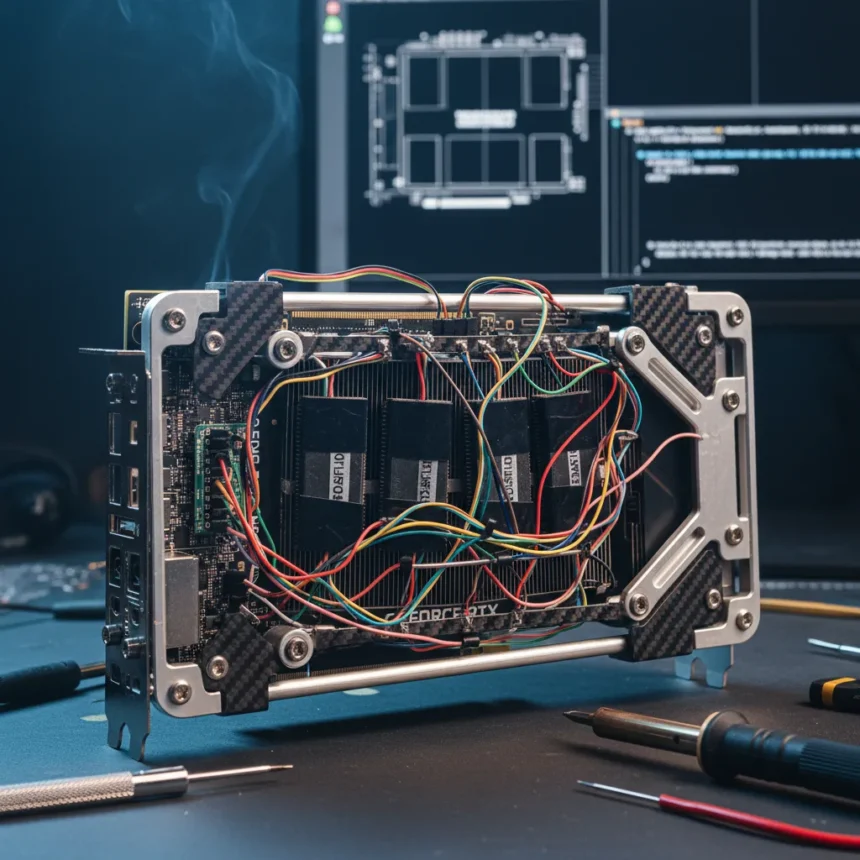
RTX 4090 PCB sagging is killing expensive GPUs, but modders just proved that even terminal damage doesn’t have to mean the trash bin. A YouTuber recently documented the resurrection of a severely bent RTX 4090 using nothing more than jumper wires, electrical bypassing, and a custom BIOS modification that disabled one entire memory channel.
Key Takeaways
- Modders repaired a damaged RTX 4090 using jumper wires to bypass broken PCB traces caused by sagging.
- Custom BIOS flashing disabled 4GB of VRAM, reducing the card from 24GB to 20GB but restoring functionality.
- The RTX 4090 uses an AD102 GPU core with 12 GDDR6X memory chips totaling 24GB originally.
- Repair demonstrates extreme feasibility for high-end GPUs despite severe physical damage.
- Contrasts sharply with VRAM upgrade mods that add capacity but carry bricking and warranty risks.
How RTX 4090 PCB sagging Destroys Hardware
The RTX 4090’s massive cooler and dense power delivery create mechanical stress that causes the PCB to sag over time. This bending breaks electrical traces—the tiny copper pathways that carry signals between the GPU core and memory chips. When traces snap, data cannot flow, and the card becomes unusable. Most owners would replace it. The modders in this case took a different approach.
The damage was severe enough that the card was headed for disposal. The bent PCB had severed connections critical to memory operation, making standard repairs impossible without replacing the entire board. Yet the GPU core itself remained intact, and most of the memory chips were still functional. That realization sparked the repair attempt.
Jumper Wires and Custom BIOS: The Resurrection Method
The repair leveraged two techniques working in tandem. First, modders soldered jumper wires directly onto the PCB to bypass the broken traces, physically rerouting electrical signals around the damage. This restored basic connectivity but revealed a second problem: some memory channels were still compromised and unstable.


Rather than attempt further hardware surgery, the team flashed a custom BIOS that disabled one entire memory channel, effectively turning off 4GB of the card’s 24GB capacity. The RTX 4090 originally ships with 12 GDDR6X memory chips, each contributing 2GB. By disabling one channel, half of those chips were taken offline. The result: a stable, functional 20GB card instead of a broken 24GB brick.
This sacrifice of capacity for stability is the key insight. The modders recognized that a working GPU with reduced VRAM beats a non-working GPU with full specs. Most gamers and creators would accept that trade-off if it meant keeping a card worth over a thousand dollars in operation.



RTX 4090 PCB sagging repair versus VRAM upgrade mods
The repair story gains context when compared to the opposite end of the modding spectrum: VRAM upgrades. Some modders have attempted to add capacity to RTX 4090s and RTX 3090s by desoldering the GPU core, reballing it, and adding extra GDDR6X chips to the PCB—expanding 24GB cards to 48GB or more. These upgrades are far riskier than the sagging repair.
Upgrade mods require removing and replacing the GPU itself, a process that risks cold solder joints and permanent damage. They also require flashing modified BIOS files that may break with driver updates, leaving the card bricked and unusable. Warranty is voided entirely. The payoff is extra VRAM for AI inference tasks, where some modders have achieved around 18 tokens per second on large language models like Deepseek R1-70B-Q4. But that performance gain comes with significant risk and no safety net.
The sagging repair, by contrast, uses low-cost jumper wires and a targeted BIOS hack to restore a card that would otherwise be worthless. It sacrifices capacity but preserves the core functionality and avoids the desoldering risk that upgrade mods carry. For owners facing a sagging RTX 4090, this approach is far more conservative and practical.
Why RTX 4090 PCB sagging matters to the modding community
PCB sagging is a known failure mode for high-end GPUs, especially cards with massive coolers and high power consumption. The RTX 4090 is particularly vulnerable because of its size and weight. Modders have long been exploring ways to extend the life of expensive hardware, and this repair demonstrates that even severe damage can be partially overcome with ingenuity and precision soldering.



The success also highlights the gap between consumer expectations and hardware durability. Nvidia’s warranty does not cover sagging damage, treating it as a user responsibility despite it being a design flaw inherent to the card’s architecture. Modders filling this gap—whether through repairs or upgrades—are essentially engineering solutions that manufacturers should have built in from the start.
Could you use this repair method on your own RTX 4090?
The jumper wire and custom BIOS approach requires advanced soldering skills and access to BIOS modification tools. This is not a consumer-friendly fix. Attempting it without proper equipment and expertise will likely destroy the card further. If your RTX 4090 is sagging, contact Nvidia support first, though warranty coverage for sagging is limited or nonexistent.
Is RTX 4090 PCB sagging a widespread problem?
PCB sagging affects high-end GPUs broadly, not just the RTX 4090. The issue is driven by the weight of large coolers and the lack of structural support in the PCB design. Nvidia has not issued a recall or design revision, treating sagging as an environmental or user-installation issue rather than a manufacturing defect. This repair proves that even when sagging occurs, the card is not necessarily beyond recovery.
What does the future hold for GPU durability?
This repair story underscores a hard truth: premium GPUs are not built to last. A card costing over a thousand dollars should not fail from its own weight, yet the RTX 4090 does. Modders are stepping into the role manufacturers abandoned, proving that with enough skill and determination, even terminal hardware damage can be partially reversed. That should not be necessary, but until GPU makers redesign their coolers and PCBs for long-term durability, modders will keep finding creative workarounds.
The resurrected RTX 4090 is a testament to both the ingenuity of the modding community and the inadequacy of modern GPU engineering. It runs at 20GB instead of 24GB, but it runs. That is worth far more than a dead card gathering dust.
Edited by the All Things Geek team.
Source: Tom's Hardware