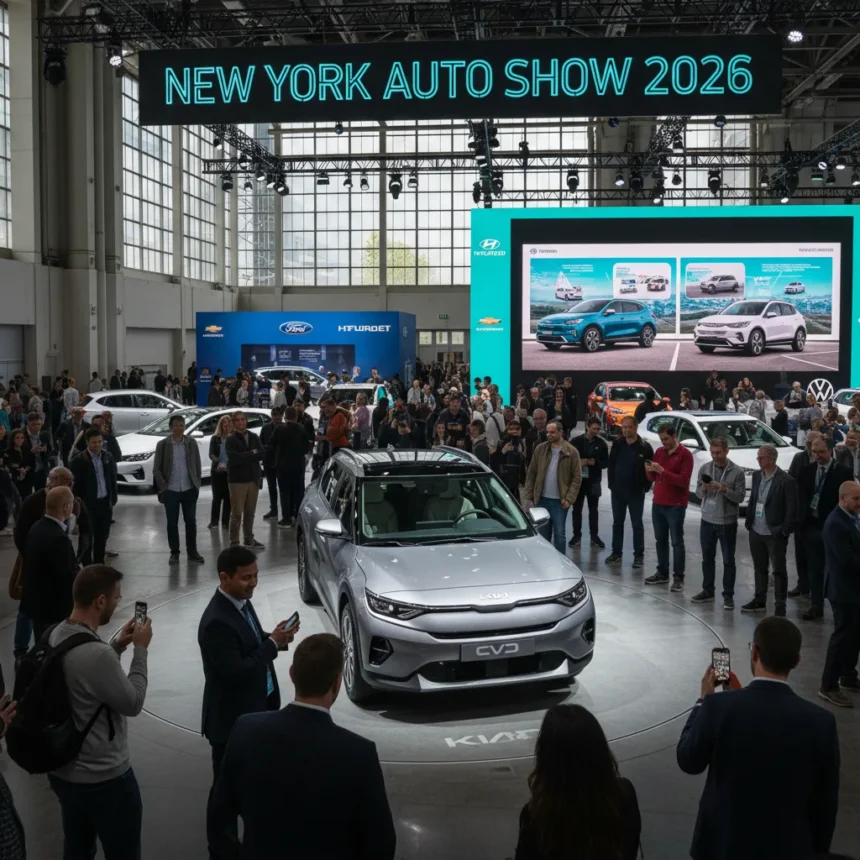
The electric vehicles market 2026 is not contracting—it is accelerating. At the New York International Auto Show running April 3-12, 2026, at the Javits Center in Manhattan, the narrative of EV decline collided with hard evidence of momentum. The show’s expanded Multi-Brand EV Test Track featured one-third more vehicles than 2025, including offerings from Cadillac, Chevrolet, Dodge, Ford, Jeep, Kia, Nissan, Toyota, and Volkswagen. This is not a niche segment anymore. This is the mainstream.
Key Takeaways
- New York Auto Show 2026 expanded EV test track by one-third, showcasing 9+ major brands with electric and plug-in hybrid options
- Kia EV3 delivers 320+ miles range in an affordable, compact package designed to compete with incoming cheap Chinese EVs
- Three-row electric SUVs from Subaru and Toyota signal the market is moving beyond compact cars to family-sized vehicles
- Toyota expanding hybrid lineup to 18 models by 2030 while adding extended-range EVs to reduce range anxiety
- Hyundai Boulder Concept previews an off-road electric truck before 2030, targeting adventure-focused buyers
Why the Kia EV3 is the show’s real story
The Kia EV3 emerged as the most important EV at the show, and for good reason. This compact SUV delivers nearly 500 kilometers (over 320 miles) of range while staying small enough and affordable enough to compete directly with the wave of cheap Chinese EVs entering global markets. The EV3 comes in multiple battery configurations and with front-wheel or all-wheel drive options, giving buyers real choice at a price point that matters. In Canada, where rising gas prices are reshaping buyer priorities, the EV3 represents the exact vehicle size and price segment that consumers are actively seeking. It is not a niche luxury play. It is a volume-segment answer to a real market demand.
The electric vehicles market 2026 is being reshaped by affordability and practicality, not by premium positioning. With gas prices climbing, manufacturers are finally shipping the small, efficient EVs that buyers actually want to own. The Kia EV3 is not the flashiest car at the show. It is the most strategically important one.
Electric vehicles market 2026 is expanding beyond compact cars
Subaru and Toyota are both launching three-row electric SUVs, signaling that the EV market is moving into family-vehicle territory. The 2027 Subaru Getaway delivers 420 horsepower, standard all-wheel drive, and over 300 miles of range in a configuration designed for families. It shares a platform with the Toyota Highlander EV, but Subaru’s version comes better equipped. Toyota is not stopping there. The company is expanding its hybrid lineup to 18 models by 2030 while simultaneously adding extended-range EVs that promise an EV-like daily driving experience without range anxiety. This dual strategy—hybrids for traditionalists, extended-range EVs for pragmatists—shows how seriously Toyota is hedging its bets across the entire electrification spectrum.

The Cadillac VISTIQ, OPTIQ, and Escalade IQ round out the luxury EV offerings, each pairing advanced technology with refined craftsmanship and powerful performance. These vehicles are not experiments. They are production models backed by major manufacturer commitments.
Off-road concepts signal where the EV market is heading
Hyundai’s Boulder Concept is a body-on-frame off-road truck and SUV with 37-inch tires, previewing an electric pickup truck before 2030. The Jeep Wagoneer S EV brings rugged off-road performance and premium interiors to the electric segment. These are not mall-crawler concepts. They are serious attempts to prove that electric powertrains can handle the same terrain and towing demands that gas-powered trucks have owned for decades. The message is clear: if you want an EV truck that can actually go off-road, the industry is building one.



Volkswagen’s ID. Buzz—an all-electric van with spacious seating and advanced connectivity—targets the adventure and family-van segment. Kia’s PV5, already on sale in South Korea and Europe and bound for Canada, is offered as a wheelchair-accessible taxi concept at the show. The electric vehicles market 2026 is not just about sedans and compact SUVs anymore. It is about every vehicle category.
What this show reveals about the real EV market
The perception of EV decline was always a narrative built on specific data points: slower growth in certain quarters, inventory challenges, early-adopter saturation in premium segments. What the New York Auto Show 2026 demonstrates is that the market is not shrinking—it is maturing. The affordable, practical vehicles that were missing from showrooms two years ago are now arriving in volume. The test track expansion, the number of brands committing resources, and the diversity of vehicle types on display are not the actions of an industry in retreat.
Manufacturers are not launching electric vehicles because they have to meet regulations. They are launching them because the cost curves have finally aligned with consumer demand. Gas prices are rising. Battery costs are falling. The economics now favor electrification across price segments that matter to mass-market buyers.
Is the EV market really recovering, or is this just hype?
The New York Auto Show 2026 is a snapshot of what manufacturers have committed to building and selling, not a prediction of future sales. However, the sheer number of affordable options on the test track—the Kia EV3, the Subaru Getaway, the Toyota extended-range EVs—suggests that the supply side has finally caught up with what buyers have been asking for. The electric vehicles market 2026 is not proving that EVs have won. It is proving that they have become normal.



What does the Kia EV3’s focus on affordability mean for the broader EV market?
The Kia EV3’s emphasis on small size and affordable pricing signals that manufacturers now see the mass market as the growth opportunity, not the premium segment. This shift from luxury EVs to volume EVs is the real story of 2026. When Kia positions the EV3 as a direct competitor to incoming cheap Chinese EVs, the company is signaling confidence that it can compete on price and value, not just on brand prestige.
Why is Toyota adding extended-range EVs instead of going all-in on battery electric vehicles?
Toyota’s strategy of expanding hybrids to 18 models while adding extended-range EVs reflects the company’s belief that no single powertrain will dominate the next decade. Extended-range EVs deliver electric driving for daily commutes with a gas engine backup for long trips, eliminating range anxiety without requiring the charging infrastructure that full battery EVs demand. This is pragmatism, not hedging. Toyota is betting that customers want choices, and the company is building them.
The New York Auto Show 2026 did not prove that EVs are perfect or that the transition to electric power is inevitable. What it proved is that the electric vehicles market 2026 has moved beyond the early-adopter phase into the mainstream, with affordable options, diverse vehicle types, and manufacturer commitments that suggest this is not a trend—it is the direction the industry is taking. The decline narrative was always incomplete. The show made that clear.
Edited by the All Things Geek team.
Source: Tom's Guide