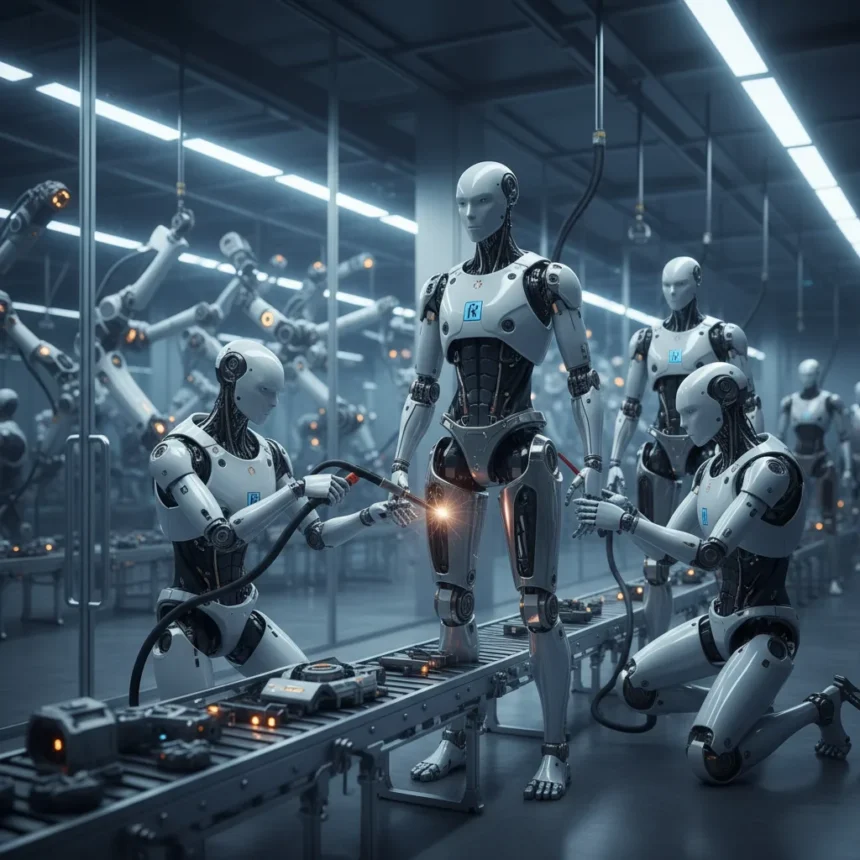
The 1X NEO humanoid robot has crossed a threshold that science fiction writers imagined but engineers struggled to achieve: robots helping manufacture other robots. A new production video from 1X Technologies shows NEO units actively assisting in factory assembly, turning the abstract concept of machine self-replication into tangible reality.
Key Takeaways
- 1X NEO robots are now assisting in their own factory production, marking a milestone in autonomous manufacturing participation.
- NEO uses a physics-grounded video-based World Model to learn tasks autonomously without prior examples.
- The 1X NEO humanoid robot pre-orders start at $20,000 USD with delivery expected in 2026.
- NEO supports full autonomy, AI companion mode, and chores mode with continuous self-improvement via data uploads.
- Early adopters will provide real-world data through tele-operation to refine the robot’s AI capabilities.
What Makes the 1X NEO Humanoid Robot Different
The 1X NEO humanoid robot represents a departure from traditional robotics development. Rather than relying on pre-programmed routines, NEO learns by visualizing future actions using a physics-grounded video model, allowing it to generalize to tasks it has never encountered before. This self-teaching capability means the robot improves continuously by generating and analyzing its own operational data, creating a feedback loop that strengthens its AI without constant human intervention.
Unlike earlier humanoid approaches that required explicit instruction for each scenario, the 1X NEO humanoid robot can assess novel environments, plan adaptive responses, and handle unexpected obstacles dynamically. The architecture combines vision-language-action modeling with reinforcement learning, enabling the robot to move through homes, avoid hazards, and adjust its approach when circumstances change. This flexibility is what allows NEO to participate in factory tasks—it observes, learns patterns, and executes without needing task-specific programming.
The Factory Footage and What It Reveals
The recent production video showing 1X NEO humanoid robots working alongside each other in assembly represents more than clever marketing. It demonstrates that the robots have reached sufficient autonomy and precision to handle real manufacturing tasks. The footage captures NEO units performing roles in their own production chain, a scenario that validates months of development in real-world conditions rather than controlled laboratory settings.



This milestone matters because it proves autonomous learning at scale. The 1X NEO humanoid robot does not simply follow predetermined paths—it adapts to the physical demands of assembly work, which requires fine motor control, spatial reasoning, and real-time problem-solving. When a robot can help build its successor, it signals that the underlying AI model has moved beyond narrow task execution into genuine adaptive behavior.
How the 1X NEO Humanoid Robot Learns and Improves
The 1X NEO humanoid robot leverages internet-scale video data refined through actual robot experience, creating a self-reinforcing learning system. By visualizing future actions with a physics-grounded video model, NEO can predict outcomes before executing them, similar to how humans mentally rehearse complex movements. This predictive capability allows the robot to generalize to entirely new situations and grow in AI capabilities as video models improve.



For early adopters, the learning process becomes collaborative. Pre-order customers will provide real-world data through tele-operation videos that train the AI models, effectively crowdsourcing the robot’s education. As users interact with their 1X NEO humanoid robots, the data flows back to 1X Technologies, refining the model for all future units. This creates a virtuous cycle: more real-world footage produces smarter models, which produce more capable robots, which generate richer training data.
1X NEO Humanoid Robot Specifications and Capabilities
The 1X NEO humanoid robot is engineered from the ground up for household environments, with safety as a foundational principle rather than an afterthought. It operates in multiple modes: full autonomy for independent task execution, AI companion mode for interactive assistance, and chores mode for specific household work like cleaning, fetching, and organizing. The robot’s safety architecture relies on continuous environmental assessment, dynamic movement adjustment, and the ability to handle unexpected scenarios without human intervention.
Pre-orders for the 1X NEO humanoid robot begin at $20,000 USD, with delivery scheduled for 2026. Interested buyers can place orders through 1X Technologies’ official channels. The company has positioned NEO as one of the first humanoid robots genuinely designed for home use, equipped with full AI software rather than tele-operated functionality.
Why This Matters Beyond the Hype
The 1X NEO humanoid robot participating in its own production is significant because it sidesteps a critical bottleneck in robotics: manufacturing scale. Human workers can only assemble so many robots before costs explode and timelines stretch. When robots assist in production, the economics shift. Faster assembly means lower per-unit costs, which makes adoption more feasible for mainstream consumers rather than just wealthy early adopters.


There is also a philosophical dimension. For decades, the robotics industry promised autonomous machines that could learn and adapt. Most delivered rigid systems that performed specific tasks in controlled environments. The 1X NEO humanoid robot’s participation in factory work suggests that the field has finally moved past that limitation—at least for certain applications. Whether this generalizes to truly flexible home robots remains an open question, but the factory footage is genuine progress.
Privacy Considerations for 1X NEO Humanoid Robot Owners
One aspect of the 1X NEO humanoid robot that warrants caution is data collection. Early adopters will allow tele-operation video uploads for model training, and company representatives may access the home through the robot’s camera to provide assistance. This raises legitimate privacy questions. Users considering the 1X NEO humanoid robot should understand that their home footage becomes part of the training dataset, and that remote human access to the robot’s sensors is possible.
1X Technologies frames this as necessary for rapid improvement, and there is logic to that argument. However, potential buyers should evaluate their comfort level with home surveillance before committing. The 1X NEO humanoid robot’s learning depends on real-world data, but that data comes from inside your living space.
FAQ
How much does the 1X NEO humanoid robot cost?
The 1X NEO humanoid robot pre-order price is $20,000 USD, with delivery expected in 2026. Orders are available through 1X Technologies’ official website.
What tasks can the 1X NEO humanoid robot perform?
The 1X NEO humanoid robot is designed for household chores including cleaning, fetching, organizing, and personalized assistance. It can also operate in full autonomy or AI companion mode, adapting to new tasks it has not encountered before through its physics-grounded learning model.
Is the 1X NEO humanoid robot available now?
The 1X NEO humanoid robot is available for pre-order now, with delivery scheduled for 2026. Early adopters will participate in real-world data collection to improve the robot’s AI capabilities.
The 1X NEO humanoid robot’s factory debut signals that the robotics industry is finally delivering on promises of genuine autonomy and adaptive learning. Whether it lives up to the hype once it reaches homes in 2026 remains to be seen, but the engineering foundation appears solid.
Edited by the All Things Geek team.
Source: TechRadar