






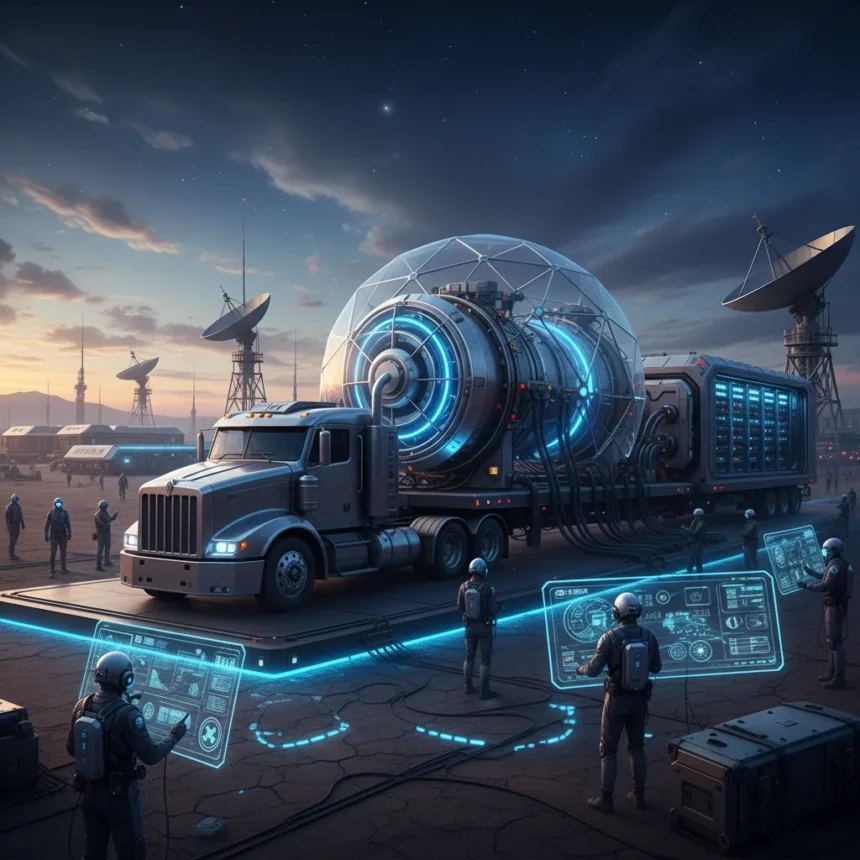
China has begun testing the world’s first truck-mounted nuclear reactor, a 10MW mobile power unit designed to sustain massive artificial intelligence data centers for decades without refueling. The prototype represents a fundamental shift in how remote and high-demand facilities could access reliable energy, potentially displacing traditional diesel and coal generators entirely. This is not a distant concept—testing is underway now, and the implications for the AI energy crisis are immediate.
Key Takeaways
- China’s truck-mounted nuclear reactor prototype generates 10 megawatts, sufficient to power a medium-sized AI data center.
- Developed by Wu Yican’s team at the Institute of Nuclear Energy Safety Technology, the unit operates for decades without refueling.
- The compact design prioritizes ultra-safety, ultra-small size, and decades-long operational lifespan without recharging.
- Positioned as a mobile alternative to stationary power sources, eliminating battery anxiety and grid dependency.
- Testing phase underway; developers describe it as a nuclear power bank for the AI era.
What Is a Truck-Mounted Nuclear Reactor?
A truck-mounted nuclear reactor is a self-contained, transportable nuclear power unit small enough to travel on a vehicle while delivering industrial-scale electricity output. Wu Yican, chief scientific adviser at the Institute of Nuclear Energy Safety Technology under the Chinese Academy of Sciences, describes the truck-mounted nuclear reactor as a new generation of nuclear energy systems with three defining characteristics: ultra-safety, ultra-small size, and ultra-long-lasting performance. The 10MW prototype can power a medium-sized artificial intelligence data center continuously for decades without requiring refueling or recharging.
This is not incremental engineering. The truck-mounted nuclear reactor fundamentally changes the economics of powering remote facilities, emergency response operations, and data centers in regions without grid access. Traditional diesel generators require constant fuel supply, produce emissions, and operate for years, not decades. The truck-mounted nuclear reactor eliminates that logistical burden entirely.
Why AI Data Centers Need This Technology Now
Artificial intelligence workloads consume staggering amounts of electricity. Data centers running large language models, training pipelines, and inference servers operate 24/7 at maximum load. Most existing facilities rely on grid power supplemented by diesel backup generators—a combination that is expensive, carbon-intensive, and vulnerable to supply chain disruptions. The truck-mounted nuclear reactor solves this by providing self-sufficient, mobile power that never needs refueling.



Wu Yican stated that the truck-mounted nuclear reactor application can free people from battery anxiety, a phrase that captures the perpetual energy insecurity facing data center operators. A facility powered by this system would not face the operational constraints of battery-dependent setups or grid blackout risk. For a data center operator, that reliability translates directly into uninterrupted service and reduced costs. The truck-mounted nuclear reactor is not theoretical—it is being tested in real-world conditions right now.
Design Philosophy and Safety Approach
The truck-mounted nuclear reactor is built on a principle Wu Yican calls ensuring nuclear safety from the source. Rather than adding safety layers after the fact, the design embeds safety into the core architecture. The unit is compact enough to transport by truck, which requires extreme engineering discipline—every component must be ruggedized, every system must be fail-safe, and the entire unit must operate with zero margin for error.



The truck-mounted nuclear reactor operates for decades without maintenance, refueling, or human intervention. This longevity is not a marketing claim; it is a fundamental design requirement. A mobile power unit that requires frequent servicing defeats the purpose of mobility. Wu Yican’s team has engineered the truck-mounted nuclear reactor to be as autonomous as possible, minimizing the need for technician visits and supply chain dependencies.
Competitive Advantage Over Traditional Power Sources
Diesel generators have dominated portable power for decades. They are cheap upfront, easy to operate, and widely understood. But they are also dirty, loud, fuel-dependent, and expensive to run continuously. A diesel generator requires constant supply shipments, produces greenhouse gas emissions, and typically operates for 5-10 years before major overhaul. The truck-mounted nuclear reactor operates for decades and produces zero emissions.
Coal plants and grid-dependent facilities face similar limitations. They require massive infrastructure investment, long permitting timelines, and transmission infrastructure that does not exist in remote regions. The truck-mounted nuclear reactor eliminates these barriers. A single unit can be transported to a site and begin operations without grid connection, environmental permitting delays, or fuel supply chains. For AI data centers expanding into regions without existing power infrastructure, this is a game-changing advantage.
Current Testing Phase and Commercial Timeline
The truck-mounted nuclear reactor prototype has moved from theoretical design into active testing. Wu Yican’s team has built what they describe as the world’s first 10-megawatt vehicle-mounted nuclear power bank engineering integrated simulation test prototype. This means the unit is being tested in controlled conditions to validate safety systems, power output, and long-term reliability before commercial deployment.



No specific commercial launch date or regional availability has been announced. The testing phase will likely run for months or years, as nuclear regulators in China and potentially other nations evaluate the design. However, the fact that testing is underway indicates the technology has moved beyond concept stage into practical engineering validation.
Is the truck-mounted nuclear reactor commercially available yet?
No. The prototype is currently in testing phase. Wu Yican’s team has completed engineering design and simulation work, and physical testing has begun, but the unit is not yet available for commercial purchase or deployment. Commercial and industrial applications are being sought as the testing phase progresses.
How long can a truck-mounted nuclear reactor operate without refueling?
The truck-mounted nuclear reactor is designed to operate for decades without refueling or recharging. This is a core design principle, not a limitation. Unlike batteries that degrade over time or diesel generators that require constant fuel replenishment, the truck-mounted nuclear reactor maintains output for extended periods, making it ideal for remote or long-term deployment scenarios.
What power output does the 10MW truck-mounted nuclear reactor provide?
The prototype generates 10 megawatts of electrical power, sufficient to sustain a medium-sized artificial intelligence data center. This output level represents a balance between portability and practical industrial application—large enough to power significant computational workloads, compact enough to transport by truck.
The truck-mounted nuclear reactor represents a genuine inflection point in portable power technology. China’s testing of this prototype signals that mobile nuclear power is moving from speculative engineering into practical validation. For data center operators, facility managers, and energy-constrained regions, the implications are substantial. A technology that eliminates refueling, operates for decades, and produces zero emissions while delivering industrial-scale power is not incremental improvement—it is disruption. Whether this specific prototype reaches commercial deployment at scale remains to be seen, but the engineering direction is clear: the future of portable power is nuclear.
This article was written with AI assistance and editorially reviewed.
Source: TechRadar