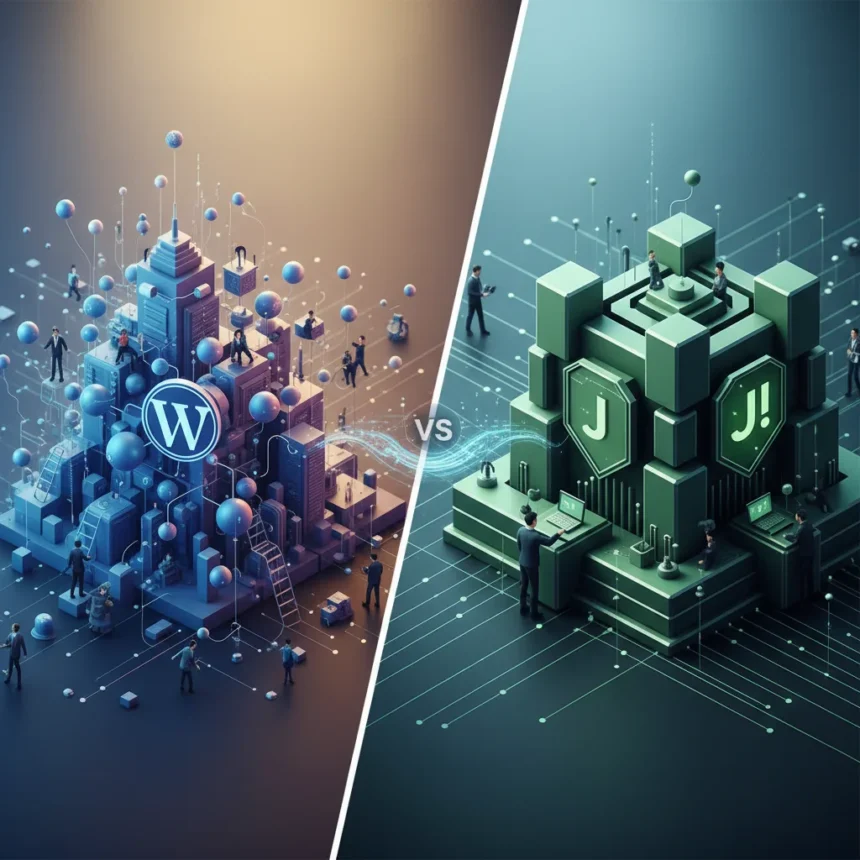
Joomla vs WordPress is a conversation that rarely happens anymore. WordPress owns roughly 43% of all websites globally, while Joomla powers roughly 3% of the web. But that market dominance doesn’t mean WordPress is the right choice for every project, and dismissing Joomla as a legacy platform misses what it actually does well.
Key Takeaways
- WordPress dominates the CMS market but isn’t universally superior for every use case
- Joomla excels at complex, multi-user environments and advanced permission systems
- WordPress has a larger plugin ecosystem; Joomla offers deeper architectural flexibility
- Migration between platforms is possible but requires careful planning and data mapping
- Choose based on project complexity and team expertise, not market share alone
Why the WordPress Monopoly Obscures Real Alternatives
WordPress became the default CMS choice because it solved a specific problem exceptionally well: letting non-technical users publish content quickly. It remains brilliant at that. But market dominance creates a feedback loop. More developers learn WordPress, more themes and plugins get built for it, and more businesses default to it without evaluating alternatives. This isn’t a technical argument—it’s a market inertia problem.
The real question isn’t whether WordPress is good. It is. The question is whether it’s the right tool for your specific constraints. A small blog with one author? WordPress wins on simplicity. A large organization with dozens of content editors, strict permission hierarchies, and complex workflow requirements? You might be fighting WordPress’s architecture rather than working with it.
Joomla vs WordPress: Core Architecture Differences
Joomla and WordPress were designed with different philosophies. WordPress treats everything as content—posts, pages, custom types—and layers complexity on top through plugins. Joomla builds permission systems, user roles, and access control into its core architecture. This isn’t a minor difference in how features are organized; it’s a fundamental difference in how the platforms think about content management.

WordPress’s plugin-first approach means flexibility and extensibility, but also fragmentation. Ten WordPress developers will install ten different plugin combinations to achieve the same result. Joomla’s more opinionated structure means less choice but more consistency. For teams that value predictability and standardization, that’s an advantage, not a limitation.
Joomla’s component system also differs from WordPress’s plugin model. A Joomla component is a more complete, self-contained application than a typical WordPress plugin. This makes Joomla suitable for building complex web applications that happen to need content management, rather than content management systems that need extra functionality bolted on.



When Joomla Actually Wins Against WordPress
Joomla excels in three scenarios where WordPress struggles. First: multi-user environments with granular permissions. If you need to restrict what different user roles can see, edit, and publish—with nested categories, conditional visibility, and audit trails—Joomla’s permission system is built for this. WordPress requires plugins and custom code to achieve the same control.
Second: complex content structures. WordPress assumes a hierarchical post/page model. Joomla’s menu system and component architecture handle more intricate information hierarchies without forcing you into custom post types and taxonomies. For sites where content relationships matter as much as content itself, this is meaningful.
Third: organizations with limited technical resources. This sounds backwards—isn’t WordPress supposed to be easier? It is, for simple sites. But for mid-size organizations building something moderately complex, Joomla’s integrated approach often means fewer plugins to manage, fewer compatibility issues, and more predictable updates. You’re not juggling 20 different plugin vendors; you’re working within one cohesive system.
The Plugin Ecosystem Reality
WordPress’s massive plugin library is real and valuable. You can find a plugin for almost anything. But quantity isn’t quality. Many WordPress plugins are poorly maintained, create security vulnerabilities, or conflict with each other. Joomla’s smaller ecosystem means fewer options, but higher average quality and better integration. The trade-off is real: breadth versus depth.



For common tasks—SEO, caching, security—both platforms have excellent solutions. For niche requirements, WordPress likely has more options. But more options also means more responsibility to vet, test, and maintain them. Joomla’s smaller but more curated ecosystem can actually reduce maintenance burden for teams without dedicated developers.
Migration: The Honest Assessment
Moving from WordPress to Joomla (or vice versa) is possible but not trivial. Content can be exported and imported, but metadata, custom fields, and plugin-specific data often require manual mapping. User roles and permissions rarely translate directly. If you’re considering a switch, budget for a deliberate migration process, not an automated conversion.
The real cost isn’t the technical migration—it’s retraining your team and rebuilding customizations. If your WordPress site relies on 15 plugins that do specific things, you’ll need to evaluate Joomla equivalents or rebuild that functionality. For small sites, this might be straightforward. For large installations with years of customization, it’s a significant project.
Which Platform Should You Actually Choose?
Start with your constraints, not the market leader. If you’re building a simple blog or small business site and you have no technical expertise, WordPress is faster to launch. If you’re building something with complex permission requirements, multiple content types with intricate relationships, or a team of non-technical editors who need predictable, controlled environments, Joomla deserves serious consideration.
Evaluate based on your actual needs: How many users will manage content? How complex are your permission requirements? How much customization will you need? How much technical support is available to your team? The answers to these questions matter more than market share percentages.
FAQ
Is Joomla still actively developed and maintained?
Yes. Joomla receives regular updates and security patches. Its community remains active, though smaller than WordPress’s. The platform is stable and suitable for production use, with a clear roadmap for ongoing development.
Can you migrate content from WordPress to Joomla?
Yes, but it requires planning. Basic content (posts, pages, authors) can be exported and imported, but custom fields, plugin data, and user roles often need manual mapping or custom scripts. Expect the migration to take time proportional to your site’s complexity.
Why doesn’t Joomla have more market share if it’s so capable?
Market share reflects network effects and brand awareness, not necessarily technical superiority. WordPress benefited from earlier adoption, simpler positioning, and a larger beginner audience. Joomla’s steeper learning curve and more enterprise-focused positioning limited its mainstream appeal, even though it excels for specific use cases.
The choice between Joomla and WordPress shouldn’t be dictated by what everyone else uses. Evaluate your actual project requirements, your team’s expertise, and your long-term maintenance capacity. WordPress’s dominance makes it the safe default, but Joomla remains a capable, well-maintained alternative that solves different problems more elegantly.
Edited by the All Things Geek team.
Source: TechRadar