





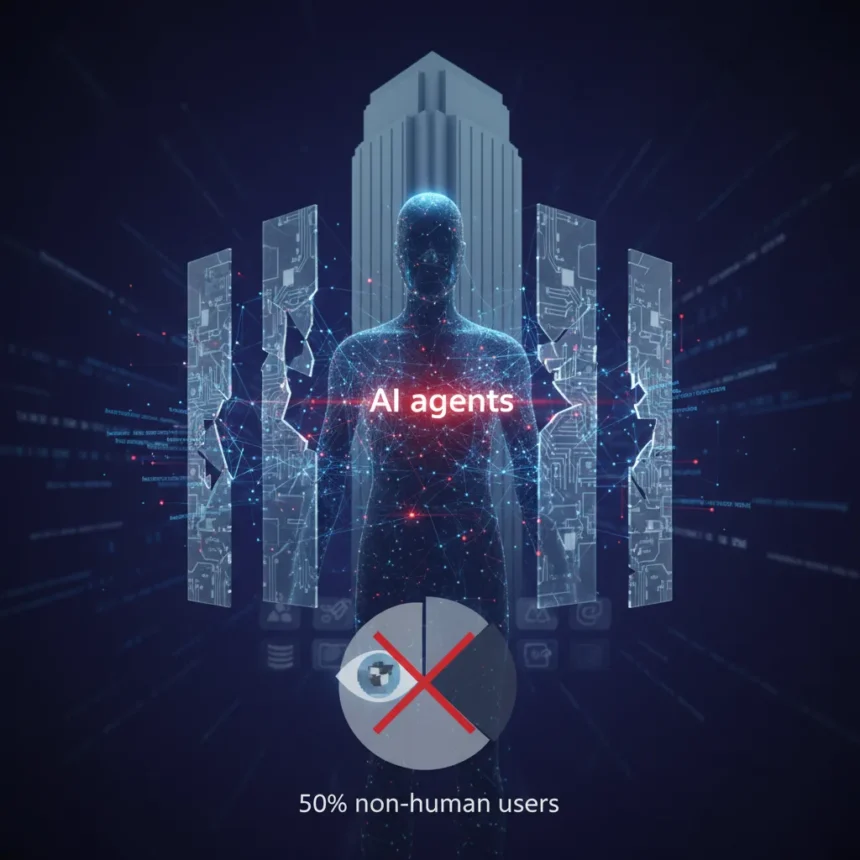
AI agent security governance has become the blind spot in modern enterprise security. Organizations are deploying autonomous agents that access sensitive data, financial records, and proprietary systems—yet most security teams have no idea these non-human users even exist. Your security model was built for humans. Your agents operate at machine speed, always on, making decisions without pause. That fundamental mismatch is creating a governance crisis.
Key Takeaways
- Most enterprises lack visibility into AI agents accessing corporate data and systems
- Current cybersecurity frameworks prioritize human risk management, not autonomous agent behavior
- AI agents can access staffing data, financial records, and proprietary secrets without traditional identity controls
- Enterprises must implement structured training, testing, and probation before agents reach mission-critical systems
- Cross-functional governance from day one is essential to map responsibilities and human-in-the-loop decisions
Why Traditional Security Misses AI Agents
Cybersecurity was designed to manage human risk. Employees have identities, login credentials, and audit trails. Security teams know who they are, what they can access, and when they log in. Agents break every assumption in that model. An AI agent can access enterprise data, applications, staffing information, sensitive financial data, and proprietary product secrets. It operates continuously. It learns. It adapts. And your security team likely has no record of it.
The problem is architectural. Traditional identity and access management assumes users are human: they work during business hours, they take vacations, they follow policy because they understand consequences. Agents are different. They don’t sleep. They don’t second-guess decisions. They execute instructions at machine speed. Businesses can’t secure what they don’t understand, and current frameworks simply weren’t built to understand agents as a distinct security category.
This isn’t a theoretical risk. Agents can be compromised from outside—attackers can learn what works and adapt their approach through repeated attempts. They can also be misused internally, either through misconfiguration or malicious intent. The access they hold is real. The damage they could cause is real. The visibility gap is the only thing that isn’t.



AI Agent Security Governance Requires New Thinking
Treating agents as non-human resources (NHRs)—similar to how HR manages employees—creates a useful framework. Just as employees need induction, training, and clear limitations on what they can do, agents need the same structure. But this isn’t metaphorical. Agents create real costs: computing resources, architectural complexity, security overhead. They deserve the same governance rigor.
The security of the AI model underlying an agent should be extensively red-teamed using simulated attacks to expose weaknesses and design flaws. When an agent has access to tools and data, a critical test is whether it can resist agentic attacks—attacks that learn what works, then adapt accordingly. This isn’t standard penetration testing. It’s a new category of threat that most enterprises haven’t even named yet.



Enterprises need to build cross-functional governance from day one. That means mapping responsibilities across security, engineering, and business units. It means surfacing hidden dependencies—which systems does this agent touch, and what breaks if it fails? It means clarifying which decisions must keep a human in the loop. No AI agent should be allowed into mission-critical systems without undergoing structured training, testing, and probation.
Building AI Agent Security Governance in Practice
Start by identifying which use cases are actually suitable for agentic activity. Not every workflow needs an agent. Some decisions are too consequential, too ambiguous, or too dependent on human judgment. Once you’ve decided an agent makes sense, build the appropriate technology and business models around it, not the other way around.
Red-team the agent’s underlying AI model. Use simulated attacks to find where it breaks. Test whether it can resist adaptive attacks when given real tools and data. This is uncomfortable work—you’re deliberately trying to make your own systems fail. But failure in testing beats failure in production.
Then comes the hard part: governance. Map who owns what. Which team is responsible if the agent makes a mistake? Who has authority to shut it down? What happens when it accesses data it shouldn’t? Surface these dependencies before they become crises. Clarify which decisions require human oversight. Some organizations will decide that certain agent actions always need human approval. Others will set thresholds—approve automatically below this risk level, escalate above it.



Finally, implement a probation period. Give agents structured training and testing before they touch anything critical. You wouldn’t let a fresh graduate run a billion-dollar division on day one—treat agents the same way.
Why This Matters Now
The urgency is real. Organizations are deploying agents today. They’re accessing data. They’re making decisions. Most security teams have no visibility into what’s happening. The gap between agent deployment and agent governance is widening, and that gap is where risk lives.
This isn’t about stopping AI adoption. It’s about doing it safely. Enterprises that build AI agent security governance now—that invest in visibility, red-teaming, and cross-functional oversight—will avoid the incidents that will force governance on everyone else. Those that ignore it will learn the hard way that security models built for humans don’t scale to machines.
How do I get visibility into AI agents in my organization?
Start with an audit: what agents exist, what systems do they access, who deployed them, and when? You likely have shadow agents—deployed by teams without security involvement. Map them all. Then implement identity controls that treat agents as distinct from human users, with their own access policies, audit trails, and governance requirements.
What’s the difference between AI agent security and regular API security?
APIs are static: they do what they’re programmed to do. Agents are adaptive—they learn, they adjust their behavior, they can be manipulated through repeated interactions. An agent can be attacked in ways a traditional API cannot, because the agent itself is the threat surface, not just the endpoint it connects to.
Should all AI agents require human approval before taking action?
Not necessarily. The answer depends on the risk. Some agents can operate autonomously in low-stakes domains. Others—especially those accessing financial data or customer information—should require human approval for significant actions. The key is deciding explicitly which decisions need human oversight, rather than assuming all agent behavior is safe.
AI agent security governance isn’t optional anymore. It’s the difference between controlled adoption and chaotic risk. Organizations that build visibility, red-team their agents, and implement cross-functional governance will thrive. Those that deploy agents without security frameworks will become the cautionary tales that force everyone else to finally take this seriously.
Edited by the All Things Geek team.
Source: TechRadar




