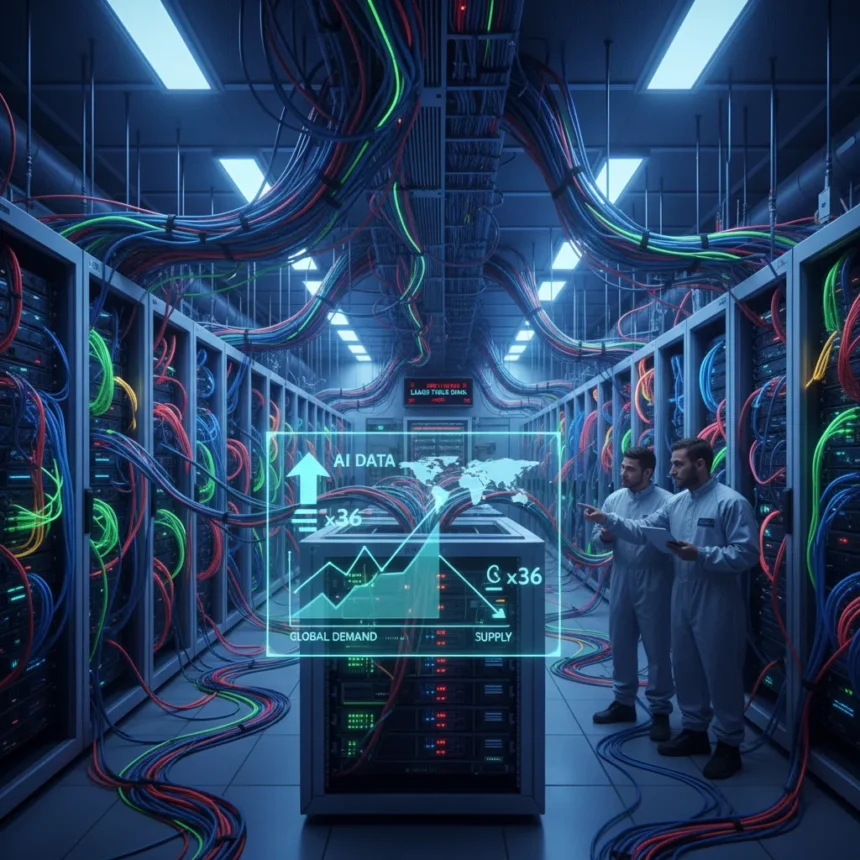
The AI data center fiber optic shortage is reshaping global supply chains in ways the telecom industry never anticipated. AI data centers require 36 times more fiber optic cable than designs using standard servers, a dramatic difference that has overwhelmed manufacturers worldwide and created a bottleneck that will persist for years.
Key Takeaways
- AI data centers consume 36 times more fiber optic cable than standard server architectures.
- Major Chinese optical fiber manufacturers report order books extending into 2027.
- Lead times for fiber optic cable products now stretch to approximately one year.
- Glass shortages are compounding cable production delays across the industry.
- The shortage reflects rapid AI infrastructure buildouts outpacing manufacturing capacity.
Why AI Data Centers Are Draining the Global Fiber Supply
The fiber optic shortage stems from a fundamental architectural difference. AI data centers are far more bandwidth-intensive than traditional server farms, requiring vastly more cable to handle the exponential data flows between GPUs, storage systems, and networking hardware. This intensity translates directly into material demand that manufacturers simply cannot match.
Rapid AI infrastructure expansion has caught the supply chain off guard. Companies racing to build out AI capabilities are placing orders faster than factories can produce. The result is a cascading delay: major Chinese optical fiber manufacturers now report order books stretching into 2027, meaning customers signing contracts today may not receive their full orders for two or three years. For data center operators on tight deployment schedules, this timeline is catastrophic.
The shortage is not evenly distributed. Some fiber optic cable products face approximately one-year lead times, while others experience even longer delays. This variability creates a secondary problem for builders: they cannot simply substitute alternative cable types or suppliers without redesigning portions of their infrastructure.


Glass Shortages Compound the Fiber Crisis
Fiber optic cables begin with optical glass, and that material is also constrained. Severe glass shortages are pushing production bottlenecks deeper into the supply chain, preventing manufacturers from ramping output even when they have factory capacity. Glass suppliers cannot keep pace with demand, creating a choke point that cable makers cannot bypass.
This two-tier constraint—glass scarcity feeding into cable scarcity—means the shortage will not resolve quickly. Even if fiber manufacturers wanted to double production tomorrow, they would still be limited by how much optical glass they can source. The glass shortage alone suggests this crisis will persist well into 2026 and beyond.



How AI Data Centers Compare to Traditional Telecom Infrastructure
Traditional telecom networks and broadband buildouts drove fiber demand for decades, but they operated at a different scale and intensity. Telecom cables connect cities and regions; AI data center cables connect thousands of processors within a single facility, creating a density of demand that telecom infrastructure was never designed to accommodate.
The distinction matters because it explains why the shortage caught the industry flat-footed. Manufacturers had forecasting models based on telecom growth rates. AI data center buildouts follow no such historical pattern—they are exponential, unscheduled, and driven by corporate competition rather than regulatory deployment cycles. A single hyperscaler’s decision to build three new facilities can absorb years of planned fiber production.
What This Means for AI Infrastructure Timelines
Data center operators face a hard choice: wait for fiber and delay deployments, or accept partial connectivity and reduced performance. Neither option is attractive. Delays push back AI service launches and increase competitive risk. Reduced connectivity undermines the entire purpose of building high-performance infrastructure.
The shortage also creates pricing pressure. When supply is constrained and demand is urgent, manufacturers can raise prices. Customers have limited negotiating power when lead times stretch to a year and alternatives do not exist. This cost inflation will eventually flow into the price of AI services and cloud computing for end users.



FAQ
How much longer will the fiber optic shortage last?
Based on order books extending into 2027 and glass supply constraints, the shortage will persist through at least 2026 and likely into 2027. Full normalization may take until 2028 or later, depending on whether manufacturers can expand glass production capacity.
Can data centers use alternative cable types to avoid the shortage?
In theory, yes—but redesigning infrastructure to use different cable specifications requires time and capital that most data center operators do not have. Substituting cables mid-project is not practical, so most operators are locked into waiting for their original orders.
Why did manufacturers not anticipate this demand?
AI data center growth was exponential and largely unpredicted by supply chain forecasters. Historical models based on telecom and broadband demand could not account for the intensity and speed of AI infrastructure buildouts. Manufacturers planned for gradual growth, not the sudden surge driven by competing hyperscalers racing to deploy AI capacity.
The AI data center fiber optic shortage is a defining supply chain crisis of the AI era. It reveals the gap between the speed of technological innovation and the pace of industrial manufacturing. Until glass and cable production capacity expands significantly, data center operators will face multi-year delays and rising costs. This shortage is not a temporary disruption—it is a structural constraint that will shape AI infrastructure deployment for the next two years.
Edited by the All Things Geek team.
Source: Tom's Hardware