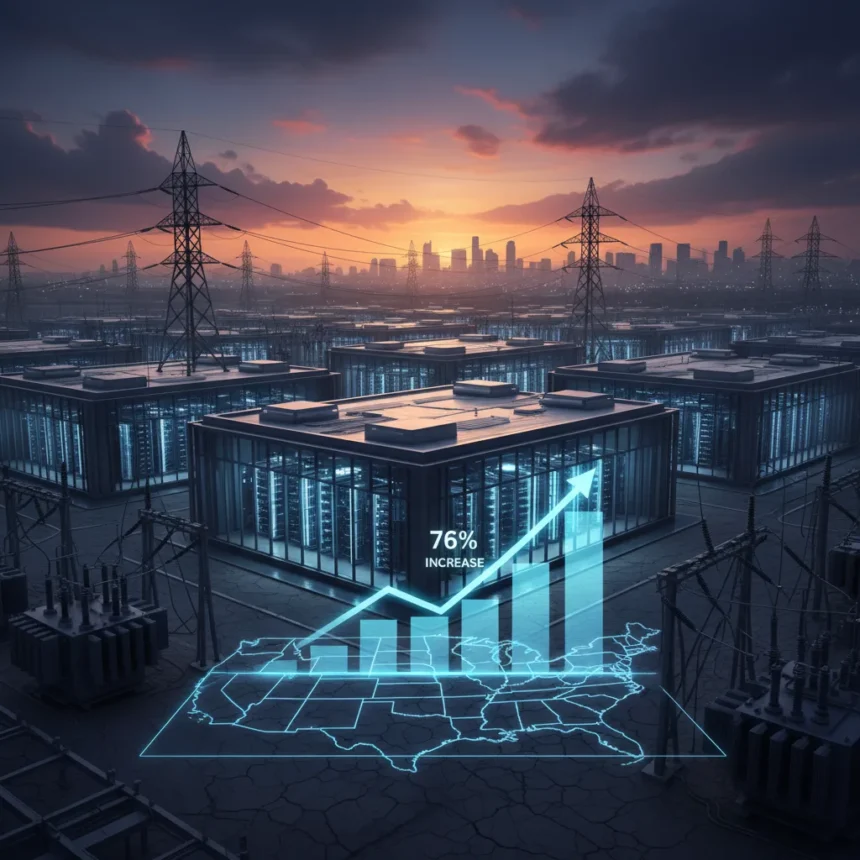
AI data centers electricity prices are reshaping the economics of America’s largest power market. Wholesale electricity costs on PJM Interconnection—which serves roughly 67 million people across 13 states from New Jersey to Illinois—jumped 76% in the first quarter of 2026, according to Bloomberg reporting cited in the industry analysis. The spike is no longer a theoretical concern. It is showing up in grid costs and customer bills right now.
Key Takeaways
- Wholesale electricity prices on PJM Interconnection rose 76% in Q1 2026, driven by AI data center demand.
- AI-related electricity demand has already added approximately 13.8 billion dollars to customer obligations.
- Capacity costs jumped nearly 400 percent; congestion costs surged 300 percent.
- Maryland regulators estimate AI-driven grid upgrades could cost state customers 1.6 billion dollars alone.
- PJM’s independent market monitor argues tech companies should pay more for power infrastructure.
Why AI Data Centers Electricity Prices Are Climbing So Fast
Data centers running artificial intelligence models consume power continuously. Unlike a typical office building that draws electricity during business hours, a data center runs 24/7 at maximum load. When hundreds of these facilities cluster in a single grid region, the demand becomes staggering. PJM’s capacity costs—the price utilities pay to ensure enough power is available during peak demand—jumped nearly 400%. Congestion costs, which reflect bottlenecks in the transmission network, surged 300%. These are not gradual increases. They are structural shocks to the grid.
The scale of the cost burden is becoming visible. According to PJM’s independent market monitor, AI-related demand has already added roughly 13.8 billion dollars to customer obligations. That is money ratepayers across the region are now responsible for covering. The bill keeps growing as more data centers come online.
AI Data Centers Electricity Prices Are Creating a Consumer Cost Crisis
State regulators are pushing back. Maryland officials are openly fighting PJM over billions in projected consumer costs tied to data center growth. One estimate tied AI-driven grid upgrades to approximately 1.6 billion dollars in additional costs for Maryland customers alone. These are not hypothetical future expenses—they represent real money consumers will pay through higher electricity bills and grid maintenance charges.



The problem is structural. Data centers do not arrive and operate in isolation. They require new transmission lines, upgraded substations, and expanded generation capacity. Someone has to pay for that infrastructure. Currently, the cost is distributed across all ratepayers in the region, meaning households and small businesses subsidize the power infrastructure that serves tech companies. A homeowner in New Jersey pays higher electricity rates partly because a data center in Ohio needs a new transmission corridor.
Should Tech Giants Pay More for Power Infrastructure?
PJM’s independent market monitor argues they should. The watchdog contends that technology companies benefiting from massive power consumption ought to shoulder more of the infrastructure burden themselves. This is not a radical position—it mirrors how other utilities operate. A manufacturing plant that requires dedicated power lines often pays for those lines. Why should data centers be different?



The counter-argument from tech companies is that data center development brings jobs, tax revenue, and economic growth to regions. That is true. But it does not resolve the core issue: someone still has to build the grid infrastructure, and someone has to pay for it. Right now, that someone is the broader ratepayer base, not the companies driving the demand.
What Happens Next?
The PJM region faces a choice. It can continue distributing infrastructure costs across all ratepayers, which means rising electricity prices for consumers and small businesses. It can implement cost-recovery mechanisms that require data centers to fund new transmission and generation capacity they drive demand for. Or it can limit data center growth until the grid catches up, which would slow AI infrastructure expansion but protect consumer costs.
Maryland’s regulatory fight with PJM suggests states are not willing to absorb unlimited costs passively. Other regions served by PJM—Pennsylvania, Ohio, Illinois, and others—will likely face similar pressure. The question is not whether AI data center demand will continue rising. It will. The question is who bears the cost of the grid that serves them.
Could other US power markets face the same AI data centers electricity prices pressure?
Yes. PJM is the largest and most densely populated grid region in the US, but data centers are expanding nationwide. Other regional transmission operators will face similar demand spikes. The difference is that PJM’s situation is visible first because the concentration of data center growth there is most acute.


Why are AI data centers electricity prices rising faster than data center demand?
Grid costs rise faster than demand because infrastructure—transmission lines, substations, generation plants—cannot be built overnight. When demand jumps suddenly, utilities must rapidly expand capacity, which is expensive. Additionally, data centers cluster in specific regions, creating localized bottlenecks that require targeted, costly infrastructure upgrades rather than distributed, cheaper expansion.
Are consumers responsible for paying AI data center infrastructure costs?
Currently, yes. The cost is embedded in wholesale electricity prices and capacity charges that all ratepayers share. This means households and small businesses are effectively subsidizing the infrastructure that serves tech companies. State regulators argue this is unfair and are pushing for cost-recovery models that shift more of the burden to data center operators themselves.
The AI data centers electricity prices crisis in PJM is a preview of a broader reckoning. As AI infrastructure expands, regions will have to decide whether ratepayers or technology companies should bear the cost of the grid that serves them. So far, regulators are signaling that the current model—spreading costs across all consumers—is unsustainable. Change is coming, and it will reshape how data centers are financed and sited across America.
Edited by the All Things Geek team.
Source: Tom's Hardware