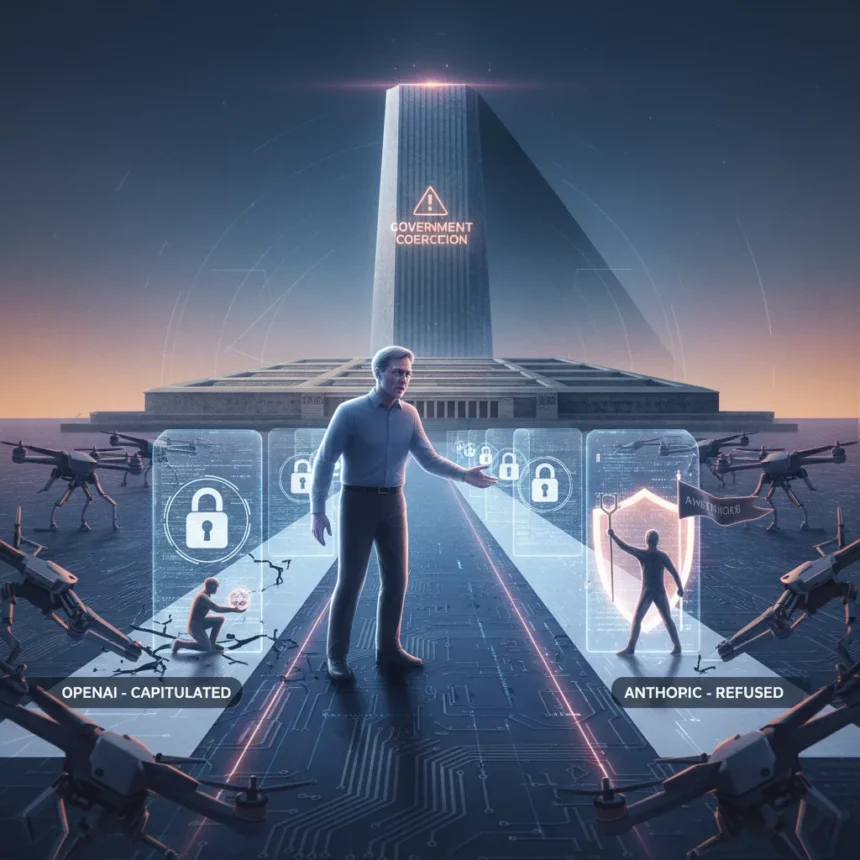
The escalating standoff over AI military use restrictions marks a critical inflection point for the tech industry’s relationship with government power. Sam Altman, OpenAI’s CEO, sent a memo to staff in late February 2026 warning that Pentagon pressure on AI companies could trigger nationalization or coercion of the entire sector—a blunt acknowledgment that the stakes extend far beyond any single contract.
Key Takeaways
- OpenAI accepted Pentagon deal for classified military networks on February 27, 2026; Anthropic refused, citing safety concerns.
- Pentagon labeled Anthropic a “supply-chain risk” and demanded Claude be available for “all lawful purposes” without safeguard restrictions.
- Altman publicly warned that enforcing supply-chain designations against AI companies would be “very bad for our industry and our country.”
- OpenAI employees signed an open letter supporting Anthropic’s stance, creating internal friction over the Pentagon deal.
- Anthropic maintains a $200 million existing military contract but insisted on excluding surveillance and autonomous lethal weapons.
How Pentagon pressure forced OpenAI and Anthropic into opposite corners
On February 27, 2026, the Pentagon issued Anthropic a hard deadline: drop all restrictions on Claude’s use for “all lawful purposes” by 5:01 p.m. ET that day. Anthropic CEO Dario Amodei refused. Hours later, the Department of War labeled Anthropic a supply-chain risk—a designation that would effectively block the company from federal contracts. That same day, OpenAI struck its own deal with the Pentagon, allowing ChatGPT and other models into classified military networks while excluding uses deemed illegal or inappropriate.
The timing was not coincidental. Altman’s memo to OpenAI staff made clear that the company shares Anthropic’s core red lines: no AI for mass surveillance, whether domestic or foreign, and no autonomous lethal weapons without human oversight. Yet OpenAI chose to negotiate with the Pentagon rather than resist. Altman framed the deal as a de-escalation tactic—a way to prevent worse outcomes for the entire industry.
Anthropic saw it differently. In a memo to employees, CEO Amodei stated that OpenAI’s willingness to accept the Pentagon’s terms reflected a choice to placate employees rather than prevent genuine harms. “They cared about placating employees, and we actually cared about preventing abuses,” Amodei wrote. The contrast between the two companies crystallized a fault line in Silicon Valley: whether to accommodate government pressure or resist it on principle.



Why Altman fears AI military use restrictions could destroy industry independence
Altman’s public statements reveal deeper anxiety about the precedent being set. He told CNBC that threatening companies with supply-chain designations is fundamentally wrong, and he called the Pentagon’s move “a very bad decision” that he hoped would be reversed. On social media, he emphasized that “a good relationship between the government and the companies developing this technology is critical over the next couple of years,” but that relationship cannot be built on coercion.
The real fear is not about any single contract. If the Pentagon can successfully pressure one AI company into compliance by labeling another a supply-chain risk, the precedent invites escalation. Nationalization of AI labs, forced technology transfer, or regulatory capture become plausible end states. Altman’s memo acknowledged this explicitly: the Anthropic dispute “has become a concern for the entire industry, and it is crucial to clarify our position”.



OpenAI’s deal does include safeguards—the Pentagon agreement excludes uses the company deems illegal or inappropriate—but those guardrails depend entirely on OpenAI’s willingness to enforce them against a customer with enormous leverage. Anthropic’s refusal to negotiate at all is a bet that maintaining independence is worth the economic cost.
The employee rebellion and Anthropic’s $200 million gamble
OpenAI employees signed an open letter backing Anthropic’s stance, signaling that the company’s deal did not sit well internally. Altman defended the decision on social media, admitting the optics were rushed but arguing that industry stability required negotiation rather than confrontation. The tension reveals a split in how AI leaders weigh principles against pragmatism.
Anthropic’s position is strengthened by its existing $200 million military contract, which it has maintained while providing Claude for intelligence analysis, cyber operations, and operational planning. The company has also cut revenue from Chinese military firms and supports U.S. export controls on AI technology. This record suggests Anthropic is not anti-military—it is anti-unconstrained military use.
The stakes for Anthropic are enormous. If the supply-chain risk designation sticks, the company loses federal contracts and faces reputational damage as unpatriotic. If it holds firm and other AI companies follow suit, the precedent shifts power back toward the industry. If OpenAI’s deal becomes the template and Anthropic remains isolated, the company risks obsolescence in military applications.


What happens if other AI companies adopt Anthropic’s stance?
The outcome depends on whether Google, Meta, or other major AI developers adopt similar red lines on AI military use restrictions. If they do, the Pentagon faces a unified industry position that is harder to break through supply-chain pressure or selective deals. If they follow OpenAI’s model, Anthropic becomes an outlier and its leverage evaporates.
Altman’s public warnings suggest he fears the first scenario—a collective industry stance that forces genuine confrontation with government power. His preferred outcome is negotiated compromise: deals that allow military use of AI while preserving safeguards against the worst abuses. Whether that middle ground holds depends on whether future administrations honor the boundaries embedded in contracts or simply rewrite the rules when national security demands it.
Is OpenAI’s Pentagon deal a victory or a capitulation?
OpenAI frames the deal as a strategic win that prevents worse outcomes and stabilizes government-industry relations. The company negotiated safeguards into the contract and avoided the supply-chain risk designation that crippled Anthropic. From a pure business standpoint, OpenAI gained access to classified military networks while Anthropic lost federal leverage.
But the deal also set a precedent: AI companies can be pressured into compliance through selective punishment of competitors. Future administrations may view this as a template. Altman’s warnings suggest he understands this risk, even if OpenAI concluded the immediate cost of refusal was too high.
FAQ
What are the main AI military use restrictions both companies agreed to?
Both OpenAI and Anthropic oppose using AI for mass surveillance and autonomous lethal weapons without human oversight. OpenAI’s Pentagon deal excludes uses deemed illegal or inappropriate; Anthropic refused to negotiate but maintains these same red lines in its existing military contracts.
Why did Anthropic refuse the Pentagon’s deadline while OpenAI accepted?
Anthropic CEO Amodei stated the company prioritized preventing genuine abuses over employee appeasement, implying OpenAI chose to placate staff concerns rather than maintain absolute safeguard standards. OpenAI viewed negotiation as necessary to prevent industry-wide coercion and nationalization.
Could the supply-chain risk designation destroy Anthropic?
The designation blocks Anthropic from federal contracts, but the company’s existing $200 million military contract and established role in intelligence and cyber operations provide some insulation. Long-term survival depends on whether the designation is reversed or whether private-sector AI revenue can offset federal losses.
The AI military use restrictions standoff reveals a fundamental tension: whether tech companies can maintain independence from government pressure or whether national security will inevitably subordinate private interests. Altman’s warnings suggest the answer will shape the entire industry for years to come.
Edited by the All Things Geek team.
Source: TechRadar