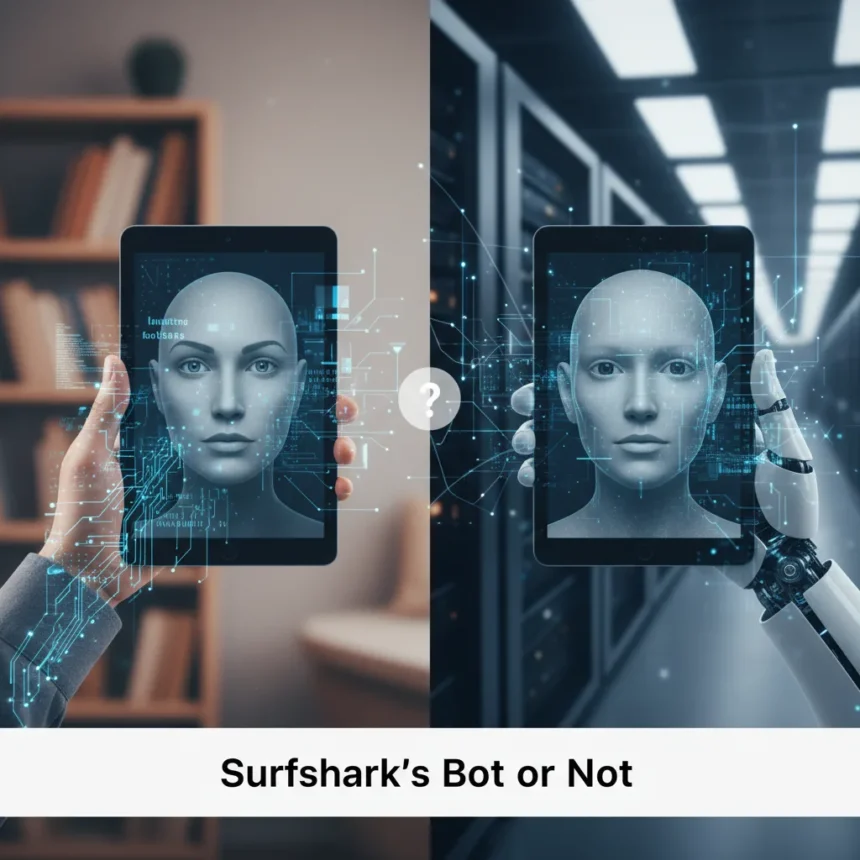
Your ability to tell AI bots from humans online might be worse than you think. Surfshark’s new experiment, called Bot or Not, found that 47% of participants failed to distinguish AI-generated profiles from real human accounts on simulated social platforms. The result underscores a growing crisis: as AI becomes more convincing, our capacity to spot synthetic accounts and content is quietly eroding.
Key Takeaways
- Surfshark’s Bot or Not experiment found 47% of participants could not tell AI bots from humans.
- The test used simulated social platforms to measure bot detection ability.
- Nearly half of online users lack reliable skills to identify synthetic accounts.
- The finding highlights a critical trust and verification problem on social media.
- Readers can participate in the experiment themselves to test their own detection abilities.
Why Bot Detection Matters More Than Ever
Distinguishing between AI bots and humans online has become a fundamental literacy skill, yet most people lack it. When nearly half of test participants cannot tell AI bots from humans, the implications extend far beyond curiosity. Synthetic accounts spread misinformation, manipulate public opinion, impersonate real people, and erode trust in online spaces. The problem is not theoretical—it is happening right now, on every major social platform, and most users cannot see it coming.
The Bot or Not experiment taps into a real anxiety. Social platforms have become increasingly difficult to navigate safely. Fake accounts pose as friends, influencers, and authorities. Bots amplify divisive content. Deepfakes and AI-generated text blur the line between authentic human expression and machine-generated mimicry. Surfshark’s finding that 47% of participants failed to tell AI bots from humans suggests the problem is worse than many realize. If you cannot reliably spot a bot in a controlled test environment, your chances of catching one in the wild are even slimmer.
What the Surfshark Experiment Reveals About AI Realism
The Bot or Not test demonstrates that AI has crossed a critical threshold. Bots are no longer obviously artificial. They write naturally. They reference current events. They use humor and sarcasm. They build rapport. To the untrained eye—which is most of us—they are indistinguishable from real people. This is not a flaw in the experiment; it is a feature of modern AI. Language models have become so sophisticated that they can mimic human behavior convincingly enough to fool nearly half of a test population.



The simulated social platforms used in the experiment created a controlled environment where participants could focus purely on detecting bots without the noise and distraction of real-world social media. Even in this simplified setting, nearly half failed. Real-world detection would be even harder, where users are scrolling quickly, emotionally invested in content, and primed to trust accounts that seem familiar or credible. The gap between controlled testing and real-world performance suggests the actual problem is deeper than the 47% failure rate indicates.
How This Compares to Human Judgment in Other Domains
Humans are surprisingly bad at spotting deception when it is sophisticated. We struggle to detect deepfakes, identify manipulated images, and spot phishing emails. The inability to tell AI bots from humans fits a broader pattern: as technology becomes more convincing, human judgment lags behind. Unlike other deception detection tasks, however, bot identification has a unique challenge. Bots are designed specifically to pass as human, with every response optimized to seem natural and trustworthy. The asymmetry is stark—machines are improving at mimicking humans far faster than humans are improving at spotting them.



What You Can Do to Improve Your Bot Detection
Surfshark invites readers to test themselves by participating in the Bot or Not experiment. This hands-on approach offers a practical way to calibrate your instincts and understand where your detection weaknesses lie. Taking the test yourself reveals patterns you might otherwise miss: bots often lack genuine personal details, struggle with nuanced follow-up questions, or repeat phrases. They may seem too polished or too perfectly on-brand. Human accounts, by contrast, contain contradictions, tangents, and the messy authenticity of real life.
Beyond testing yourself, adopt simple habits: verify accounts through secondary sources before trusting them, check post history for consistency and depth, and be skeptical of accounts that seem too good to be true. Look for signs of automation—identical responses to different prompts, content posted at inhuman frequencies, or engagement patterns that seem mechanical. None of these strategies is foolproof, but together they raise your baseline detection ability above the 47% failure rate.
The Broader Implications for Online Trust
If nearly half of people cannot tell AI bots from humans in a controlled test, what does that mean for the reliability of social platforms as sources of information and connection? It suggests that trust on these platforms is increasingly fragile. Misinformation spreads faster when bots amplify it. Public discourse becomes distorted when synthetic voices shape the conversation. Communities fragment when people cannot distinguish authentic members from infiltrators. The Bot or Not experiment is not just a curiosity—it is a warning about the erosion of trust in digital spaces.
Platforms themselves bear responsibility for making bot detection easier. Verification badges, transparency about account age and activity, and clearer labeling of AI-generated content could all help. But these solutions require platform investment and user attention. Until they are widely implemented, the burden falls on individual users to develop their own detection skills. Surfshark’s experiment highlights the gap between the sophistication of modern AI and the average person’s ability to spot it.



Can You Tell a Bot From a Human Online?
The Bot or Not experiment lets you test your own bot detection skills. Surfshark designed it so readers can participate and see how they compare to the 47% failure rate. Taking the test reveals your personal blind spots and helps you understand what makes AI-generated content convincing.
Why Are Bots Becoming Harder to Detect?
AI language models have advanced rapidly, enabling bots to write naturally, reference current events, and mimic human personality traits. The gap between machine-generated and human-written text has narrowed dramatically. Bots are also trained on human conversation data, so they absorb the patterns, quirks, and linguistic markers that make humans sound authentic.
What Should I Do if I Suspect an Account Is a Bot?
Report the account to the platform and verify any information it shares through independent sources. Check the account’s creation date, post history, and engagement patterns. Look for signs of automation or repetitive behavior. If something feels off, trust your instinct and do not engage with the account as if it were human.
The Bot or Not experiment serves as a wake-up call. Nearly half of people cannot tell AI bots from humans online, and that gap is widening as AI improves. The solution is not to panic—it is to become a more skeptical, informed user of social platforms. Test yourself. Learn what to look for. Stay alert. In an age of increasingly convincing AI, your ability to spot the synthetic from the authentic is becoming a critical survival skill.
Edited by the All Things Geek team.
Source: TechRadar