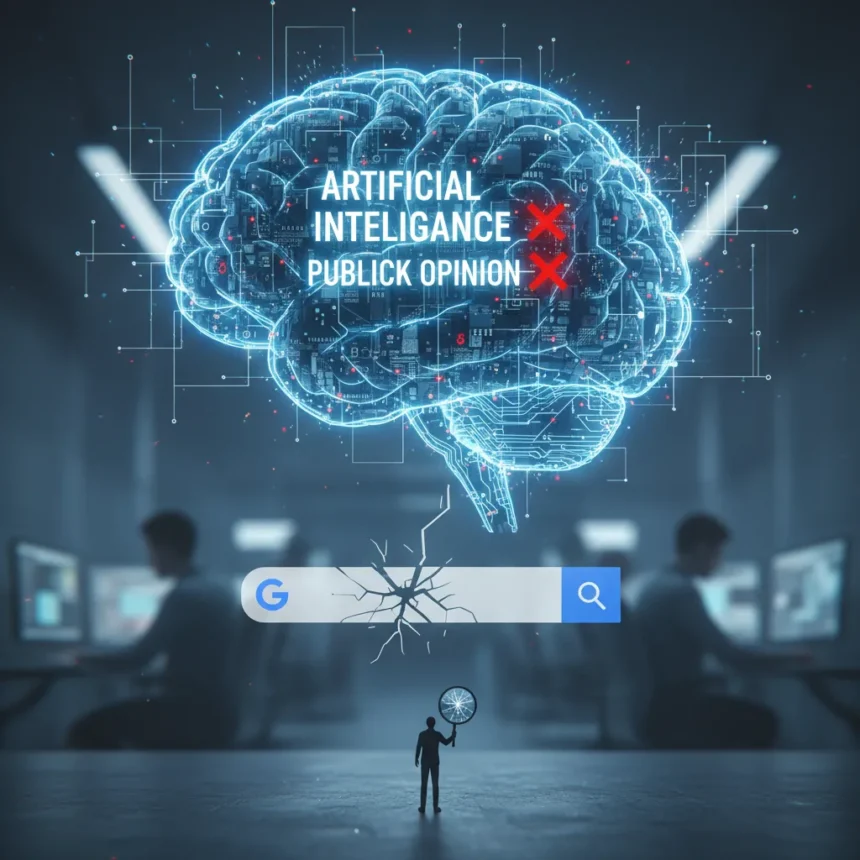
AI Overviews reliability has become a flashpoint for how we should trust AI-powered search. Google’s own AI system can confidently correct typos in user queries while simultaneously failing to spell basic terms correctly—a contradiction that reveals something far more troubling than a simple glitch. When an AI tool can handle some language tasks but botches others, users face an impossible question: which answers should I trust?
Key Takeaways
- Google’s AI Overviews demonstrate inconsistent performance across basic language tasks.
- The system can fix typos but struggle with simple spelling, undermining user confidence.
- Reliability failures in AI search tools signal a broader trust problem for the industry.
- Confident-sounding wrong answers pose a greater risk than obviously broken systems.
- Users cannot reliably predict when AI Overviews will succeed or fail.
The paradox of selective AI competence
AI Overviews reliability becomes questionable when the same system exhibits wildly different performance levels across similar tasks. The ability to correct a user’s typo suggests the AI understands language patterns, context, and common mistakes. Yet spelling its own product name correctly should be trivial—far easier than inferring intent from a misspelled query. When both capabilities exist in the same system but only one works reliably, the problem is not computational power or training data. It is something more fundamental: unpredictability.
This inconsistency matters because users have no way to know in advance whether they are getting a corrected answer or a confident hallucination. A traditional search engine that returns no results for a misspelled query is honest about its limitations. An AI system that sometimes fixes errors and sometimes does not creates a false sense of reliability. Users will trust the correct answers and, crucially, will also trust the incorrect ones with equal confidence. That asymmetry is dangerous.
Why AI Overviews reliability affects search trust fundamentally
Search has always been about trust. When you type a question into Google, you expect the engine to either find relevant information or tell you it cannot. You do not expect it to confidently provide an answer that sounds plausible but is factually wrong. AI Overviews reliability problems introduce exactly that risk—answers that read authoritatively but may be incorrect.



The spelling error is funny on the surface, which is precisely why it matters. A system that gets the easy things wrong is not trustworthy on hard things. If AI Overviews cannot reliably handle a task as simple as spelling, what does that say about its ability to synthesize complex information, distinguish between reliable and unreliable sources, or avoid repeating misinformation? The glitch is not the real problem. The real problem is that it exposes a gap between what users assume these systems can do and what they actually can do reliably.
The broader implications for AI-powered search
Google is not the only company building AI search tools. As more search engines integrate generative AI, the reliability question becomes industry-wide. Every system that prioritizes speed and scale over consistency runs the risk of producing confident errors. Users will encounter these failures at different rates depending on the tool, the query, and factors they cannot predict or control.



This creates a market problem. If users cannot trust AI Overviews reliability, they will either stop using the feature or stop trusting the search engine altogether. Neither outcome is good for Google or for the future of AI-powered search. The company has invested heavily in this technology, but trust cannot be engineered around a fundamental reliability issue—it has to be solved. A system that works 95 percent of the time is not five percent better than one that works 90 percent of the time. It is infinitely better, because users can develop confidence in it. A system with unpredictable failure modes is worse than a system that fails consistently, because at least users learn to work around consistent failures.
Can AI Overviews reliability be fixed?
The technical answer is probably yes. Better training data, more robust testing, and stronger guardrails could improve AI Overviews reliability significantly. The practical answer is more complicated. Generative AI systems are inherently probabilistic—they generate text one word at a time based on statistical patterns, not rules. Pushing reliability to 99 percent or higher on all tasks may not be possible without fundamentally changing how these systems work.
That does not mean Google should give up. It means the company needs to be honest about what AI Overviews can and cannot do reliably, and design the feature accordingly. That might mean showing confidence scores, limiting AI Overviews to specific query types where reliability is proven, or making it easier for users to report errors and improve the system over time. What it cannot mean is shipping a feature that sounds authoritative but behaves unpredictably.
What does this mean for users right now?
For most users, AI Overviews reliability problems are not yet a daily crisis. The feature works correctly most of the time, and when it fails, the failures are often obvious enough to catch. But the spelling error is a reminder that you should never trust an AI answer without verification, especially on important decisions. Use AI Overviews as a starting point, not an endpoint. Cross-check claims against multiple sources. Be skeptical of answers that sound authoritative but lack citations or supporting evidence.


The long-term risk is that as AI search becomes more integrated into how people find information, reliability failures accumulate. One wrong answer about a medical symptom, a legal question, or a financial decision could have real consequences. Google has the resources to make AI Overviews reliability a priority. Whether it will treat it as one remains to be seen.
Does AI Overviews reliability affect all search queries equally?
No. AI Overviews reliability likely varies by query type. Factual questions with clear answers—capital cities, product specifications, historical dates—are probably handled more reliably than subjective or nuanced queries that require judgment. The spelling error happened on a task that should be trivial, which suggests even basic factual reliability is not guaranteed. Users should assume AI Overviews reliability is lowest on ambiguous queries and highest on straightforward factual lookups, but should verify important information regardless.
Why does AI Overviews reliability matter more than other AI failures?
Because search is the gateway to information for billions of people. A spelling mistake in an email draft is annoying. A spelling mistake in a search overview that millions of people read is a trust issue at scale. When people rely on a tool for information, reliability is not a nice-to-have feature—it is the core product. AI Overviews reliability is not a technical problem to optimize around. It is a fundamental question about whether AI is ready to be the primary interface between people and information.
Closing thoughts on AI Overviews reliability
Google’s AI Overviews reliability problem is not about one spelling mistake. It is about a system that behaves unpredictably in ways users cannot anticipate or control. Until Google can guarantee that AI Overviews will handle basic language tasks consistently, users should treat every answer as provisional. Verify, cross-check, and stay skeptical. The future of search depends on building systems people can actually trust—and right now, AI Overviews reliability is not there yet.
Edited by the All Things Geek team.
Source: Tom's Guide