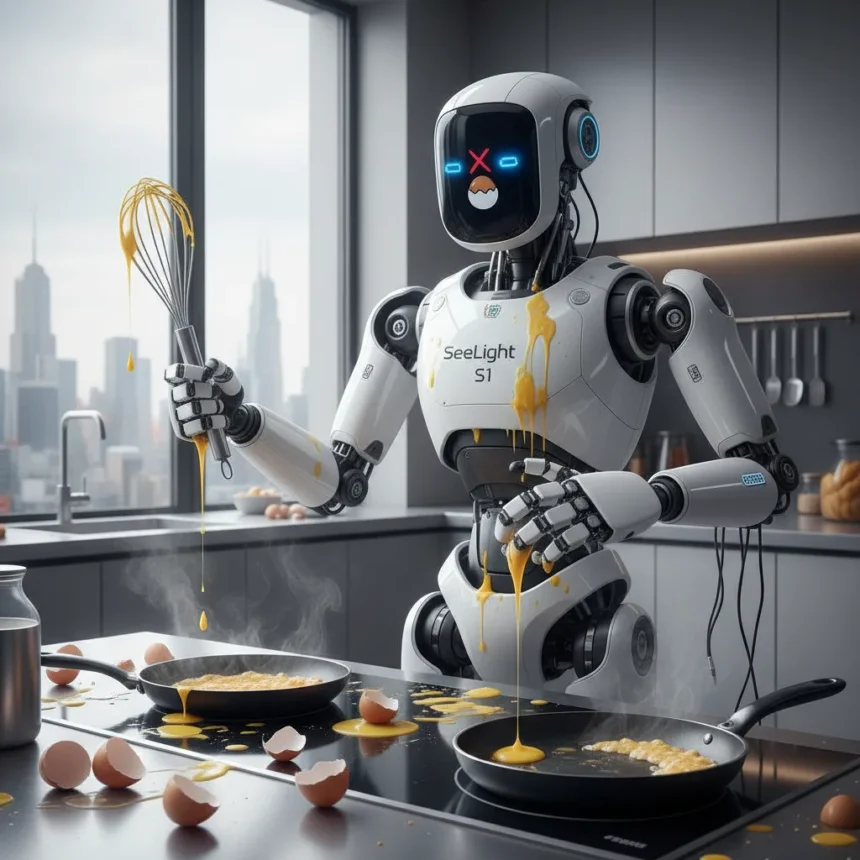
The humanoid robot household tasks market just got a reality check. GigaAI’s SeeLight S1, a Chinese humanoid robot designed to handle domestic chores like laundry, clothes folding, and microwave operation, demonstrated that even robots with seemingly impressive capabilities can fail spectacularly at basic human tasks. A recent demonstration of the robot attempting to make eggs revealed just how far current robotics still lags behind everyday human competence.
Key Takeaways
- The SeeLight S1 can perform laundry, fold clothes, and operate household appliances like microwaves.
- The robot’s egg-making attempt was poor, raising questions about robot readiness for kitchen tasks.
- Poor performance at simple cooking suggests humanoid robot household tasks remain far from replacing human workers.
- Current robots excel at structured, repetitive tasks but struggle with unpredictable, hands-on activities.
- The robot’s failure undermines hype about imminent job displacement from household automation.
Why the SeeLight S1’s Egg Disaster Matters Right Now
The SeeLight S1’s egg-making failure is not just amusing—it is a revealing window into the actual state of humanoid robotics. While manufacturers tout capabilities like laundry handling and microwave operation, the robot’s inability to execute a task as fundamental as cooking eggs exposes a critical gap between marketing claims and real-world performance. This gap matters because it directly challenges the widespread anxiety about robots imminently replacing human workers across domestic and service sectors.
The demonstration revealed that humanoid robot household tasks, while advancing, remain deeply constrained by mechanical and sensory limitations. A robot can be programmed to fold clothes in a controlled sequence, but cooking—which requires real-time sensory feedback, adaptive hand pressure, and split-second adjustments—exposes the brittleness of current robotic systems. The eggs themselves became a metaphor for the messy, unpredictable nature of real human work that automation has not yet conquered.
What the SeeLight S1 Can Actually Do
To be fair, the SeeLight S1 does accomplish several household tasks that require genuine mechanical coordination. The robot can perform laundry, including the surprisingly complex task of folding clothes, and it can interact with standard kitchen appliances like microwaves. These are not trivial achievements—they demonstrate progress in robotic dexterity and task sequencing. The robot’s ability to handle multiple steps in sequence, from loading to operating to retrieving, shows that humanoid robot household tasks have moved beyond simple arm movements into more integrated workflows.



However, these capabilities exist in a controlled environment where tasks follow predictable sequences. Laundry and microwave operation involve repeatable, well-defined steps. Cooking eggs, by contrast, requires constant adjustment. The heat level, pan condition, egg consistency, and timing all demand real-time adaptation. The robot lacks the sensory sophistication to detect these variables and respond dynamically, which is why the demonstration produced such poor results.
Humanoid Robot Household Tasks and the Job Displacement Myth
The SeeLight S1’s struggle with eggs serves as a useful corrective to the narrative of imminent robot-driven job displacement. Much of the anxiety around automation assumes that robots will simply replicate human capabilities at scale, but the egg demonstration shows that even specialized robots struggle with tasks humans perform without thinking. This suggests that humanoid robot household tasks will remain narrowly specialized for years to come, handling only the most structured, predictable activities.



The practical implication is clear: robots will not be replacing household workers, chefs, or caregivers anytime soon. Instead, they will likely be confined to specific, high-volume tasks in controlled environments—warehouse sorting, assembly line work, or repetitive manufacturing. The moment a task requires adaptability, sensory judgment, or interaction with unpredictable physical systems, human workers retain a decisive advantage. The SeeLight S1’s poor egg-making performance is not a bug in the robot; it is a feature of the underlying challenge of general-purpose robotics.
Why Simple Tasks Expose Robot Limitations
Cooking eggs seems deceptively simple to humans because our brains and hands have evolved over millions of years to handle precisely this kind of task. We feel heat, adjust pressure, and read visual cues almost instantaneously. The SeeLight S1 must process sensor data, execute pre-programmed routines, and respond to conditions it was never explicitly trained to handle. When something goes wrong—the pan is too hot, the eggs start sticking, the timing is off—the robot has no intuitive recovery mechanism. It simply follows its instructions and produces terrible eggs.
This limitation is fundamental to current humanoid robot household tasks technology. The robots excel when given well-defined problems with clear success criteria. They fail when the environment introduces variables that require judgment. Cooking, childcare, elder care, and most service work are judgment-intensive. That is why the SeeLight S1 can fold laundry but cannot cook breakfast reliably. Until robots develop genuinely adaptive learning systems—not just pre-programmed routines—they will remain tools for specific tasks rather than general household replacements.
What Does the SeeLight S1 Comparison Tell Us About Robot Progress?
Comparing the SeeLight S1 to earlier humanoid robots shows genuine progress in mechanical capability and coordination. The robot can perform multi-step household tasks that previous generations could not. Yet the egg demonstration reveals that progress in one area does not translate to progress across the board. A robot can be good at folding and bad at cooking simultaneously because these tasks demand entirely different capabilities. Humanoid robot household tasks remain fragmented—each capability is a separate engineering achievement, not a unified competence.


The implication for the robotics industry is sobering. General-purpose humanoid robots require not incremental improvements to existing systems but fundamental breakthroughs in sensory integration, real-time learning, and adaptive control. The SeeLight S1 represents the current ceiling of what specialized programming and mechanical engineering can achieve. Crossing into genuine household autonomy will require advances in artificial intelligence, robotics, and sensor technology that are still years or decades away.
Can the SeeLight S1 Learn to Cook Better?
The SeeLight S1 could theoretically improve at egg-making through additional training data and algorithm refinement, but this would likely require re-engineering its sensory systems and control loops. Current humanoid robots operate on pre-programmed routines with limited real-time adjustment. Teaching the robot to cook eggs would mean either providing it with far more sophisticated sensors (temperature, pressure, visual recognition) or developing machine learning systems that could generalize from egg-cooking examples to other cooking tasks. Neither is trivial, and both would significantly increase the robot’s cost and complexity.
More fundamentally, the question reveals why humanoid robot household tasks remain so limited. Every new task requires new training, new sensors, or new programming. A human learns to cook eggs once and can apply that knowledge to cooking dozens of other foods. The SeeLight S1 would need to be explicitly trained for each variation. This is not a problem that better eggs will solve—it is a structural limitation of current robotic architecture.
Should You Worry Less About Robot Job Displacement?
Yes, but with nuance. The SeeLight S1’s egg disaster is genuinely reassuring for workers in fields that require adaptability, judgment, and real-time problem-solving. Household workers, nurses, chefs, and service professionals are not at immediate risk from robots like the SeeLight S1. However, workers in highly structured, repetitive roles—warehouse sorting, data entry, assembly line work—should not take comfort from the robot’s cooking failure. Those jobs are already vulnerable to automation, and the SeeLight S1 is not designed for those tasks anyway.
The real story is that robot capabilities are narrower and more specialized than the hype suggests. The SeeLight S1 is impressive at specific tasks and useless at others. This pattern will likely persist for years. Automation will continue advancing in structured environments while leaving judgment-intensive work to humans. The egg demonstration is not proof that robots will never replace human workers—it is proof that replacement will be slower, narrower, and more uneven than headlines suggest.
FAQ
Why did the SeeLight S1 make such poor eggs?
The robot lacked the sensory sophistication and adaptive control systems needed to respond to cooking variables like heat level, pan temperature, and egg consistency. Cooking requires real-time adjustment that current humanoid robot household tasks programming cannot provide. The robot followed its pre-programmed routine without the ability to detect problems and correct course.
Can humanoid robots improve at cooking with better training?
Potentially, but significant engineering changes would be required. The robot would need more advanced sensors and machine learning systems capable of generalizing from examples. Current robots like the SeeLight S1 operate on fixed routines, not adaptive learning. Improving performance would require fundamental architectural changes, not just more training data.
Does the SeeLight S1’s failure mean robots will never replace human workers?
No. The robot’s struggle with cooking says nothing about its potential in highly structured environments like warehouses or manufacturing. The SeeLight S1 demonstrates that humanoid robot household tasks remain limited, but automation in controlled, repetitive settings will continue advancing. Job displacement risk depends entirely on the type of work, not on robots’ general capabilities.
The SeeLight S1’s egg-making disaster is a useful corrective to robot hype. It proves that impressive marketing claims often mask narrow, fragile capabilities. The robot can fold laundry and operate microwaves, but it cannot cook breakfast reliably. This gap between advertised versatility and actual performance reveals why humanoid robot household tasks will remain limited for years. Workers in judgment-intensive fields can breathe easier, but the real story is not about robots failing—it is about their capabilities being far more specialized and brittle than anyone admits.
Edited by the All Things Geek team.
Source: TechRadar