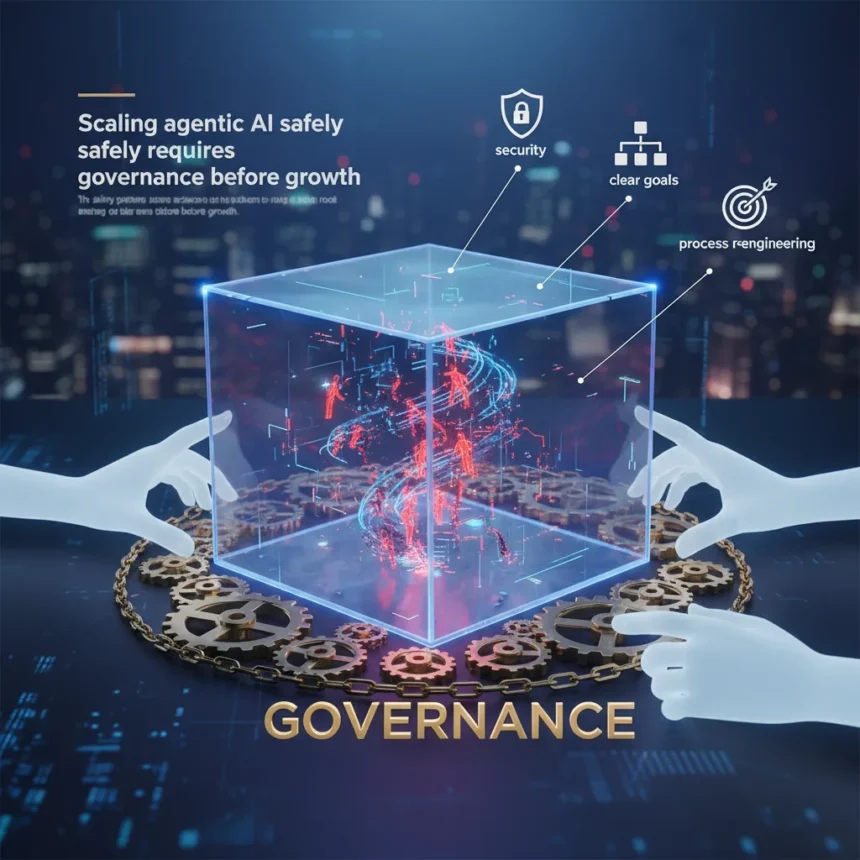
Scaling agentic AI safely is where most enterprises stumble. Agentic AI systems monitor conditions, interpret data, and trigger responses within defined limits—but the jump from controlled pilots to production-scale deployment exposes critical fragility. Workflows become unpredictable, attention spreads thin, and issues aren’t caught quickly. The difference between a successful rollout and a costly failure comes down to governance embedded from day one, not bolted on afterward.
Key Takeaways
- Agentic AI agents fail at scale without clear business goals and governance frameworks.
- Security and governance must be embedded early, including access controls, audit trails, and live monitoring.
- High-quality, governed data with role-based permissions and PII controls is non-negotiable for safe scaling.
- Business process re-engineering is essential—agentic workflows demand operational readiness, not just data architecture.
- Risk-based rollout starting with low-risk pilots and behavioral analytics reduces deployment risk.
Why Scaling Agentic AI Safely Demands Governance First
Most enterprises approach agentic AI like they approached cloud—as a technology problem. It is not. Scaling agentic AI safely is fundamentally a governance problem. Companies that delay security and governance until after agents are built face cascading failures: agents with unclear authority, unpredictable behavior, no audit trail, and no way to override decisions when they drift. The cost of fixing governance later is exponentially higher than building it in from the start.
The core challenge is autonomy itself. Traditional automation follows predetermined paths. Agentic workflows operate in networks, making decisions across multiple steps with machine-scale analysis and human-in-the-loop decision points. That autonomy is powerful—and dangerous without guardrails. Enterprises must define exactly which actions agents can take autonomously and which require human pause or override. Observing natural human interventions reveals how agents actually behave, creating feedback loops that refine agent behavior over time.
The Seven-Step Roadmap for Scaling Agentic AI Safely
Scaling agentic AI safely requires a structured approach. Start by defining exact goals for what AI agents will solve—not aspirational goals, but specific business problems that agents can actually address. Unfocused agents solve nothing and waste resources. Second, embed security and governance immediately: implement access controls, audit trails, data protections, and live monitoring before agents touch production workflows. Third, explicitly define which actions agents can take autonomously and which require human review. Monitor overrides to refine agent behavior continuously.



Fourth, ensure a strong data foundation. High-quality, governed data with clear ownership, role-based permissions, PII controls, and approved sources is non-negotiable. Fifth, build institutional knowledge infrastructure—knowledge graphs and similar systems that grow autonomously as agents operate. Sixth, re-engineer business processes for agentic workflows. This is critical: agentic AI demands operational understanding and process redesign, not just data architecture. Seventh, adopt a risk-based rollout: start with low-risk scenarios, use behavioral analytics to detect drift, and maintain clear escalation protocols.
Data Readiness: The Foundation Enterprises Overlook
Scaling agentic AI safely fails without clean, structured, secured data. Banks cannot deploy agents handling account details without secure pipelines and compliance measures. Enterprises cannot orchestrate multi-agent workflows across sensitive employee information, contracts, or financial records without explicit data governance. This is not optional—it is the difference between safe scaling and catastrophic drift.



Role-based permissions ensure agents access only what they need. PII controls prevent agents from exposing customer or employee information. Approved data sources prevent agents from pulling information from unreliable or unauthorized systems. Companies responsible for monitoring agent behavior must treat data governance like they treat employee access controls—with the same rigor, the same audit trails, the same enforcement. A governed production environment prevents drift, vulnerabilities, and unauthorized actions at scale.
Governance Frameworks That Build Stakeholder Confidence
Strong governance accelerates adoption. Stakeholders—executives, compliance teams, operations leaders—resist agentic AI because they fear unpredictable behavior. A clear governance framework addresses that fear directly. Define rules of use, escalation protocols, ethical boundaries, and operational accountability. Make these explicit and enforceable.
Agentic swarms operating at scale need governed production environments. Without governance, agents drift. Without escalation protocols, minor issues become major incidents. Without ethical boundaries, agents optimize for metrics in ways humans never intended. Companies that define these frameworks early build confidence and accelerate adoption. Those that skip this step face resistance, delayed rollouts, and reactive crisis management.
Process Re-Engineering: Why Technology Alone Fails
Scaling agentic AI safely requires business process re-engineering. Many enterprises believe readiness is about data architecture—clean databases, governed schemas, approved sources. It is not enough. Agentic workflows demand operational understanding: which human decisions can be delegated to agents, where human judgment is irreplaceable, how to structure workflows so agents operate predictably.



This is fundamentally different from traditional automation. Automation replaces manual tasks with deterministic workflows. Agentic AI handles intricate problems that monolithic systems cannot solve alone—multi-step processes, conditional logic, real-time analysis. But that complexity only works when business processes are re-engineered to support it. Enterprises that treat agentic AI as a technology overlay on existing processes fail. Those that redesign processes for autonomous agents succeed.
Risk-Based Rollout: Starting Small, Scaling Smart
Pilots are forgiving. Teams can be hands-on, monitoring closely, fixing issues quickly. Scale demands predictability. Behavioral analytics detect when agents deviate from expected patterns. Proactive deception detection catches malicious inputs before agents act on them. Clear roles, escalation protocols, and ethical boundaries prevent agents from making decisions outside their authority.
Start with low-risk scenarios: routine data processing, non-critical decision support, tasks where human override is easy. As agents prove predictable behavior and governance holds, expand to higher-risk domains. This risk-based strategy reduces deployment risk and builds organizational confidence in agentic systems.
Can enterprises deploy agentic AI without full governance from day one?
No. Enterprises that delay governance until after agents are built face costly rework. Access controls, audit trails, and data protections must be embedded early. Retrofitting governance is exponentially more expensive than building it in from the start.
What is the difference between agentic workflows and traditional automation?
Traditional automation follows predetermined paths. Agentic workflows operate autonomously across networks, making decisions with human-in-the-loop checkpoints. This autonomy is more powerful but requires governance, clear boundaries, and continuous monitoring to operate safely at scale.
How should enterprises handle human overrides of agentic decisions?
Monitor overrides as behavioral signals. When humans override agent decisions, that reveals gaps in agent training or misaligned goals. Use overrides to refine agent behavior over time, creating feedback loops that improve autonomy while maintaining control.
Scaling agentic AI safely is not a technology challenge—it is a governance challenge. Enterprises that embed security, governance, and process re-engineering early will scale confidently. Those that treat governance as optional will face unpredictable agents, regulatory risk, and delayed adoption. The path forward is clear: define goals, embed governance, ensure data readiness, and re-engineer processes. The enterprises that execute this roadmap will capture the value of agentic AI. Those that skip steps will pay the price.
Edited by the All Things Geek team.
Source: TechRadar