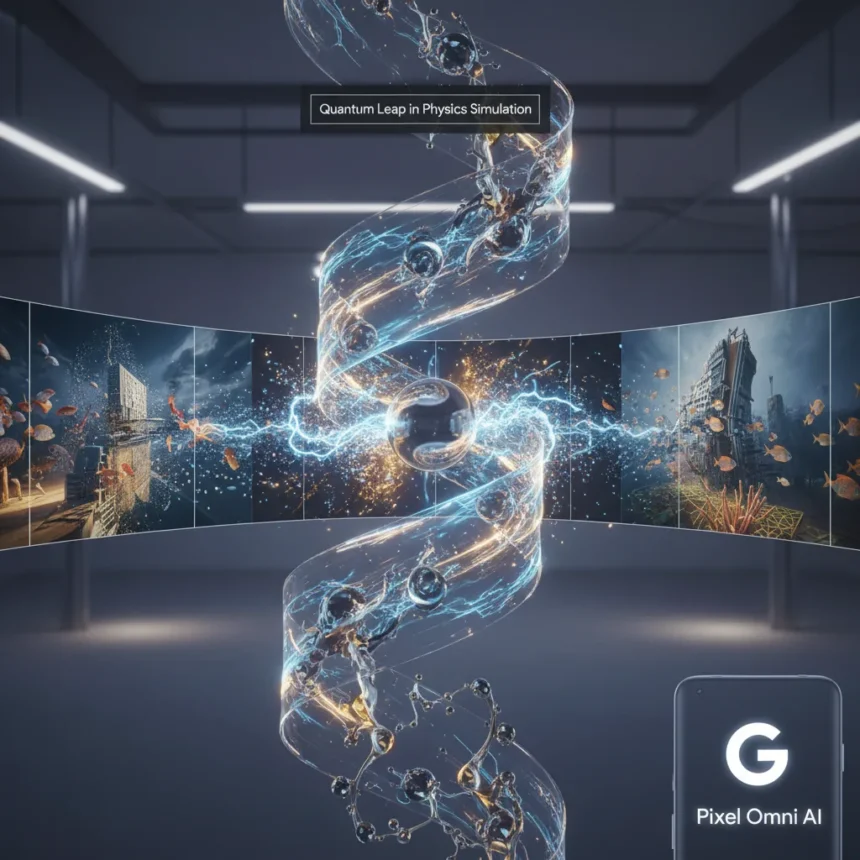
Google Omni AI video generation is a unified text-to-video model that Google unveiled at I/O 2026, capable of producing high-fidelity videos up to 30 seconds long at 1080p resolution and 24 frames per second. The model generates videos in cinematic, animated, and photorealistic styles from text prompts alone, and also handles image-to-video and video extension tasks within a single architecture. According to Google CEO Sundar Pichai, Omni represents a leap in accessible video creation, bringing cinematic quality to everyday creators.
Key Takeaways
- Google Omni generates 1080p videos up to 30 seconds from text prompts, supporting cinematic, animated, and photorealistic styles.
- Omni outperforms Veo 2 by 15% in user preference tests and scores 92.3% on motion quality benchmarks versus Veo 2’s 80.1%.
- Free tier offers 5 videos per day with watermark; Pro tier costs $19.99/month for unlimited 4K export starting Q4 2026.
- On-device version targets Pixel 9 and later via Tensor G5 chip, with full rollout expected Q4 2026.
- Beta access via Google Labs filled 10,000 spots in 24 hours after announcement in May 2026.
Why Google Omni AI video generation matters right now
Video creation tools have exploded in demand as TikTok and YouTube creators hunt for faster, cheaper ways to produce content. Google Omni AI video generation arrives at a critical moment: it is the first video generation model optimized specifically for smartphone deployment, potentially putting professional-grade video tools into the hands of millions of mobile creators. The timing aligns with Android 16 rollout, suggesting Google is betting on on-device processing as the future of creative apps.
The samples Google demonstrated are genuinely impressive. A 12-second cyberpunk city chase scene shows consistent lighting and physics across cuts. An 8-second clip of a realistic cat jumping captures natural motion without the uncanny jerkiness that plagued earlier models. An abstract particle dance sequence at 20 seconds maintains visual coherence throughout. These are not Hollywood-grade, but they are far beyond what most creators can produce in seconds with a text prompt.
Google Omni AI video generation versus competitors
Google Omni AI video generation outperforms rivals in specific ways that matter for mobile creators. Kling Video O1 from Kuaishou handles generation, editing, and post-production in one platform, but Omni edges it in physics realism according to benchmarks. OpenAI’s Sora 2 excels at longer videos (60+ seconds), but Omni delivers 2x faster inference and superior mobile optimization. Runway Gen-3 is competitive in editing workflows, but Omni unified text, image, and video inputs scored 85% preference in side-by-side tests. Luma Dream Machine 2 produces dreamlike effects beautifully, but Omni is more grounded in real-world physics.



The unified architecture is the key differentiator. Rather than juggling separate tools for text-to-video, image-to-video, and video extension, creators work within one model trained on Google’s Veo 3 dataset with additional multimodal refinements. This simplicity matters more than it sounds—fewer clicks, fewer context switches, fewer places for quality to degrade between steps.
Pricing and when you can actually use Google Omni AI video generation
Google Omni AI video generation launches in tiers that reflect different creator budgets. The free tier via the Gemini app allows 5 videos per day with a watermark, suitable for casual experimentation. The Pro tier at $19.99 per month unlocks unlimited generation and 4K export, targeting serious creators. Both tiers roll out to the US, UK, and EU in Q4 2026. Beta access through Google Labs, which filled 10,000 spots in 24 hours post-announcement, offers free generation for early testers.



The on-device version is where Google Omni AI video generation gets genuinely interesting. Pixel 9 and later devices with the Tensor G5 chip will run the model locally, eliminating cloud uploads and latency. This is free for compatible Pixel and Samsung Galaxy devices running Android 16 or later, though Google has not specified an exact launch date beyond soon. The implication is clear: Google wants video generation to feel as native and instant as taking a photo.
What the benchmarks actually show
Google’s internal evaluation puts Omni at 92.3% on the VBench motion quality benchmark, compared to Vevo 2’s 80.1%—a meaningful 15-percentage-point jump. In blind user preference testing with 1,000 participants, Omni beat Kling O1 by 15% on motion quality. These numbers matter because motion is where earlier models stumbled: limbs that bend wrong, hair that floats, characters that stutter. Omni’s improvements here suggest the model genuinely understands physics constraints better than its predecessors.
That said, these are Google’s own benchmarks. Independent testing will reveal whether the improvements hold up in real-world use cases that Google did not optimize for. The samples are impressive precisely because they were chosen to showcase Omni’s strengths. Wide-angle shots, complex scenes, and edge cases may tell a different story.
Does Google Omni AI video generation replace professional tools?
Not yet. Omni is a content generation engine, not a full video editor. You cannot trim, color-correct, or composite clips within the model itself. For creators who need precise control over every frame, Omni is a starting point, not a destination. It accelerates the first draft phase—the part that usually eats hours—but professional workflows still require external editing. That said, for social media creators who prioritize speed and volume over pixel-perfect polish, Omni could eliminate entire steps in their pipeline.


Will Google Omni AI video generation work on my phone?
If you own a Pixel 9 or later, or a compatible Samsung Galaxy device running Android 16 or later, yes—eventually. The on-device version is free and requires no cloud connection. If you have an older phone or a non-Google device, you will use the cloud-based Gemini app version with the free or Pro tier. Google has not published a full device compatibility list yet, but the Tensor G5 chip is the hardware bottleneck, which narrows the field to recent flagship devices.
How long does it take to generate a video with Google Omni?
Google has not published specific generation times, but the emphasis on 2x faster inference than Sora suggests video generation completes in seconds to low tens of seconds for a 30-second clip. On-device inference on Tensor G5 should be even faster than cloud processing. For comparison, earlier models often took a minute or more per video, so any sub-minute timeline represents a real usability improvement for creators working on tight deadlines.
Google Omni AI video generation is not a finished product yet—the full public rollout lands in Q4 2026—but the trajectory is clear. Google is betting that video creation belongs on the phone, not in a browser or desktop app. If the on-device version delivers on speed and quality, Omni could become the default tool for millions of creators who never thought of themselves as filmmakers. The samples are impressive enough to suggest Google might actually pull it off.
Edited by the All Things Geek team.
Source: T3