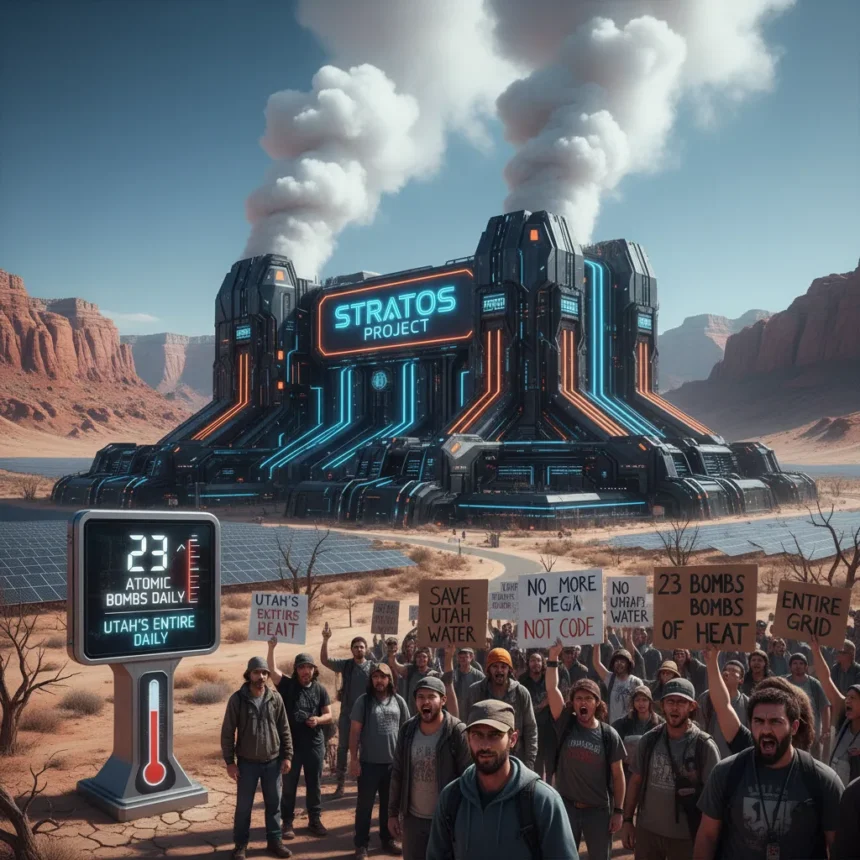
The Stratos Project AI data center in rural Utah represents a collision between America’s AI arms race and environmental preservation, with a proposed facility in Hansel Valley that would fundamentally alter the region’s climate and ecosystem. The project, planned for Box Elder County at the north end of the Great Salt Lake, would consume 9 gigawatts of electricity at full buildout—more than double the entire state of Utah’s current electricity usage. Local residents and environmental experts are not just concerned; they are terrified of what this facility would do to their fragile desert landscape.
Key Takeaways
- Stratos Project will consume 9GW of power, exceeding Utah’s total state electricity use by 100 percent.
- Thermal output of 16GW is equivalent to 23 atomic bombs worth of energy dumped daily into the local environment.
- Predicted temperature increases: daytime rises of 5°F, nighttime spikes up to 28°F, potentially creating a Sahara-like heat island.
- Recent water diversion application was withdrawn after thousands of local complaints from Utah residents.
- Physics and ecology professors from Utah State University and Brigham Young University have publicly challenged the project’s environmental viability.
Why the Stratos Project Matters Right Now
The Stratos Project has become a flashpoint in America’s AI infrastructure race at a moment when data center energy demands are spiraling out of control. This is not an abstract debate—it is happening in a specific place with specific people who will experience the consequences. The project’s recent water diversion application pullback, triggered by thousands of complaints, signals that public resistance to mega-scale AI facilities is hardening. Tech companies can no longer assume that rural communities will quietly accept industrial transformation in the name of technological progress.
What makes Stratos uniquely alarming is the scale of its thermal footprint. Robert Davies, a physics professor at Utah State University, calculated that the facility’s servers would convert power into 7 to 8 gigawatts of thermal energy, and when combined with power generation systems, the total thermal load reaches 16 gigawatts. Davies’s calculation—that this equals about 23 atom bombs worth of energy dumped into the local environment every single day—is not hyperbole designed for headlines. It is a physicist’s attempt to make an incomprehensible number concrete.
The Environmental Cost of Hansel Valley’s Transformation
Hansel Valley is a high desert area that has remained largely undeveloped. The Stratos Project would change that entirely. Local daytime temperatures could rise by 5°F, but nighttime temperatures could spike by up to 28°F—a figure that suggests the area could become a permanent heat island resembling the Sahara. For a desert ecosystem already stressed by the declining Great Salt Lake, this is not an adaptation challenge; it is an existential threat.



Ben Abbott, an ecology professor at Brigham Young University, articulated the core problem: if a facility this massive is dumping heat, pollution, and noise into the environment, the region loses a critical chunk of its natural character and ecological function. The Great Salt Lake is already facing severe environmental strain from water diversion and climate change. Adding a thermal load equivalent to 23 daily atomic bombs is not a solution—it is an accelerant.
The water diversion application that was pulled back after public complaints reveals how much pressure communities are willing to exert when they understand what is at stake. Thousands of Utah residents recognized that losing access to Salt Wells Spring stream was not a separate issue from the data center—it was part of a single industrial footprint that would consume resources and reshape the landscape in ways that cannot be undone.



AI Data Centers and the Energy Crisis They Create
The Stratos Project is not unique in its hunger for power, but its scale and location make it a test case for how America will balance AI development with environmental survival. Data centers already consume roughly 1-2 percent of global electricity. As AI models grow larger and training demands intensify, that percentage will climb steeply. Companies like OpenAI, Google, and Microsoft are racing to secure energy-intensive infrastructure, and rural areas with available land and lower regulatory friction are obvious targets.
What distinguishes Stratos is the willingness of its proponents to build in a location where the environmental cost is not abstract—it is visible, measurable, and borne by people who did not choose to participate in the AI arms race. The facility would not just consume electricity; it would reshape the microclimate of a region that depends on stable temperature and water patterns for its survival. That is not a trade-off that should be made quietly or without the explicit consent of the communities affected.
What Comes Next for Stratos?
The project remains in the proposal stage, but the momentum is uncertain. The withdrawn water application suggests that local opposition is effective when organized and vocal. However, tech companies have deep pockets and political connections, and the pressure to build AI infrastructure is real. The question is whether Utah’s communities will continue to resist, or whether economic arguments about jobs and tax revenue will eventually overcome environmental concerns.
What is clear is that the Stratos Project has become a symbol of a larger conflict: the clash between industrial ambition and environmental stewardship. If Stratos moves forward, it will signal that AI development trumps local environmental protection. If it stalls or is abandoned, it will suggest that communities can still push back against mega-scale industrial projects that threaten their survival.


Can AI data centers ever be environmentally sustainable?
Sustainable AI data centers require renewable energy sources, efficient cooling systems, and careful siting that minimizes environmental impact. The Stratos Project’s location in a fragile desert ecosystem near the Great Salt Lake makes sustainability nearly impossible, regardless of power source, because the thermal output alone would alter the region’s climate. A truly sustainable approach would mean building data centers in cooler climates where waste heat can be more easily dissipated, or dramatically reducing the size and power requirements of individual facilities.
Why is the Great Salt Lake relevant to the Stratos Project?
The Great Salt Lake is already experiencing severe environmental stress from water diversion and climate change, with declining water levels threatening ecosystems and air quality. The Stratos Project’s water diversion application and massive thermal output would add additional strain to an ecosystem that cannot absorb it. Building a facility this large in proximity to an already-fragile lake is environmentally reckless.
What do Utah State and Brigham Young University professors say about Stratos?
Robert Davies at Utah State University calculated that the facility’s thermal output equals 23 atom bombs worth of energy daily, while Ben Abbott at Brigham Young University emphasized that the project would destroy the region’s ecological function and natural character. Both experts have publicly opposed the project based on environmental grounds.
The Stratos Project is a test of whether America’s AI ambitions will be constrained by environmental reality or whether tech companies will continue to externalize the costs of their infrastructure onto rural communities and fragile ecosystems. The answer will shape how we build AI in the decade ahead.
Edited by the All Things Geek team.
Source: Tom's Guide