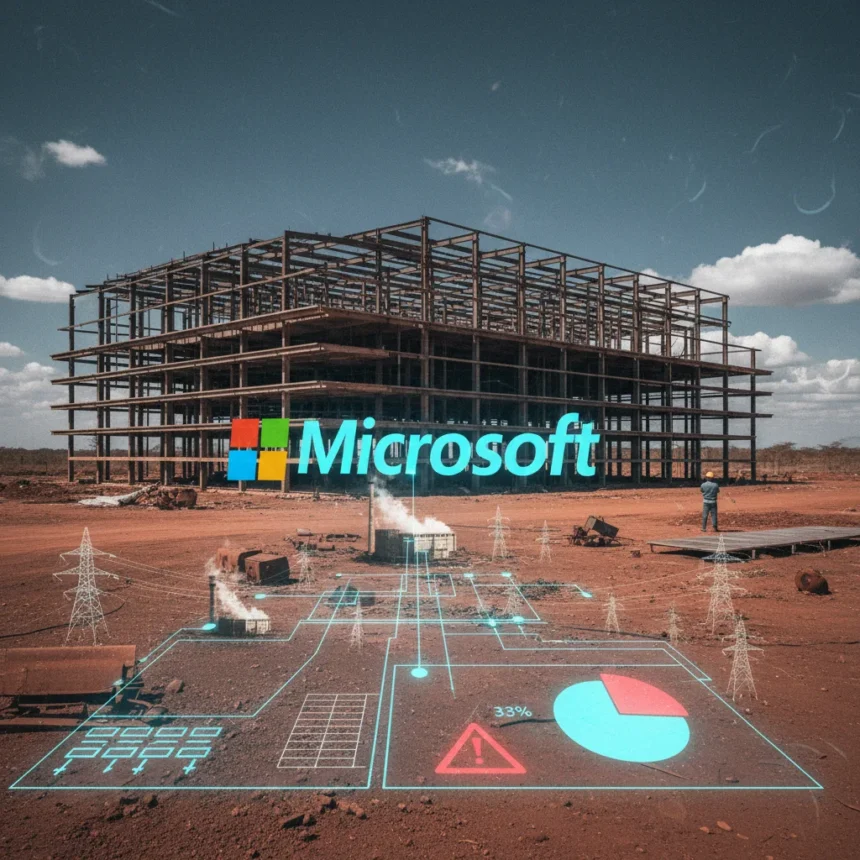
Microsoft’s $1 billion AI data center project in Kenya has stalled, exposing a fundamental crisis in AI infrastructure: the explosive power demands of AI data center power requirements are colliding head-on with the electrical grids of developing nations. President William Ruto was blunt about it: to power the facility, Kenya would need to “switch off power for half the country.”
Key Takeaways
- Microsoft and G42’s $1B geothermal data center would require 1,000MW, roughly one-third of Kenya’s 3,000MW national capacity.
- Kenya suspended the project in late 2024 due to insufficient power infrastructure and grid capacity constraints.
- The data center was planned for Olkaria, where KenGen operates over 700MW of geothermal generation capacity.
- AI data center power requirements are forcing hyperscalers to confront infrastructure limits in regions with weak grids.
- EcoCloud’s competing Project Eagle, a smaller 24MW geothermal facility at the same location, represents a more realistic near-term alternative.
Why a $1B AI Project Just Hit a Brick Wall
Kenya announced the partnership with Microsoft and Dubai-based AI firm G42 in May 2024 during President Ruto’s state visit to Washington. The vision was ambitious: a geothermal-powered AI data center campus in Olkaria, about 100 kilometers northwest of Nairobi in the Rift Valley, designed to anchor a new East Africa Azure cloud region. Initial capacity was pegged at 100 megawatts of IT load, expandable to 1 gigawatt. The project was supposed to be operational within 24 months of signing definitive agreements.
Then reality intervened. Kenya’s total national installed power capacity sits at roughly 3,000 megawatts. The data center alone would demand approximately 1,000 megawatts—consuming one-third of the country’s entire grid. For context, that means running the facility at full capacity would require Kenya to shut off power to half its population. Ruto later explained the decision to suspend the project: “the project would have consumed a disproportionate share of the country’s electricity supply.” No amount of geothermal energy sourcing changes the basic math: Kenya simply does not have enough power to spare.
This is not a story about green energy failing. Kenya’s Olkaria geothermal fields, operated by Kenya Electricity Generating Company (KenGen), generate over 700 megawatts of clean power. The data center was designed to run entirely on geothermal energy with advanced water conservation technology. The problem is that even renewable energy has hard limits when the grid is already strained. Kenya’s infrastructure cannot absorb a 1,000-megawatt consumer without collapsing service elsewhere.


AI data center power requirements are reshaping global infrastructure planning
The Kenya suspension is a warning signal for the entire developing world. Hyperscalers like Microsoft are racing to build AI capacity globally, but they are running headlong into grids that were never designed for facilities consuming hundreds of megawatts. A smaller competing project, EcoCloud’s Project Eagle—also backed by G42 and also in Olkaria—started with a more modest Phase 1 footprint of just 24 megawatts across eight 3-megawatt halls. That project broke ground in 2023 and represents the kind of incremental scaling that actual infrastructure can support.
The broader tension is stark: AI data center power requirements are doubling and tripling globally as companies compete to build the next generation of training infrastructure. Yet in regions with developing economies and aging grids, the math does not work. A facility that would be routine in North America or Europe becomes impossible in Kenya, not because of political opposition or technology gaps, but because the electrical system simply cannot handle it.



This creates a vicious cycle. Developing nations want the economic benefits of cloud infrastructure and AI investment. But they cannot afford the grid upgrades needed to support hyperscale facilities. Meanwhile, hyperscalers are caught between their climate commitments (geothermal power in Kenya sounds good) and their capacity demands (1,000 megawatts is what the business model requires). The Kenya project exposed this contradiction in the starkest possible terms.
What happens to the $1 billion investment now?
As of early 2025, the Microsoft-G42 project remains suspended with no confirmed resumption date or revised timeline. The investment has not been cancelled outright, but it is effectively frozen until Kenya can either upgrade its grid infrastructure dramatically or Microsoft and G42 agree to scale back the facility to something the grid can actually handle. Neither seems imminent.
The real lesson is not about Kenya specifically. It is about the limits of AI infrastructure ambitions in regions where power grids are already stretched. If Kenya—which has substantial geothermal resources and a partnership with two of the world’s largest tech companies—cannot make a 1-gigawatt data center work, which developing nations can? The answer may be: none of them, at least not without years of grid modernization that costs billions and diverts resources from other infrastructure needs.
Is the Microsoft Kenya data center project cancelled?
The project is suspended, not officially cancelled. Kenya’s government halted it due to insufficient power capacity and infrastructure gaps, but Microsoft and G42 have not withdrawn the investment entirely. However, no timeline for resumption has been announced, and major revisions to the original 1,000-megawatt plan would likely be required before the project could proceed.



What are the AI data center power requirements for Microsoft’s facility?
The initial phase was designed for 100 megawatts of IT load, expandable to 1 gigawatt. At full scale, the facility would require approximately 1,000 megawatts of power—roughly one-third of Kenya’s entire national electrical capacity. This demand was the core reason the government suspended the project.
Could a smaller geothermal data center work in Kenya instead?
Yes. EcoCloud’s Project Eagle, a competing 24-megawatt geothermal facility in the same Olkaria region, demonstrates that smaller-scale AI infrastructure is feasible with Kenya’s current grid. That project broke ground in 2023 and represents a more realistic near-term model for cloud expansion in the region. However, it provides a fraction of the capacity Microsoft and G42 were aiming for.
The Kenya suspension is a watershed moment for AI infrastructure planning. It proves that raw ambition and clean energy sources are not enough—the electrical grid itself is now the bottleneck constraining AI’s global expansion. Until developing nations invest heavily in grid modernization, hyperscale AI data centers will remain out of reach. For Microsoft and G42, the $1 billion project serves as an expensive lesson: AI’s power hunger has finally hit a limit that no amount of geothermal energy can overcome.
Edited by the All Things Geek team.
Source: Tom's Hardware