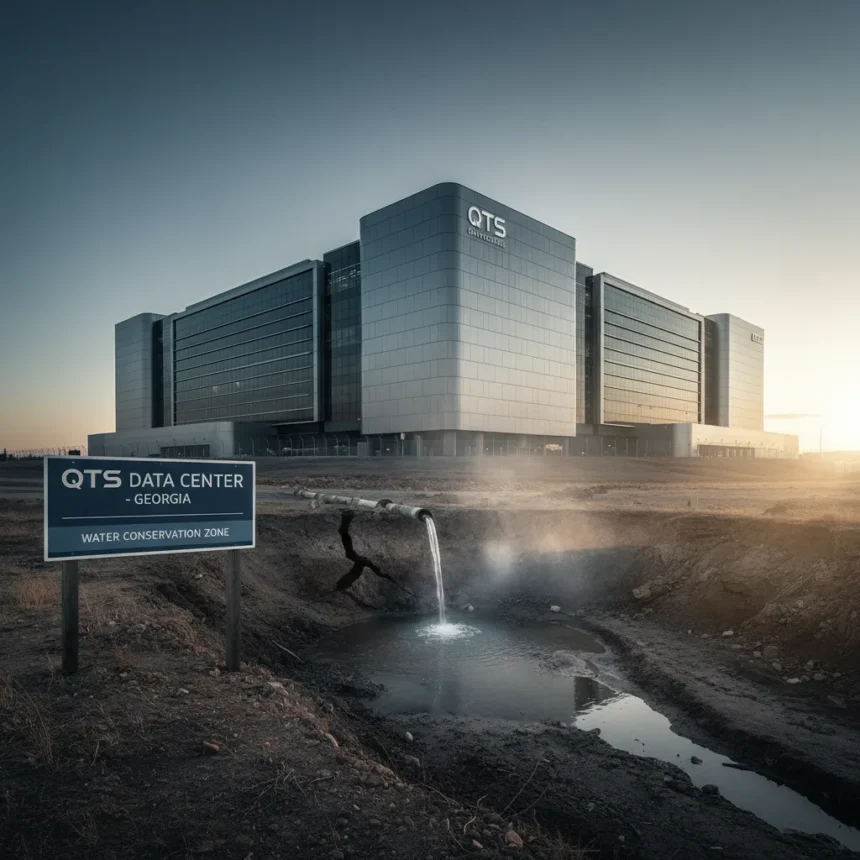
Data center water consumption has emerged as a critical infrastructure vulnerability in the United States, and a recent incident in Fayetteville, Georgia, exposes how easily massive facilities can operate outside regulatory oversight. A QTS data center campus, spanning 6.2 million square feet, secretly drew 29 million gallons of water over 15 months before residents complaining about low water pressure forced local utilities to investigate. The discovery raises urgent questions about how AI-driven infrastructure expansion is straining regional water systems while regulators struggle to keep pace.
Key Takeaways
- QTS data center in Georgia consumed 29 million gallons of water over 15 months without proper authorization.
- Residents detected the unauthorized use only after experiencing low water pressure in their homes.
- Local officials declined to fine the 6.2 million-square-foot facility despite the massive breach.
- QTS attributes the consumption to temporary construction activities including concrete work and dust control.
- The company claims its closed-loop cooling system will limit long-term water use to the equivalent of four U.S. households per month.
How the Georgia Data Center Water Breach Went Undetected
Data center water consumption monitoring failed spectacularly in Fayetteville because the local water utility was simultaneously upgrading to a cloud-based management system while trying to accommodate an industrial customer. The utility discovered two unaccounted-for water connections at the QTS site only after residents reported pressure drops in their lines. This dual transition—new software infrastructure plus new industrial demand—created a gap that a 6.2 million-square-foot facility exploited for over a year. The incident illustrates a fundamental problem: as data centers expand rapidly across the country, water authorities lack real-time visibility into consumption patterns at major industrial users. A single oversight in a management system transition allowed QTS to draw 29 million gallons without triggering alerts.
The timing of the discovery matters. Residents noticed the pressure drop, investigated, and forced the utility’s hand—not regulatory inspections or proactive monitoring. This reactive model is increasingly inadequate as data center clustering accelerates in water-stressed regions. Georgia’s data center boom, driven partly by AI infrastructure buildout, is outpacing the regulatory infrastructure designed to protect public water supplies. The Fayetteville case suggests that without mandatory real-time metering and automated alerts, similar breaches are likely occurring undetected elsewhere.
QTS’s Explanation and the Cooling System Question
QTS attributes the 29 million gallons to temporary construction-related activities, including concrete work, dust control, and site preparation—not cooling operations. The company maintains that once fully operational, the facility will employ a closed-loop cooling system that consumes water only for domestic purposes (bathrooms, kitchens, and similar uses), equivalent to roughly four U.S. households per month. This claim is critical because it separates the unauthorized past consumption from the company’s promised future footprint. However, the distinction between temporary and operational water use raises a downstream question: what happens if the closed-loop system requires maintenance, upgrades, or emergency flushing? The research brief does not provide independent verification of QTS’s cooling efficiency claims or monitoring protocols to ensure the company stays within its stated domestic-use target.


Data center water consumption varies dramatically depending on cooling architecture. QTS’s closed-loop design is more efficient than open-loop systems that require continuous water cycling, but the company’s claim of minimal long-term consumption assumes perfect system performance. Any cooling system failure, expansion, or seasonal demand spike could require additional water draws. The Fayetteville case demonstrates that without active oversight, a facility can justify massive consumption as temporary, complete construction years behind schedule, and avoid penalties while local residents absorb the water-pressure impact.
Why Local Officials Refused to Fine a Major Violator
The decision by Fayetteville officials not to fine QTS despite 29 million gallons of unauthorized consumption reveals the economic calculus that governs data center regulation at the local level. A 6.2 million-square-foot facility represents significant tax revenue, job creation, and regional prestige in a competitive market for AI infrastructure investment. Penalizing QTS aggressively risks deterring future data center projects or prompting the company to relocate expansion plans to a more permissive jurisdiction. This dynamic—where local governments prioritize industrial recruitment over resource protection—is not unique to Fayetteville but is amplified by the speed and scale of data center expansion.



The lack of fines also signals weak enforcement mechanisms. If a facility can consume 29 million gallons without authorization and face no financial penalty, the deterrent value of water regulations collapses. Competing municipalities watching the Fayetteville outcome may conclude that aggressive oversight is economically risky, creating a race to the bottom in water governance. Georgia, already facing water stress in metro areas, cannot afford a regulatory environment where major industrial users operate with impunity.
Data Center Water Consumption as a Growing Regional Crisis
The Fayetteville incident is not an isolated failure but a symptom of a broader mismatch between data center expansion and water infrastructure capacity. AI-driven data center clustering is accelerating precisely in regions—the Southeast, Southwest, and parts of the Midwest—where water scarcity is already a constraint. Data centers now consume water at scales comparable to entire municipalities, yet they operate under regulatory frameworks designed for smaller industrial users. The QTS facility is still actively building and expects completion in three to five years, meaning its actual operational footprint and water demand remain uncertain.
What makes the Fayetteville case particularly troubling is its invisibility. Residents discovered the breach through a side effect—low water pressure—not through transparent reporting or public notification. If the QTS facility had not created a pressure drop noticeable to homeowners, the 29 million gallons might still be flowing undetected. This suggests that similar breaches at other data centers could be occurring in jurisdictions with less attentive residents or less responsive utilities. The Georgia case should prompt states and the federal government to mandate real-time water metering, public disclosure of consumption data, and enforceable penalties that actually deter violations.
Is the QTS data center still under construction?
Yes. QTS is actively building and expanding the Fayetteville campus and expects completion in three to five years. The facility is not yet at full operational capacity, meaning its long-term water consumption profile remains to be tested in real-world conditions.



What is the closed-loop cooling system QTS claims to use?
A closed-loop cooling system recirculates water internally without requiring continuous fresh-water intake for heat dissipation. QTS claims its system will limit water consumption to domestic uses only (bathrooms, kitchens) equivalent to about four U.S. households per month once operational. The claim has not been independently verified through published monitoring data.
Why did local officials decline to fine the QTS facility?
The research brief does not provide explicit statements from officials explaining their decision. However, the refusal to fine a 6.2 million-square-foot facility suggests that local government prioritized economic development incentives and tax revenue over enforcement of water regulations, a pattern common in competitive data center recruitment markets.
The Georgia data center water breach is a watershed moment—literally and figuratively—for how the United States governs AI infrastructure expansion. Until local governments and regulators establish transparent metering, real-time monitoring, and enforceable penalties that actually deter violations, data centers will continue to treat water as an unaccounted externality. The residents of Fayetteville detected the problem only by accident. The next breach might go undetected for years.
Edited by the All Things Geek team.
Source: Tom's Hardware