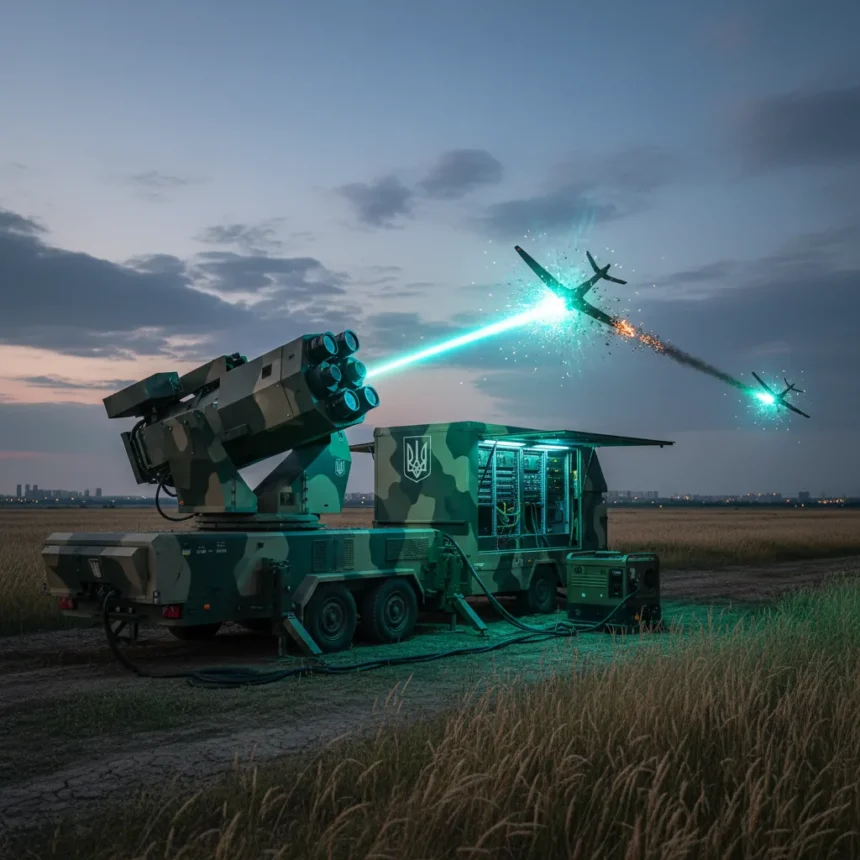
Ukraine’s Trizub laser system represents a significant leap in air defense technology, designed specifically to counter the growing threat of Iranian Shahed drones supplied to Russian forces. The Trizub laser system, developed by Celebra Tech, is a mobile, trailer-mounted weapon that can engage and disable unmanned aerial vehicles from distances up to 5 kilometers (3.1 miles), with the system currently in final testing stages as of May 2026.
Key Takeaways
- Trizub can engage Shahed-type drones from 5 kilometers, significantly extending Ukraine’s air defense range
- AI-assisted targeting system automatically detects, tracks, and locks onto aerial targets without human intervention
- Laser can disrupt drone electronics or damage airframes during engagement
- System entered final testing in May 2026 after development began in December 2024
- Secondary utility for demining operations expands the weapon’s operational value beyond air defense
How the Trizub Laser System Works
The Trizub laser system operates through a multi-stage autonomous targeting process. Detection begins when the AI-assisted targeting system automatically identifies aerial targets, then tracks their flight path and locks onto them for engagement. The system synchronizes with radar stations to improve targeting accuracy and reduce response time, allowing it to engage targets moving at speeds up to 800 kilometers per hour. Once locked, the laser fires to either disrupt drone electronics or damage the airframe, disabling the target.
The engagement ranges vary depending on target type: reconnaissance drones can be engaged up to 1.5 kilometers away, first-person-view (FPV) drones up to 900 meters, and larger unmanned aerial vehicles like Shahed-type drones up to 5 kilometers in the current configuration. This tiered capability allows Ukrainian forces to adapt to different drone threats across multiple operational scenarios. The system’s mobility—mounted on a trailer for rapid redeployment—gives it tactical flexibility that stationary air defense installations cannot match.
Demonstrated Effectiveness Against AI-Enhanced Threats
Public demonstrations in April 2025 showed the Trizub laser system successfully striking both stationary ground targets and moving aerial targets. In one notable engagement, the laser blinded the fiber-optic camera on an FPV drone, causing immediate loss of control and visual navigation capability. This capability directly addresses an emerging threat: Russia has begun deploying AI-enhanced variants of the Shahed-136 drone equipped with thermal imaging, visible-spectrum cameras, Nvidia Jetson AI processors, and four-antenna satellite navigation systems resistant to GPS jamming.



The timing of Trizub’s development is critical. Ukrainian defense officials have expressed alarm at the autonomous capabilities now appearing in Russian-supplied drones. An anonymous senior Ukrainian defense official stated that the addition of machine vision and thermal tracking transforms Shahed drones from blind kamikaze weapons into semi-autonomous hunters. Celebra Tech countered this threat directly, stating that the Trizub is practically capable of reaching targets at 5 kilometers distance, allowing for effective engagement of Shahed-type unmanned aerial vehicles.
Trizub laser system compared to other Ukrainian air defense
Ukraine has developed multiple AI-enhanced air defense systems in parallel. The Sky Sentinel, another Ukrainian air defense turret equipped with heavy machine guns and AI-based targeting, can engage targets at speeds up to 800 kilometers per hour and has proven effective against drones five times smaller than Shaheds. However, Sky Sentinel requires constant visual lock on its target and uses real-time calculations without guided munitions, making it fundamentally different from the laser-based approach.



The Trizub laser system offers advantages in range and speed of engagement compared to traditional gun-based systems. Where Sky Sentinel relies on ballistic trajectory calculations and ammunition resupply, the Trizub operates at the speed of light with no physical ammunition requirement. The laser approach also eliminates the acoustic and visual signature of gunfire, reducing the system’s detectability to enemy forces. However, the Trizub’s laser engagement depends on atmospheric conditions—dust, smoke, and precipitation can degrade performance—whereas ballistic systems are less affected by weather.
Secondary applications beyond air defense
The research brief notes that the Trizub laser system has utility for demining operations, though specific technical details on how the laser would be employed for this purpose are not disclosed. This dual-use capability suggests the system’s high-power laser could potentially detonate or disable explosive ordnance from a safe distance, though operational procedures for demining remain undisclosed.
What happens next for the Trizub system?
The Trizub laser system remains in final testing as of May 2026, with no confirmed deployment date or production timeline disclosed. Celebra Tech has not announced quantity orders, planned production numbers, or pricing information. The transition from testing to operational deployment typically requires validation against real-world combat conditions, integration with existing Ukrainian air defense networks, and logistics planning for supply and maintenance. Given the rapid development timeline—approximately 18 months from December 2024 to May 2026—deployment could occur within months of testing completion, though no official timeline has been announced.
Can the Trizub laser system operate in all weather conditions?
The research brief does not specify performance degradation in rain, snow, dust, or fog. Laser systems generally perform best in clear atmospheric conditions, but the Trizub’s operational envelope in adverse weather is not disclosed. This represents a potential limitation compared to radar-guided systems, which function regardless of visibility.


How does the Trizub compare to Western air defense systems?
The research brief does not provide comparative data with NATO-standard air defense systems like the Patriot or IRIS-T. The Trizub’s 5-kilometer engagement range positions it as a medium-range system suitable for point defense rather than area defense, but direct performance comparisons with Western systems are not available.
Ukraine’s Trizub laser system represents a pragmatic response to a specific, immediate threat. Developed under wartime pressure and entering final testing within 18 months, it addresses the growing sophistication of Russian-supplied drones with a technology that offers speed, precision, and sustainability advantages over traditional ammunition-based systems. Whether it proves effective in sustained combat operations remains to be seen, but its development signals that Ukrainian defense innovation is keeping pace with emerging threats in real time.
Edited by the All Things Geek team.
Source: Tom's Hardware