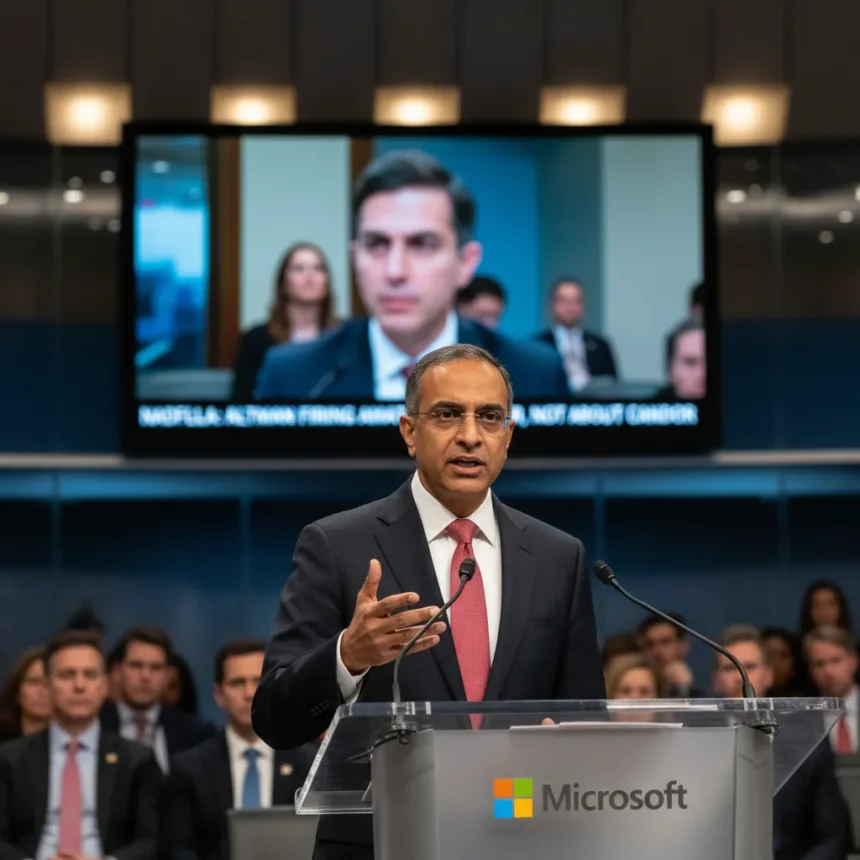
Satya Nadella, Microsoft’s CEO, took the stand on May 11, 2026, in the federal Musk v. Altman trial in Oakland, California, delivering testimony that directly undermines Elon Musk’s case against OpenAI and Sam Altman. In week three of the high-stakes litigation, Nadella characterized the 2023 removal and reinstatement of Altman as “amateur city”—a blunt assessment that contradicts Musk’s framing of the firing as a justified response to Altman’s communication style.
Key Takeaways
- Nadella testified that Musk never raised concerns directly despite having his contact information
- Microsoft has invested over $13 billion in OpenAI across three deals since 2019
- Nadella showed jurors an email where Musk thanked him for financial support in 2016
- The Musk v. Altman trial seeks damages as high as $150 billion
- Nadella denied that Microsoft demanded Altman’s reinstatement, framing it as stabilization
Why Nadella’s “Amateur City” Remark Matters
Nadella’s characterization of Altman’s firing as mismanagement directly challenges Musk’s lawsuit narrative. Musk is pursuing damages of as much as $150 billion, alleging that Microsoft aided and abetted OpenAI’s breach of its nonprofit mission by funding its transition to a for-profit structure. By calling the firing “amateur city,” Nadella suggested it was bungled execution rather than a principled stand against Altman’s communication approach. The testimony carries weight because Nadella was not defending Altman’s conduct—he was attacking the decision-making process itself. This distinction matters to jurors trying to determine whether the firing reflected legitimate governance concerns or merely internal chaos.
What makes Nadella’s position particularly damaging to Musk’s case is the simplicity of his counterargument: if Musk had genuine concerns about OpenAI’s direction, he could have called. Nadella testified that “We have each other’s phone numbers,” and even showed jurors an email from 2016 in which Musk thanked him for financial and computing support for OpenAI. The implication is stark—Musk’s silence throughout Microsoft’s expanding partnership with OpenAI suggests his objections are retroactive rather than principled.
Microsoft’s Role in the Musk v. Altman Trial
Microsoft is named as a defendant in the Musk v. Altman trial, accused of knowingly facilitating OpenAI’s shift away from its nonprofit charter. Nadella’s testimony reframes Microsoft’s involvement as straightforward business partnership rather than conspiracy. Microsoft has invested more than $13 billion in OpenAI across deals in 2019, 2021, and 2023, with the largest single investment at $10 billion in 2023. Nadella testified that Microsoft was a for-profit company with responsibility to shareholders, not a co-conspirator in some scheme to hollow out OpenAI’s charitable mission.



The partnership structure itself became central to Nadella’s defense. Microsoft obtained an exclusive license to develop commercial products from OpenAI’s technology—though OpenAI retained the same right—and embedded 20 full-time employees at OpenAI under a future arrangement entitling Microsoft to one embedded employee for every 10 OpenAI employees. Nadella denied demanding Altman’s reinstatement, characterizing Microsoft’s stabilization efforts as prudent risk management for a $13 billion investment. Musk’s attorney, Marc Toberoff, countered that Nadella was instrumental in Altman’s reinstatement and in choosing a new board for the nonprofit, but Nadella’s testimony stood firm on the distinction between supporting a partner and orchestrating corporate governance.
Musk’s Silence Undermines His Own Case
Perhaps the most damaging element of Nadella’s testimony is the timeline of Musk’s complaints. Nadella testified that Musk never raised concerns with him directly as Microsoft’s lucrative licensing and revenue-sharing partnership with OpenAI grew. Musk only began pursuing legal action in 2024, years after the investments and partnerships were public knowledge. This gap between Musk’s inaction and his later lawsuit suggests to jurors that his objections may be motivated by something other than principled concern for OpenAI’s nonprofit mission. Nadella’s evidence—the 2016 thank-you email, the lack of direct complaints—paints a picture of a founder who benefited from Microsoft’s involvement and only cried foul when his influence waned.



Musk’s own testimony had already revealed some of this weakness. He stated that he was “concerned they were really trying to steal the charity” and claimed “I was foolish enough to believe him” regarding Altman’s commitments to the nonprofit structure. But these concerns, according to Nadella’s account, were never communicated to the one person in a position to address them directly. The trial is now in its third week as of May 12, 2026, with closing arguments potentially coming Thursday and Sam Altman scheduled to testify later in the week.
Why This Trial Matters Beyond the Courtroom
The Musk v. Altman trial raises fundamental questions about nonprofit-to-for-profit transitions in the AI industry and who bears responsibility when those transitions occur. Musk co-founded OpenAI as a nonprofit in 2015 but stepped down from its board in 2018, ceding governance to others. His lawsuit now alleges that Microsoft’s massive investments corrupted OpenAI’s mission, but Nadella’s testimony suggests Musk simply lost influence and is now seeking damages to reclaim it. OpenAI’s attorney, William Savitt, characterized Nadella’s testimony as “compelling, candid, straightforward,” language that reflects the advantage Nadella’s account gives to OpenAI’s defense. The trial outcome will determine not just whether Microsoft owes Musk $150 billion but whether founders retain claims on organizations they’ve left and whether large corporate partnerships are inherently corrupting to nonprofit structures.
Did Nadella demand Sam Altman’s reinstatement?
Nadella testified that Microsoft did not demand Altman’s reinstatement, characterizing its role as stabilization of a partner company facing internal chaos. However, Musk’s attorney argued that Nadella was instrumental in both Altman’s reinstatement and in selecting a new board for OpenAI’s nonprofit. The distinction between “demanding” and “facilitating” may prove crucial to how jurors interpret Microsoft’s leverage over OpenAI’s governance.
What does “amateur city” mean in Nadella’s testimony?
Nadella used “amateur city” to describe the process of firing and reinstating Altman in 2023, suggesting the decision-making was bungled and poorly executed. Rather than defending the firing as justified, he characterized it as mismanagement, which undermines arguments that Altman’s communication style warranted removal.


How much has Microsoft invested in OpenAI?
Microsoft has invested more than $13 billion in OpenAI across three deals since 2019, with the largest single investment at $10 billion in 2023. These investments form the foundation of Microsoft’s defense—such a large financial commitment suggests legitimate partnership rather than malicious intent.
Nadella’s testimony in the Musk v. Altman trial demonstrates that the lawsuit hinges less on abstract questions about nonprofit missions and more on concrete questions about who said what and when. Musk’s silence until 2024, combined with Nadella’s evidence of past gratitude and present partnership, paints the founder as a party to OpenAI’s evolution rather than a victim of it. Whether jurors accept that framing will determine whether Musk receives his $150 billion or leaves empty-handed.
Edited by the All Things Geek team.
Source: Windows Central