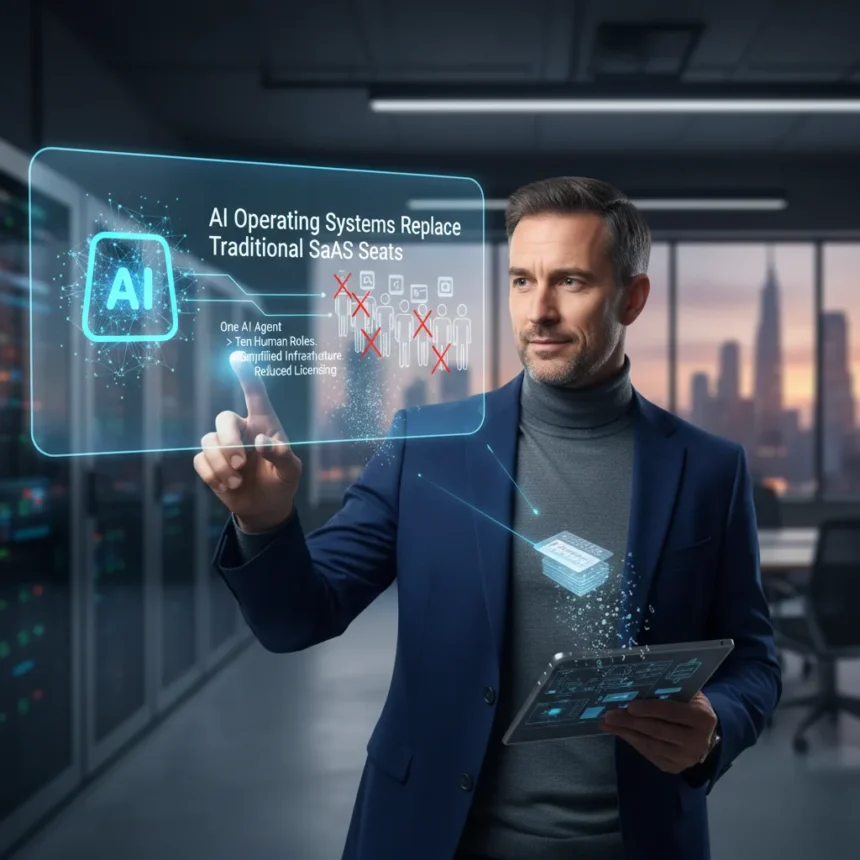
AI operating systems refer to integrated platforms that consolidate multiple software functions into unified AI agents capable of managing entire business workflows. A TechRadar Pro article documents how one publishing company founder built a custom AI operating system to eliminate the need for multiple software licenses by replacing ten employees’ work with a single AI agent.
Key Takeaways
- One AI agent can perform the work of ten people, eliminating multiple software seat costs
- ChatGPT is evolving into a full operating system with app ecosystem capabilities
- Mistral AI CEO predicts over 50% of enterprise SaaS could switch to AI-based systems
- Lenovo and other hardware makers are developing AI operating systems as Windows 11 alternatives
- Canva’s Creative Operating System demonstrates AI-OS viability in specific industries
How AI Operating Systems Challenge Traditional SaaS Models
The fundamental economics of business software are shifting. Instead of paying for separate seats in project management, email, design, and analytics tools, companies can now deploy a single AI agent that handles all these functions. This is not theoretical—a publishing company has already built and deployed such a system, replacing the need for ten individual software licenses by consolidating workflows into one AI operating system.
The cost argument is straightforward: software licensing scales with headcount. Ten employees need ten seats, ten subscriptions, ten training sessions. An AI operating system that performs equivalent work requires only one deployment, one configuration, and one maintenance burden. As Mistral AI CEO Arthur Mensch noted, more than 50% of enterprise software could switch to AI-based approaches, a shift he describes as replatforming away from legacy IT infrastructure.
ChatGPT’s Evolution Into a Full Operating System
OpenAI is actively building ChatGPT into something that functions like an operating system rather than a single application. At OpenAI DevDay 2025, Nick Turley described the evolution as moving from a standalone app toward a platform that feels like an actual operating system, complete with a third-party app ecosystem and a dedicated directory similar to an app store. This architectural shift matters because it means ChatGPT can become the central hub through which all business operations flow.



The difference between a chatbot and an operating system is integration depth. A chatbot answers questions. An operating system manages resources, coordinates tasks, runs third-party applications, and maintains state across workflows. ChatGPT’s app ecosystem allows developers to build specialized agents that plug into the platform, creating the kind of extensibility that made Windows and macOS dominant in their respective markets.
Competing AI Operating System Approaches
The AI operating system concept is not exclusive to ChatGPT. Lenovo is reportedly developing an AI operating system for multi-terminal AI PCs and agents, positioning it as a potential rival to Windows 11 in the same way Huawei’s HarmonyOS competes with Android. Canva launched its Creative Operating System, an AI-powered platform that integrates video, email, interactive design tools, and brand management into one interface.



ThunderSoft’s AI-native operating system (AIOS) takes a different approach, focusing on on-device AI deployment for vehicles and robots rather than cloud-based publishing workflows. These competing implementations suggest the market is converging on OS-like architectures across multiple domains. The common thread: replacing single-purpose software with AI agents capable of multi-function orchestration.
Why This Matters for Business Infrastructure
The publishing company example is significant because publishing involves complex, interconnected workflows—editorial planning, content production, distribution, analytics, audience management. Traditionally, these functions scattered across five to ten different SaaS platforms. One AI operating system consolidating these functions demonstrates that the concept works in real business conditions, not just in theory.
This shift threatens the subscription software model that has dominated for the past fifteen years. If one AI agent truly replaces ten people’s software tools, the addressable market for traditional SaaS shrinks dramatically. A project management tool vendor no longer competes with other project management tools—it competes with an AI operating system that handles project management as one of dozens of functions.
What About Reliability and Specialization?
The author’s claim that one AI agent equals ten people remains unverified in terms of metrics, benchmarks, or demonstrated scalability across different company sizes and industries. AI systems excel at certain tasks but may struggle with edge cases, complex decision-making, or the kind of institutional knowledge that human employees develop over years. The publishing company’s experience is instructive but not necessarily universal.


Specialized SaaS tools often outperform general-purpose AI agents in narrow domains. A dedicated analytics platform may provide deeper insights than an AI operating system handling analytics as one of many functions. The trade-off between consolidation and specialization will likely determine adoption rates across different industries and company sizes.
Is one AI agent really equivalent to ten employees?
The claim is compelling but requires context. An AI agent can handle routine tasks, data processing, and workflow coordination faster than humans. However, the comparison conflates different types of work. The agent may replace ten software licenses or reduce manual labor by 80%, but strategic decision-making, creative direction, and complex problem-solving still require human judgment. The claim is strongest when applied to administrative and operational work.
Will AI operating systems replace Windows and macOS?
Not entirely, but they will carve out significant market share in specific domains. Lenovo’s AI OS and Huawei’s HarmonyOS suggest that hardware makers see opportunity in AI-native platforms, particularly for enterprise and mobile devices. Desktop and laptop operating systems will likely incorporate AI operating system features rather than being displaced wholesale. The evolution mirrors how mobile operating systems did not replace desktop systems—they created a new category.
Can small businesses use AI operating systems?
The publishing company example does not specify company size, so scalability for small businesses remains unclear. ChatGPT’s app ecosystem and affordable pricing suggest accessibility, but building a custom AI operating system requires technical expertise. Off-the-shelf solutions like Canva’s Creative Operating System demonstrate that some AI OS capabilities are available to non-technical users. Adoption will likely follow a tiered model: large enterprises building custom systems, mid-market companies using configurable platforms, and small businesses adopting pre-built solutions.
The shift toward AI operating systems represents a fundamental restructuring of business software economics. One AI agent replacing ten software licenses is not just a cost reduction—it is a reimagining of how work gets organized and executed. As ChatGPT evolves into a true operating system and competitors like Lenovo and Canva build their own AI-native platforms, the traditional SaaS model faces genuine disruption. The publishing company’s experiment is not an outlier; it is a preview of how business infrastructure will operate in 2026 and beyond.
Edited by the All Things Geek team.
Source: TechRadar