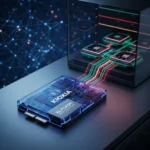
AMD and Samsung memory supply just shifted into a new gear. On March 18, 2026, the two companies signed a Memorandum of Understanding at Samsung’s Pyeongtaek manufacturing complex that goes far beyond a simple parts order—it locks Samsung as AMD’s primary supplier of HBM4 memory for next-generation Instinct AI accelerators and opens the door to Samsung manufacturing AMD chips outright.
Key Takeaways
- Samsung becomes primary HBM4 supplier for AMD’s MI455X AI accelerators, securing critical memory amid AI demand surge.
- AMD and Samsung memory supply deal includes exploration of foundry partnership, allowing Samsung to manufacture future AMD processors.
- AMD’s data center revenue jumped 39% year-over-year to $5.4 billion, driven by EPYC CPUs and Instinct accelerators.
- Samsung shifts to 3-5 year HBM contracts starting March 2026 to lock in pricing and guaranteed allocation amid chip shortages.
- Deal follows Nvidia’s announcement of its own Samsung foundry partnership for 4nm AI chips, intensifying supplier competition.
Why This Deal Matters Right Now
The semiconductor industry is in a memory crunch. AI accelerator demand has exploded, and HBM—the high-bandwidth memory that powers GPUs—is the bottleneck. By locking Samsung as its primary HBM4 supplier, AMD secures a guaranteed allocation of the memory it needs for its next-generation MI455X accelerators, the successors to the MI350X and MI355X that Samsung already supplies. This is not just about keeping the pipeline full. It is about predictability in a market where allocations can evaporate overnight.
What makes AMD and Samsung memory supply truly significant is the foundry angle. The MOU explicitly explores a potential partnership where Samsung could manufacture future AMD chips. That is a direct challenge to Nvidia’s ecosystem dominance. Nvidia has long leveraged TSMC’s exclusivity to maintain control over its supply chain. If AMD can diversify manufacturing through Samsung, it gains leverage against TSMC capacity constraints and reduces single-source risk—a massive strategic advantage.
The Timing Underscores Market Pressure
AMD announced this deal just weeks after Nvidia disclosed its own foundry partnership with Samsung at GTC, where Nvidia revealed Samsung would produce its latest AI chips on a 4nm process. The competitive signal is unmistakable: both companies are racing to secure long-term manufacturing relationships as AI demand strains the entire supply chain. Samsung, meanwhile, is shifting its HBM strategy to multi-year contracts with price locks and guaranteed allocations starting March 2026, a move designed to stabilize both supply and pricing in an unpredictable market.



AMD’s data center segment is the engine driving this urgency. Revenue hit $5.4 billion, up 39% year-over-year, powered by EPYC CPUs and Instinct accelerators. The company also signed a multi-year agreement with Meta Platforms for up to 6 gigawatts of Instinct GPUs, with the first phase arriving in the second half of 2026. That kind of scale requires guaranteed memory supply. Without it, AMD risks disappointing Meta and losing credibility in the hyperscaler market where Nvidia currently dominates.
What This Means for the Broader Chip Industry
AMD and Samsung memory supply represents a structural shift in how AI chip ecosystems organize themselves. For years, the industry consolidated around TSMC for manufacturing and Nvidia for GPUs. Now, AMD is deliberately building redundancy—securing memory from Samsung, exploring Samsung as a foundry, and positioning itself as the alternative to Nvidia’s vertically integrated model. Samsung, for its part, is betting that its HBM and foundry capabilities can capture a meaningful slice of the AI boom.



The deal also signals confidence that Samsung can compete on memory quality and capacity. Samsung has trailed the HBM market leader historically, but long-term partnerships like this one suggest it is closing the gap. For AMD customers and the broader market, competition between memory suppliers is healthy. It reduces the risk of bottlenecks and keeps pricing more rational than if one vendor controlled the entire supply.
What Comes Next
The MOU is not a binding contract—it is a framework for deeper collaboration. The real test comes when Samsung actually delivers HBM4 at scale and when (or if) the foundry partnership materializes into actual chip manufacturing. AMD will need to prove that Samsung’s memory performs as well as its current suppliers and that Samsung’s foundry capabilities can match TSMC’s precision. If both work, AMD gains a second pillar of supply chain security. If either stumbles, the MOU becomes a footnote in a strategy that failed to diversify.
Is AMD and Samsung memory supply exclusive?
No. The MOU makes Samsung the primary supplier for HBM4 and next-generation memory, but AMD will likely maintain relationships with other suppliers to ensure redundancy and competitive pricing. Samsung is securing a leading position, not a monopoly on AMD’s memory needs.
Could Samsung really manufacture AMD chips?
The MOU explores the possibility, but it remains speculative. Foundry partnerships require significant engineering alignment, yield optimization, and process maturity. Samsung would need to prove it can match TSMC’s capabilities for AMD’s most advanced designs before any high-volume manufacturing shifts occur.



How does this affect Nvidia?
Nvidia is not directly impacted by AMD’s Samsung deal, but the broader pattern is clear: suppliers are building redundancy to reduce Nvidia’s leverage. Nvidia’s own Samsung partnership, announced around the same time, suggests the industry is consciously moving away from single-source dependencies. For Nvidia, that means less control but also less risk if TSMC faces disruptions.
AMD and Samsung memory supply is ultimately a vote of confidence in AMD’s data center future and a recognition that the AI boom is real enough to justify long-term supply commitments. Whether this deal accelerates AMD’s challenge to Nvidia or remains a supporting move in a larger competitive story will depend on execution. For now, it is the most significant memory and foundry partnership announced in the AI era, and it suggests the semiconductor industry is actively rewiring itself around AI demand rather than waiting for the market to mature.
Edited by the All Things Geek team.
Source: Tom's Hardware