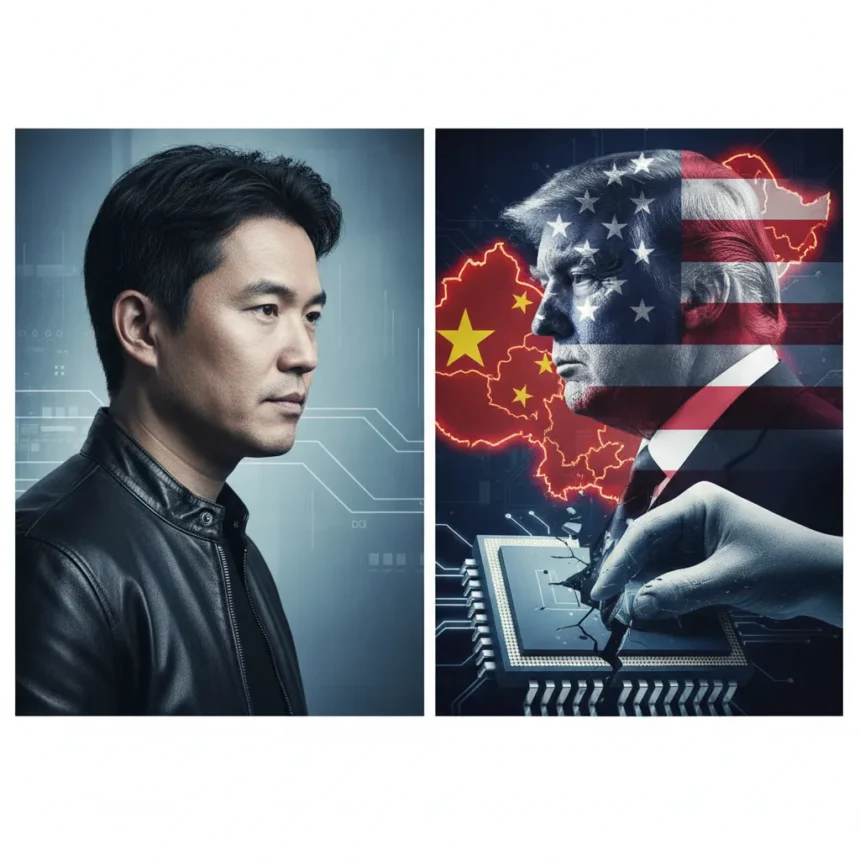
Jensen Huang snubbed Trump China state visit roster despite his history of accompanying U.S. presidents abroad. The Nvidia CEO’s absence from the delegation—which includes Apple’s Tim Cook and Elon Musk—marks a striking reversal after Huang’s previous success lobbying the White House for export licenses on designed-for-China AI chips.
Key Takeaways
- Jensen Huang excluded from Trump’s China state visit despite prior diplomatic success with the administration.
- Tim Cook and Elon Musk confirmed on the official roster, highlighting Huang’s isolation among tech leadership.
- Exclusion interpreted by experts as a “strong signal” that Washington will not compromise on high-end chip export bans.
- Huang has previously accompanied U.S. presidents on state visits across multiple continents.
- Move reflects escalating U.S.-China tech tensions over advanced AI semiconductor access.
Why Huang’s Absence Matters More Than Optics
The snub is not a minor scheduling conflict. Jensen Huang snubbed Trump China negotiations sends a deliberate message: the White House is tightening, not loosening, restrictions on exporting latest AI chips to Beijing. An expert cited in reporting on the visit described the exclusion as a “strong signal” that Washington will not budge on the high-end chip export ban, despite Huang’s track record of securing White House meetings and negotiating compromises.
This reversal is particularly sharp given Huang’s recent White House visit, where he personally lobbied the Trump administration for export licenses on Nvidia’s H20 and H200 chips—variants designed specifically to comply with U.S. restrictions while remaining useful for Chinese customers. That effort appeared to yield results at the time. The China state visit exclusion suggests those early wins are now being reversed or deprioritized as Trump’s administration hardens its stance on Beijing.
Tim Cook, Elon Musk, and the Tech Hierarchy
The roster speaks volumes through contrast. Tim Cook and Elon Musk secured spots on the delegation, positioning Apple and Tesla/SpaceX as the administration’s preferred tech partners for international diplomacy. Musk, despite being absent from a separate White House technology event held earlier, retained his seat on the China visit roster—suggesting his political capital remains intact. Cook’s inclusion underscores Apple’s supply chain importance and its ability to navigate U.S.-China relations without the export control complications that plague Nvidia.



Huang’s exclusion, by comparison, isolates him from the inner circle of tech leadership shaping U.S. policy toward China. For a CEO accustomed to direct presidential access, the snub is both a political and strategic setback. It signals that Nvidia, despite its dominance in AI chips, is now viewed as a liability rather than an asset in high-level diplomatic engagement with Beijing.
The Chip Export Ban That Huang Cannot Negotiate Away
At the heart of Huang’s exclusion lies a fundamental policy conflict. The U.S. government has imposed strict export controls on advanced AI semiconductors, specifically targeting Nvidia’s flagship GPUs that power large language models and data centers. These restrictions aim to prevent China from accessing the computational power needed to develop competing AI systems.



Huang’s previous lobbying efforts focused on creating workarounds—chips like the H20 designed to meet export compliance requirements while retaining functionality for Chinese customers. The China state visit exclusion suggests the Trump administration no longer views such compromises as acceptable. By leaving Huang off the delegation, Washington is signaling that it will not negotiate further on chip access, regardless of how cleverly Nvidia redesigns its products. The message is not subtle: the export ban is non-negotiable, and the CEO who built his case around creative licensing solutions is no longer welcome at the negotiating table.
What This Means for Nvidia’s China Strategy
Huang faces a narrowing path forward. With direct access to presidential diplomacy cut off, Nvidia must either accept the export restrictions or pursue alternative strategies—lobbying Congress, building partnerships with allies, or developing lower-tier chips that fall outside the ban. None of these options offers the kind of rapid, executive-level relief that a presidential envoy slot would provide.
The snub also weakens Huang’s domestic political position. Tech CEOs derive influence from proximity to power. Being visibly excluded from a presidential state visit—especially one that includes his competitors—signals to investors, regulators, and Congress that Huang’s influence with the White House has declined. This matters as Nvidia navigates ongoing antitrust scrutiny, regulatory challenges, and competition from AMD and other chipmakers betting on China’s isolated market developing its own alternatives.
Is Jensen Huang attending any White House events?
The research brief does not confirm Huang’s attendance at other White House events. He was absent from a White House technology event held on Thursday local time, according to reporting on the China state visit. Huang reportedly prefers one-on-one White House communications over public events, though this preference did not secure him a spot on the China delegation.



What does the chip export ban include?
The U.S. export ban targets high-end AI chips—specifically Nvidia’s advanced GPUs designed for data centers and large language model training. Nvidia developed the H20 and H200 as compliant alternatives for Chinese customers, but these chips face ongoing restrictions and have not fully solved the compliance problem. The ban is designed to prevent China from accessing the computational power needed to develop competing AI systems.
Why would Trump exclude Huang if he met with him before?
Trump’s earlier willingness to meet with Huang does not guarantee ongoing access or support. The China state visit exclusion reflects a hardening of policy, not a reversal of a prior decision. Experts interpret the snub as a signal that the White House will not negotiate further on chip export restrictions, even with a CEO who previously secured White House face time. Policy priorities shift, and Huang’s lobbying success in one meeting does not translate to influence over a presidential state visit delegation.
Jensen Huang snubbed Trump China visit represents a decisive moment in U.S. tech diplomacy. The exclusion signals that Washington’s commitment to restricting AI chip access to Beijing now outweighs even the most influential tech CEO’s ability to negotiate workarounds. For Huang, the snub is a stark reminder that in an era of great power competition, proximity to the president is no guarantee of policy influence—and absence from a single delegation can reshape an entire company’s strategic position.
Edited by the All Things Geek team.
Source: Tom's Hardware