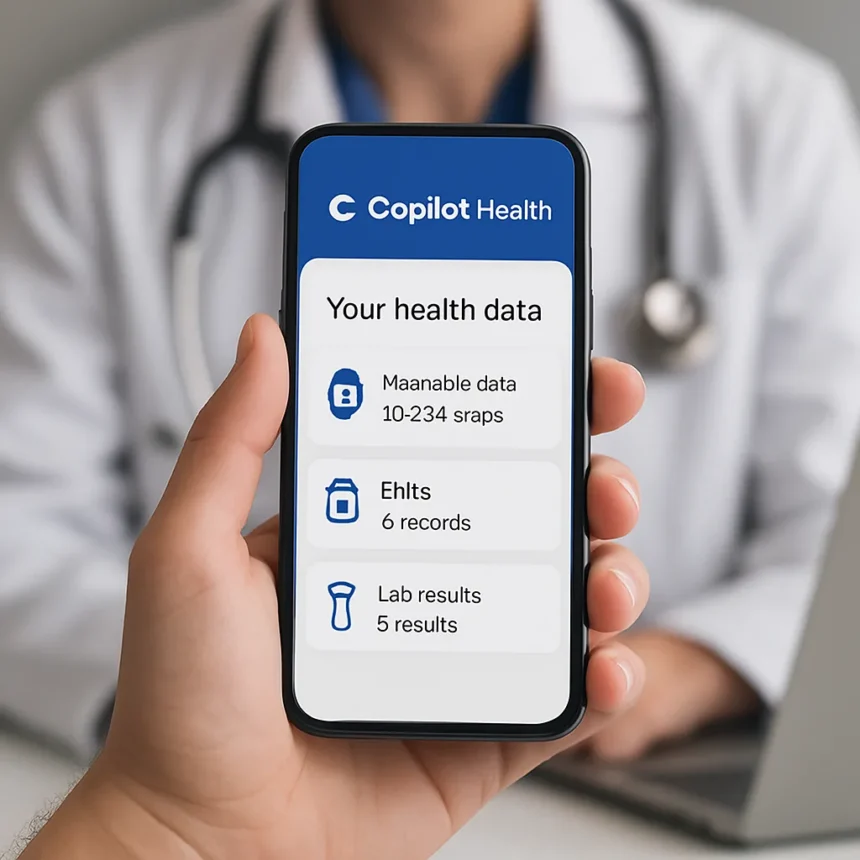
Copilot Health is a dedicated health data hub built into Microsoft Copilot, designed to aggregate personal health information from wearables, electronic health records, and lab results in one place. It connects to over 50 wearable devices including Apple Health, Fitbit, and Oura, pulls electronic health records from more than 50,000 U.S. hospitals and providers via a service called HealthEx, and integrates lab results from Function. Microsoft announced it as launching now, though no specific date or pricing was provided in the announcement. The pitch is seductive. The questions it raises are harder to answer.
What Copilot Health Actually Does
The core promise of Copilot Health is not to give you more information — it is to make sense of what you already have. Microsoft’s own announcement put it plainly: “Most people don’t need more information. They need help to make sense of what they already have. That’s what Copilot Health is for.” In practice, that means the AI analyzes patterns across your data — looking for connections between sleep quality, activity levels, and reported symptoms, for example — and generates personalized insights intended to help you understand your own health history and prepare more effectively for conversations with clinicians.
It is worth being clear about what the product is not. Copilot Health is not a diagnostic tool and does not claim to replace medical professionals. It focuses on interpreting existing data rather than generating new medical information. That is a meaningful distinction, and Microsoft deserves credit for drawing it explicitly. Whether users will actually read that distinction before treating an AI summary as medical advice is a different question entirely.
The Copilot Health Data Access Problem
The most important unanswered question about Copilot Health is also the most basic one: how, exactly, does it access your electronic health records? The announcement highlights connectivity to more than 50,000 U.S. hospitals and providers through HealthEx, but the mechanism for user consent and opt-in permissions remains unclear. That is not a minor detail. Electronic health records contain some of the most sensitive personal data that exists — medication histories, diagnoses, mental health notes, surgical records. The difference between a user actively granting access and a system that assumes broad permissions is the difference between a useful tool and a serious liability.



Microsoft says Copilot Health achieved ISO/IEC 42001 certification for AI management systems, and the product was developed with input from an advisory panel of more than 230 physicians across 24 countries, alongside AARP and the National Health Council. Those are credible signals. But ISO certification speaks to process management, not to the specific question of whether your health data is being handled in the way you would expect or consent to. Independent verification of the “industry leading safeguards” Microsoft promotes has not yet been provided beyond that certification.
How Copilot Health Compares to Microsoft’s Clinical Tools
Copilot Health sits in a different lane from Microsoft’s clinician-facing products, most notably Dragon Copilot. Where Copilot Health is designed for patients trying to understand their own data, Dragon Copilot targets healthcare providers with tools for ambient clinical documentation, coding suggestions, flowsheet generation, and real-time EHR integration. The two products address opposite ends of the same healthcare interaction — one helping clinicians document faster, the other helping patients arrive better informed. In theory, that is a coherent ecosystem. In practice, it means Microsoft is now building tools that touch sensitive health data at both ends of the clinical relationship, which concentrates a significant amount of healthcare data infrastructure within a single commercial platform.



Microsoft has also referenced broader ambitions in AI for healthcare, including the Microsoft AI Diagnostic Orchestrator — referred to internally as MAI-DxO — which has shown research results in diagnostic applications. Forthcoming publications on broader clinical applications have been mentioned, though no detailed outcomes data has been shared publicly yet. That research context matters because it signals where Copilot Health fits within a longer-term strategy aimed at what Microsoft has described as “medical superintelligence.” Copilot Health, in that framing, is less a standalone product and more an early data layer in a much larger ambition.
Should you trust Copilot Health with your health records?
That depends heavily on what Microsoft clarifies about consent and data access before you connect anything. The ISO/IEC 42001 certification is a starting point, not a finish line. If you are someone who already uses Apple Health, Fitbit, or Oura and wants a single interface to identify patterns across that data, Copilot Health has a genuine use case. The wearable integration alone — covering more than 50 devices — is genuinely broad. But connecting your full electronic health record history to any AI platform, including this one, warrants reading the permissions carefully before proceeding.
Is Copilot Health available outside the United States?
Based on what Microsoft has announced, the hospital and EHR integrations through HealthEx are U.S.-focused, covering more than 50,000 U.S. hospitals and providers. The wearable integrations — Apple Health, Fitbit, Oura, and others — are not inherently U.S.-only, but the depth of the clinical data connectivity described in the announcement applies specifically to the U.S. healthcare system. International availability details have not been provided.
What is the difference between Copilot Health and Dragon Copilot?
Copilot Health is a consumer-facing tool designed to help individuals understand and organize their personal health data, including wearable metrics, EHRs, and lab results. Dragon Copilot is a clinician-facing product focused on streamlining healthcare provider workflows through ambient documentation, coding suggestions, and EHR integration. They serve different users at different points in the healthcare process, though both sit within Microsoft’s broader healthcare AI strategy.


Copilot Health is the most ambitious consumer health AI product Microsoft has shipped, and the vision behind it — helping people make sense of fragmented health data rather than drowning them in more of it — is genuinely valuable. But ambition and trustworthiness are not the same thing. Until Microsoft provides clear, transparent answers about exactly how EHR access works, what users are consenting to, and how that data is protected beyond a certification badge, the right response is cautious interest rather than enthusiastic adoption. Your health records are not the place to move fast and figure out the details later.
Edited by the All Things Geek team.
Source: Windows Central