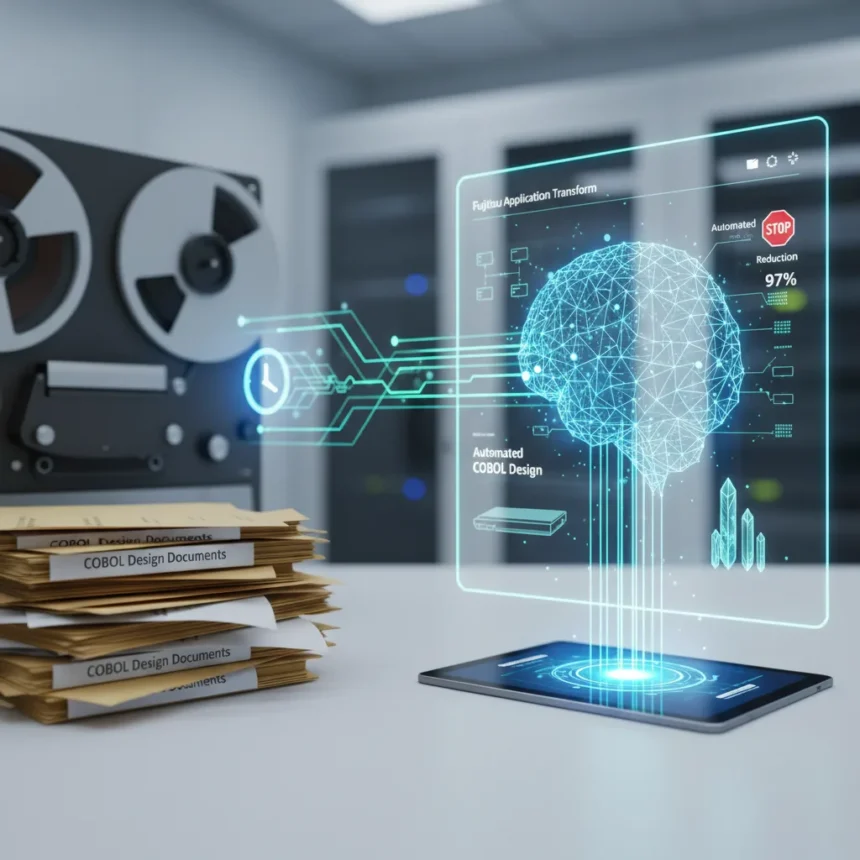
Fujitsu Application Transform powered by Fujitsu Kozuchi is a generative AI service that automatically analyzes COBOL and other legacy source code to generate design documents in minutes rather than hours. The service launched as a Software as a Service offering in Japan on March 30, 2026, addressing an urgent crisis: COBOL powers approximately 80% of in-person banking transactions and 95% of ATM swipes worldwide, yet the pool of experts who understand it is rapidly shrinking.
Key Takeaways
- Reduces COBOL design document generation time by approximately 97%, from hours to minutes without requiring expert knowledge
- Improves comprehensiveness of design documents by 95% and readability by 60% compared to conventional methods
- Detects dead code within legacy systems, enabling leaner cloud deployments and modernization
- Available as SaaS in Japan starting March 30, 2026, building on a previous software analysis service launched in February 2025
- Powers modernization by making complex COBOL logic understandable without manual reverse-engineering by scarce experts
Why COBOL design documents matter now
The global financial system depends on COBOL. Yet decades of patchwork maintenance have created what industry observers call “spaghettified” code—tangled, hard-to-follow logic that only retiring experts truly understand. When those experts leave, banks and financial institutions face a critical gap: no one knows what the systems actually do. Automating COBOL design documents isn’t a luxury—it’s survival. Fujitsu’s service addresses this by using proprietary code analysis combined with its Knowledge Graph–Enhanced RAG for Software Engineering to link large volumes of source code and prevent omissions and hallucinations that plague general-purpose AI.
The speed advantage is real. What once took hours of manual analysis by rare COBOL experts now happens in minutes, without requiring specialized knowledge. For organizations managing millions of lines of legacy code, this is transformative. A single bank or financial institution might maintain hundreds of COBOL systems. Automating documentation across that portfolio frees teams to focus on modernization rather than reverse-engineering.
How Fujitsu’s approach outperforms general AI
Generic large language models struggle with COBOL. They hallucinate, miss critical details, and misunderstand syntax specific to decades-old business logic. Fujitsu’s system improves comprehensiveness by 95% and readability by 60% compared to conventional methods, according to internal testing. The difference lies in architecture: Fujitsu’s fine-tuned LLM understands COBOL syntax and business logic deeply enough to generate consistent, complete design information even for complex legacy programs.



Beyond documentation, the service identifies dead code—obsolete logic that accumulated over years of patches and workarounds. In one case study, approximately 25% of analyzed code was identified as dead, meaning organizations can strip it away during cloud migration and modernization efforts. This matters because every line of legacy code you move to the cloud costs money and introduces risk. Removing the junk first makes modernization cheaper and faster.
Real-world validation and next steps
Fujitsu is not operating in a vacuum. SMBC Nikko Securities, a major Japanese financial services firm, has been collaborating with Fujitsu on reverse-engineering design documentation for legacy languages including COBOL since fiscal year 2025. “We have come to recognize the significant potential of this technology,” said Toshihiro Horiuchi, Managing Executive Officer at SMBC Nikko Securities. That endorsement from a major financial institution signals that Fujitsu’s approach works in the real world, not just in proof-of-concept labs.



The service builds on Fujitsu’s existing software analysis and visualization platform, which launched in February 2025. By adding generative AI to that foundation, Fujitsu has created a pipeline: analyze legacy code, understand its logic, generate documentation, and then enable modernization to cloud-native systems. For organizations holding billions of lines of COBOL, this is a practical path forward.
Is COBOL design document automation really a significant shift?
The metrics are compelling: 97% time reduction, 95% better comprehensiveness, 60% improved readability. But context matters. These figures come from Fujitsu’s internal testing and proof-of-concept work, not independent benchmarking. The baseline—how long design documentation actually took before—is not publicly detailed, so the “97% reduction” reflects Fujitsu’s estimates rather than audited measurement. That said, the qualitative claim is sound: automating something that was purely manual work will always be faster than the manual alternative.
The real value is not the speed alone. It is the accessibility. Design documentation for COBOL systems has traditionally required experts who are retiring, emigrating, or simply unavailable. Automating that work without expert knowledge means smaller teams can now modernize larger portfolios. That shifts the economics of legacy system maintenance from “find an expert” to “run the AI service.”
What about pricing and availability?
Fujitsu has not disclosed pricing for Fujitsu Application Transform powered by Fujitsu Kozuchi. The service is available as SaaS in Japan starting March 30, 2026. Availability in other markets has not been announced. For organizations outside Japan seeking COBOL modernization, the launch is a signal that the market is shifting—AI-driven legacy code analysis is becoming a category, not a curiosity.


Can this service handle all COBOL systems?
Fujitsu’s system is designed for COBOL and other legacy source code, and the company specifically tested it on complex COBOL logic. However, the research brief does not detail which COBOL dialects, versions, or specific edge cases the service handles. Organizations with highly unusual or domain-specific COBOL variants should verify compatibility before committing.
How does this compare to IBM’s COBOL modernization offerings?
The article headline positions Fujitsu as a challenger to IBM, but the research brief does not compare specific IBM products or capabilities. Both companies offer COBOL modernization tools, but Fujitsu’s focus on generative AI for automatic design document generation appears to be a distinct angle. IBM’s approach may emphasize different aspects of legacy code transformation. Without direct feature-by-feature comparison data, the sensational headline claim should be taken as marketing positioning rather than a definitive technical verdict.
The real story is not Fujitsu versus IBM—it is that COBOL modernization has become urgent enough for major vendors to invest in AI-driven tooling. That shift signals a broader industry recognition that the COBOL crisis is real, and automation is the only practical response to shrinking expert availability.
Fujitsu Application Transform powered by Fujitsu Kozuchi is a timely response to a genuine problem. Automating COBOL design document generation removes a major bottleneck in legacy system modernization. The metrics are impressive, the use case is urgent, and the early validation from financial services firms is encouraging. For organizations holding aging COBOL systems and facing talent shortages, this service represents a practical path forward—assuming it delivers on its claims once it reaches broader markets beyond Japan.
Edited by the All Things Geek team.
Source: TechRadar