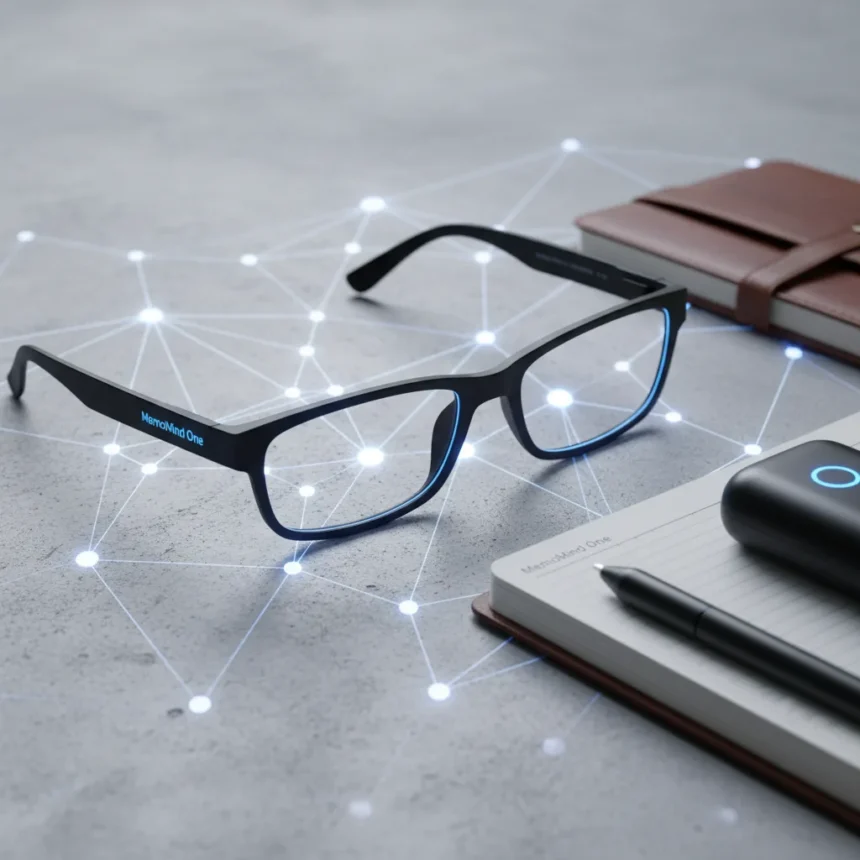
MemoMind One smart glasses are a wearable AI device designed to be inconspicuous enough that you can wear them all day without drawing attention. At 45 grams and with a design that blends into everyday eyewear, they challenge the assumption that smart glasses need cameras, displays, or obvious tech aesthetics to be useful.
Key Takeaways
- MemoMind One weighs approximately 45 grams and looks like regular glasses
- No built-in camera means privacy-friendly operation and simpler design
- Battery life reaches approximately 16 hours on a single charge
- Designed for all-day wear without attracting attention or discomfort
- Represents a shift away from camera-first smart glasses architecture
Why MemoMind One Stands Apart From Camera-First Smart Glasses
The defining choice behind MemoMind One is what it doesn’t have: no built-in camera. This architectural decision immediately separates it from the crowded field of smart glasses that treat cameras as essential components. Most competing smart glasses prioritize visual input, building their entire interface around what the wearer sees. MemoMind One inverts this logic, focusing instead on audio and contextual AI without needing to capture the world around you.
This approach solves a problem that has plagued smart glasses adoption for years—privacy concerns and social awkwardness. People instinctively distrust glasses with cameras pointed at them or their surroundings. MemoMind One eliminates that friction entirely. You can wear them in meetings, coffee shops, or crowded spaces without anyone wondering if they’re being recorded. That psychological ease is worth more than any spec sheet claim.
The weight matters too. At 45 grams, these glasses won’t trigger the fatigue that heavier wearables cause after a few hours. Comfort compounds over a full day—lightweight design becomes invisible design, and invisible design becomes actually wearable.



Battery Life and Practical All-Day Use
MemoMind One delivers approximately 16 hours of battery life per charge. That claim needs context: 16 hours covers a full waking day for most people, which means you charge them overnight like you would any other personal device. It’s not infinite, but it’s sufficient for the use case these glasses target.
The real test is whether that battery holds up under realistic conditions. A device that hits 16 hours in a lab but drops to 8 hours with heavy use is useless. The fact that multiple reviewers report wearing these glasses throughout entire days without hitting the battery wall suggests the rating is genuine rather than optimistic. This matters because previous smart glasses generations failed precisely here—impressive specs that collapsed in real-world use.



The Design Philosophy: Invisible Doesn’t Mean Boring
MemoMind One smart glasses succeed because they accept a constraint rather than fight it. They don’t try to look like futuristic tech. They look like glasses, which means they work like glasses—they disappear on your face. The moment you stop thinking about wearing them is the moment they become useful.
This contrasts sharply with the aesthetic arms race in wearables, where devices compete on how visibly advanced they look. Smartwatches got bigger and flashier. AR glasses added displays and cameras to justify their existence. MemoMind One chose the opposite path: make it so unobtrusive that the technology recedes and only the utility remains.
That philosophy extends to how the device interacts with the world. No glowing displays, no obvious gestures, no visible processing. Just glasses you wear and use naturally. For a technology category that has spent years trying to convince people smart glasses are normal, MemoMind One actually makes them normal.
What MemoMind One Gives Up (And Why It Doesn’t Matter)
The absence of a camera is a deliberate trade-off, not a limitation. Yes, you cannot use these glasses to capture images or video. Yes, you cannot use visual recognition to identify objects or read text from the environment. But those capabilities come with costs—battery drain, privacy concerns, processing overhead, and social friction. MemoMind One prioritizes the opposite: longevity, trust, and acceptance.


This is a fundamentally different product category than camera-equipped smart glasses. It’s not a worse version of something else—it’s a different thing entirely. Comparing MemoMind One to glasses with cameras is like comparing a dedicated e-reader to an iPad. They solve different problems for different use cases.
Who Should Actually Buy These
MemoMind One smart glasses work for people who want AI assistance without the visibility or complexity of camera-based systems. If you spend your day in meetings, on calls, or in situations where privacy and discretion matter, these glasses make sense. If you want to experiment with wearable AI without committing to a bulky, obvious device, they’re worth trying.
They don’t make sense if you need visual input processing, object recognition, or the ability to record your environment. For those use cases, camera-equipped smart glasses are necessary, regardless of the privacy and social trade-offs. MemoMind One isn’t trying to be everything—it’s trying to be something specific and doing it well.
Is MemoMind One worth buying?
If you want smart glasses that actually feel like regular glasses and don’t drain battery in four hours, yes. The 45-gram weight and 16-hour battery life mean you can wear them all day without thinking about them. The lack of a camera is a feature, not a bug, if privacy matters to you.
How do MemoMind One compare to other smart glasses?
MemoMind One differs fundamentally from camera-equipped smart glasses by removing visual input processing entirely. This makes them lighter, longer-lasting, and less intrusive socially. If you need visual recognition or recording, they’re not the right choice. If you want AI assistance without those capabilities, they’re more practical than heavier alternatives.
Can you wear MemoMind One all day without discomfort?
Yes. At 45 grams, they’re light enough for extended wear without the fatigue that heavier smart glasses cause. The design philosophy prioritizes comfort and invisibility, making them genuinely wearable for a full waking day.
MemoMind One smart glasses prove that the future of wearable AI doesn’t require cameras, displays, or obvious tech aesthetics. It requires the courage to build something genuinely useful instead of something that looks futuristic. After a week of wear, you stop noticing them—which is precisely when they become indispensable.
Edited by the All Things Geek team.
Source: Tom's Guide