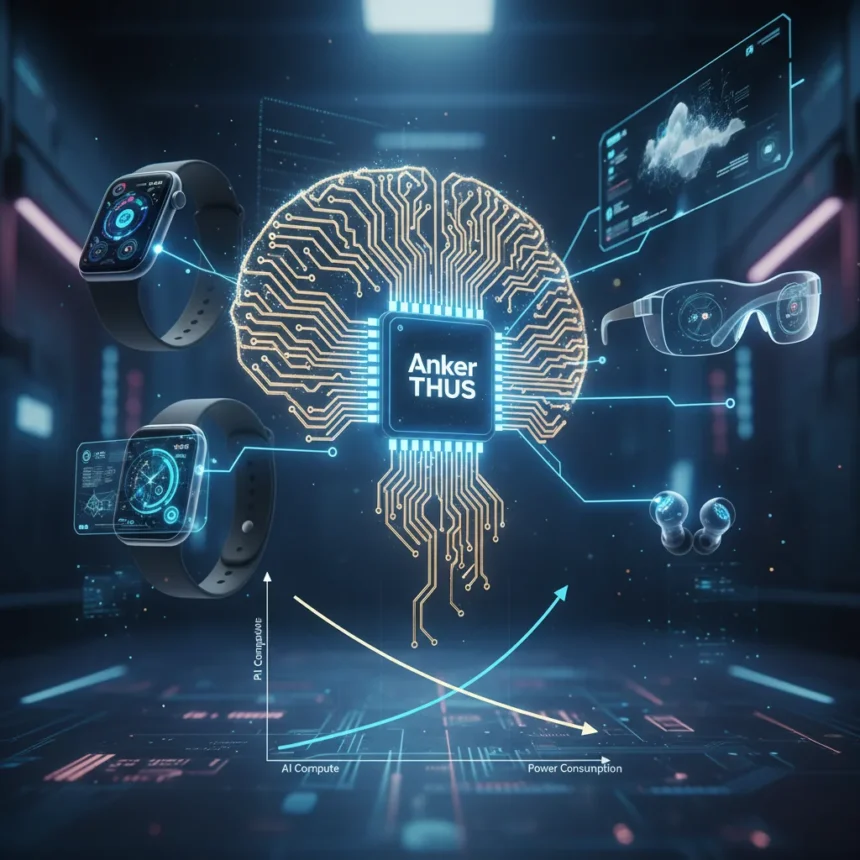
The Anker THUS chip represents a direct challenge to how the industry has approached artificial intelligence on wearable devices. Rather than conforming to established rules about what’s computationally possible on battery-constrained hardware, Anker’s custom processor employs unconventional techniques to run large AI models locally on smartwatches, fitness trackers, and other tiny devices without excessive power drain.
Key Takeaways
- Anker THUS chip uses unconventional computing methods to enable large AI models on wearables
- Local AI inference on wearables eliminates cloud dependency and reduces latency concerns
- Power efficiency is the core breakthrough—solving battery drain that limits current wearable AI
- On-device processing improves privacy by keeping sensitive health and activity data local
- Wearable AI typically struggles with data standardization and processing limits across devices
Why Wearable AI Has Been Stuck
Current wearable devices face a fundamental constraint: running sophisticated AI models requires significant processing power, which drains batteries in devices already fighting for hours of runtime. Standard chipsets designed for smartphones or laptops cannot simply be shrunk down—they consume too much energy. Most wearable AI today relies on cloud offloading, sending data to servers for processing, which introduces latency, privacy concerns, and dependency on network connectivity. The Anker THUS chip attacks this problem directly by rethinking how computation happens on the device itself.
Health monitoring wearables, smartwatches, and fitness trackers have long struggled with data standardization and processing limits that prevent truly intelligent local features. Users expect their devices to understand patterns, detect anomalies, and respond in real time—but the hardware simply hasn’t supported it. Cloud solutions work, but they’re clunky. The THUS chip aims to change that equation entirely.
How Anker THUS Breaks the Rules
The THUS chip achieves high AI performance while minimizing power consumption through unconventional computing techniques that challenge traditional hardware design principles. Rather than following the path established by existing AI accelerators, Anker’s approach prioritizes the specific constraints of wearable devices: tiny form factors, microsecond-level power budgets, and the need to run sophisticated models without killing battery life in hours.



By enabling local inference of large AI models directly on wearables, the THUS chip solves what has been the central riddle of wearable intelligence: how to deliver real-time, on-device AI without becoming a power-hungry liability. This matters because it removes the dependency on cloud connectivity, reduces latency to near-zero, and keeps sensitive personal health data and activity patterns on the device where they belong. Users no longer need to choose between having intelligent features and having a device that lasts through a full day.
The Competitive Landscape for Wearable AI
Existing wearable processors from competitors like Qualcomm (Snapdragon Wear line) and Apple (S-series chips) have made progress on efficiency, but none have publicly claimed the ability to run large AI models locally without significant battery trade-offs. Cloud-based AI remains the default for most wearable platforms because on-device alternatives have been computationally or energetically prohibitive. The THUS chip, if it delivers on its promise, would represent a meaningful shift in how the industry approaches wearable intelligence.



The broader wearable AI ecosystem faces standardization challenges and power limitations that have historically constrained what’s possible. Anker’s custom silicon approach sidesteps some of these industry-wide bottlenecks by designing specifically for the wearable use case rather than adapting general-purpose processors. This vertical integration—designing both the hardware and the optimization strategy around a single problem—is how breakthrough performance sometimes emerges.
What This Means for Wearable Devices
If the THUS chip performs as positioned, the implications are substantial. Future smartwatches could offer real-time health insights, predictive alerts, and contextual intelligence without constant cloud calls. Fitness trackers could analyze movement patterns and provide coaching in the moment. Sleep trackers could detect sleep disorders and suggest interventions without sending your sleep data to a server. All of this becomes possible when the AI runs locally and efficiently on the device itself.
The shift to on-device AI also improves privacy—a growing concern for health and fitness wearables that collect intimate behavioral data. When computation happens locally, users maintain control over their information. This is a competitive advantage as privacy regulations tighten globally and consumers become more cautious about where their biometric data flows.
Does the Anker THUS chip work as claimed?
The THUS chip’s claims about breaking computing rules are compelling, but the source material lacks detailed benchmarks, supported model sizes, or third-party validation of its performance. Without real-world demonstrations or comparisons to rival processors, the breakthrough claims remain largely promotional at this stage.


What wearables will use the Anker THUS chip?
The research brief does not specify which wearable devices or manufacturers will integrate the THUS chip, or any launch timeline or availability details. Anker has developed the chip, but deployment across the wearable ecosystem remains unclear.
How does the Anker THUS chip compare to cloud-based AI for wearables?
Cloud-based AI offers unlimited processing power but introduces latency, privacy risks, and network dependency. The THUS chip trades some raw computational capacity for instant on-device processing, offline functionality, and data privacy—a worthwhile trade-off for most wearable use cases where response time and user privacy matter more than peak performance.
The Anker THUS chip represents a meaningful attempt to solve one of wearables’ most stubborn problems: how to deliver intelligent, responsive features without sacrificing battery life or privacy. Whether it achieves that goal in practice remains to be seen, but the unconventional approach is exactly what the category needs. Wearable AI has been stuck in the cloud for too long.
Edited by the All Things Geek team.
Source: TechRadar